

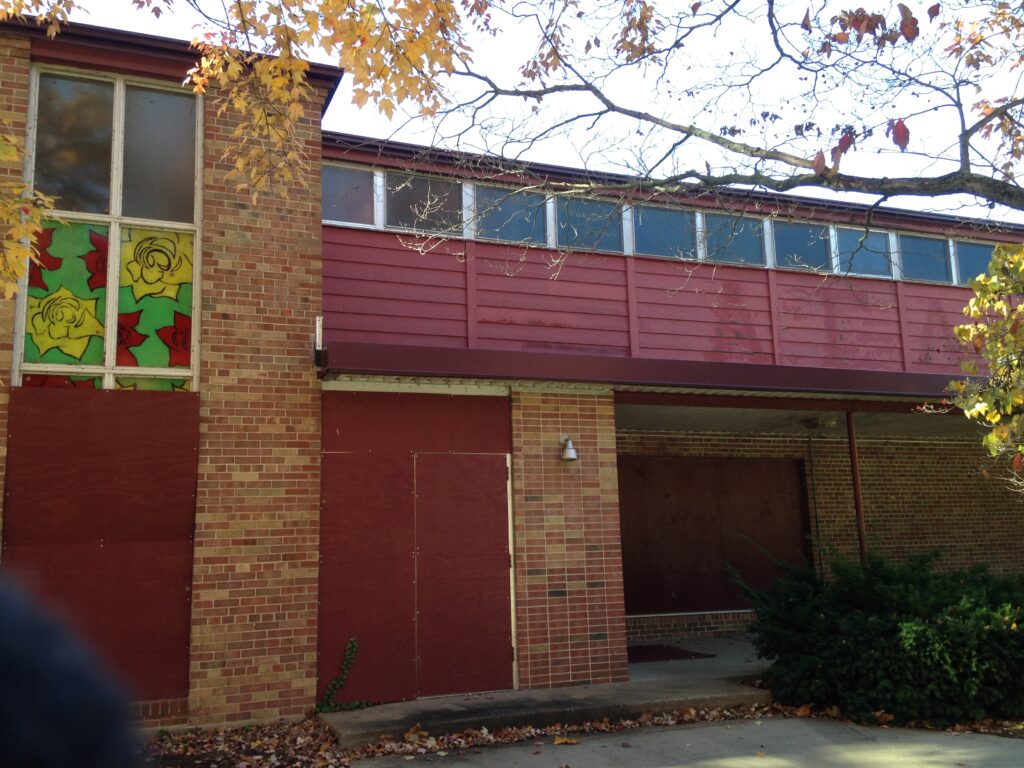
 Today, August 6, 2025, the wrecking ball comes down on most of what is left of Greek Row at Southern Illinois University. Various buildings have been demolished over the years and it’s been almost a decade since any sororities have been housed on Greek Row.
In 1995, when the world wide web was an itty bitty thing, I did my Master’s thesis, A History of the Fraternity System at Southern Illinois University from 1948-1960. That 1960 date was significant because it was when the first groups moved to Greek Row. One of the chapters chronicles the building of those homes. It is included below.
Chapter VII
THE QUEST FOR FRATERNITY HOUSING
Chapter VIII chronicles the development of University owned fraternity housing. In the planning stages for several years, the University owned fraternity houses did not become a reality until the end of the period with which this study is focused.
In 1923, Sigma Alpha Pi, in addition to being the first fraternity on the SIU campus, was also the first to provide housing for its members. Until the development of University owned Small Group Housing, the men’s and women’s fraternities at SIU were responsible for providing living accommodations for their members in either leased or owned property.
Sigma Alpha Pi’s house on the Judge Barr property at 608 Normal [now University] Avenue was, according to the March 6, 1923 Egyptian, “to be remodeled in every way during the next month and will be ready for occupancy the first of the spring term” (p. 1). In addition to rooms for 25, the club room “is one of the best in the city, being fully equipped, among other things with a radio” (Obelisk, 1923, p. 137).
Two years later, Sigma Alpha Pi’s Alumni Association planned to build a new home noting, “This will give the Southern Illinois Teacher’s College their first really modern and up to date building along this line” (Egyptian, 1925, January 27, p. 3). The men of Sigma Alpha Pi “promise that it will be one of the finest fraternity houses south of the state university campus” (Egyptian, 1925, January 27, p. 3). The fraternity disbanded in 1931 and no further information was located in regards to their plan for housing.
Anthony Hall, the first dormitory on campus, opened in 1913. It housed women, although male students then outnumbered female students on SIU’s campus. At first, the building was called the Girls’ Dormitory. Judge Barr, a member of the Southern Illinois Normal University Board of Trustees, named the hall after suffragette Susan B. Anthony (Smith, undated). Anthony Hall is one of the few buildings on campus not named in honor of an SIU affiliated individual. When Woody Hall was finished in 1953, Anthony Hall became a men’s dormitory (Mitchell, 1993). Woody Hall, named in honor of former Dean of Women, Lucy K. Woody, housed more than 400 women.
On Monday, January 7, 1924, Epsilon Beta moved into their new home on 800 Normal [now University] Avenue (Egyptian, 1924, January 15, p. 1). They hosted an open house on Thursday, February 14, and the “visitors seemed enthusiastic in their praise of the dormitory, which was especially interesting and unique to them with its ‘double deckers’ [bunk beds]” (Egyptian, 1924, February 26, p. 3).
Thus, for almost all of their existence on the SIU campus, the men’s and women’s fraternities have provided housing for at least a portion of their membership. The groups took responsibility for the entire enterprise, whether they owned the house or rented the house from a landlord. The women’s fraternities had housemothers, but there was a double standard in that some men’s fraternities did not employ housemothers.
The first mention of any institutional plan for fraternity housing occurred in President Morris’ reply to a Pi Kappa Alpha Field Secretary’s letter of August 5, 1949. “It is my possible hope that the University will be able to assist fraternities desiring to provide housing arrangements for their group” (D. W. Morris, personal communication, August, 1949).
Betty Lou Mitchell, a member of Delta Sigma Epsilon and later Alpha Gamma Delta, longtime SIU faculty member, and author of President Morris’ biography, related an incident which took place at the October 4, 1949, Delta Sigma Epsilon open house. After meeting the chapter members and the housemother, President Morris asked to see the kitchen and dining room. “When shown these, he responded, ‘You feed how many here?’ Obviously he couldn’t believe the answer! But this incident and undoubtedly others like it, set his thinking in the direction of the dire need of students for housing, including the fraternities and sororities on campus” (Mitchell, 1988, p. 25).
When Epsilon Beta became a chapter of Delta Sigma Epsilon in 1928, the chapter continued to lease the chapter house at 800 South Normal Avenue from John Stotlar. In 1939, the Alumnae Chapter of Delta Sigma Epsilon purchased property on Grand Avenue with the intention of building a “new and modern sorority house” (H. Stein, personal communication, April 9, 1959). According to Mitchell, the lot was located where the Morris Library parking lot is now located (B. L. Mitchell, personal communication, October 28, 1994). A letter dated November 30, 1948, from Helen A. Shuman, Dean of Women, to President Morris made mention of Delta Sigma Epsilon’s plans:
I do wish our University plans for student housing were more definite. You may know that the Delta Sigma Sorority is about to start building its own sorority house. I should appreciate being a participant in any meeting which the local sponsors have with the administration to discuss developing their project. Perhaps it would help to have Mrs. Pulliam [Supervisor of Off-campus Housing] there also. I believe the sorority sponsor will feel the necessity of having your blessing before they actually begin building.
According to Mitchell, the Delta Sigma Epsilon alumnae were dissuaded from beginning their building project. An agreement was signed by President Morris and Hilda Stein, Delta Sigma Epsilon alumna and SIU faculty member, regarding the exchange of the Grand Avenue property. The October 4, 1950 document, confirmed the conversation “that Delta Sigma Epsilon will be given first choice of sorority houses to be constructed, assigned or rented or leased by Southern Illinois University” in exchange for property on Grand Avenue.
According to Stein:
In 1951 at the request of the Office of the President of SIU, title to this property was transferred by good conveyance from the alumnae association to SIU for the sum of $2,700.00. Prior to this date, the alumnae chapter had refused to sell its building site for $3,000.00 because it had been the intention of this organization to construct a new and modern sorority house on the property, and it was only conveyed to SIU in order to cooperate with the University.
At the time of the conveyance to the University, the officers of the alumnae chapter were advised that it was a part of the University plan to build sorority houses which would be placed on a rental basis and that our sorority would be given the first refusal of such premises when they became available. (H. Stein, personal communication, April 9, 1959)
In the late 1940s, Delta Sigma Epsilon purchased from Stotlar the house they had been leasing since 1924. There they continued to live, waiting for their opportunity to be the first sorority to choose a University owned house.
President Morris was concerned about housing for the men’s and women’s fraternities. On a vacation trip to Maine in the summer of 1951, it was one of the topics he discussed with his wife’s uncle, Philip R. Hussey, a Phi Kappa Sigma alumnus and advisor to the fraternity’s chapter at the University of Maine (P. R. Hussey, personal communication, September, 5, 1951).
Another indication that fraternity housing was a concern of President Morris from the beginning of his tenure at SIU was this correspondence from Assistant to the President, I. Clark Davis, to President Morris:
During the past three years you and I have discussed on occasion the possibility of the University’s construction of housing units to be rented to men’s and women’s fraternities. Two things prompt me to mention the problem at this time:
1. Several inquiries have been made of staff members in recent weeks about the site area for such housing units and about the approximate time period when such building might occur.
2 ……. If we could get 100 per cent loans, we might be able to step up our fraternity (men’s and women’s) housing programs by several years. It is my hope that the University can build fraternity houses and cooperative houses to supplement the residence hall program. (I. C. Davis, personal communication, November 26, 1952)
In July of 1953, President Morris issued “A Statement on the Housing of Fraternities and Sororities at Southern Illinois University.” He wrote, “It is the assumption of those who have studied the problem that by 1960 the University should have provided for …….. single students interested in living in fraternity and sorority houses” (p. 1). He noted that the poor housing conditions had limited the growth of the Greek groups. In espousing the concept that the University might have to provide the land and underwrite a bond issue he stated, “This may be a natural solution since the University is as interested in the individual member’s achievement of the ideals of the fraternity as are the fraternity officials who give leadership and guidance to campus groups” (p. 2).
There were disadvantages of the existing housing. At the 1954 Greek Housing Conference, Maude Stewart, a faculty member and adviser to Pi Kappa Sigma, spoke about the housing problem from a social development perspective. She stated that neither exchange parties nor dances could be held in the houses due to the small commons areas. In some instances, she noted, fraternities had no extra room for housemothers. She also thought that the houses’ lack of adequate space did not provide good study conditions (Inter-Greek Housing Committee, 1954, December).
Roger Spear, a Phi Kappa Tau alumnus, joined Stewart in the panel discussion. He noted that membership in the men’s and women’s fraternities was not growing with the University. The fraternity houses were a reflection of the institution and it was his opinion that many alumni felt that their house was not “nice to come back to” (Inter-Greek Housing Committee, 1954, December, p. 6).
The quality of the existing housing varied greatly, from barely adequate to totally inadequate. A survey sent by the Inter-Greek Housing Committee during the 1953-54 school year found that the average SIU fraternity house slept about 25. Each men’s fraternity had 10 to 15 members who, for lack of space, could not live in the chapter house. Most of the houses were old and made of wood. None of the houses had adequate fire escapes. All had bad wiring and no exits from the second floors. Each member had to insure his own furnishings. There were approximately 8-12 men per bathroom with one house as high as 20 men per bathroom. The water pressure was very low and hot water was scarce. Rents for the house ranged from $150-250 per month and the fraternities spent an average of $150-200 per year on repairs. Most groups thought that the landlords would make only essential repairs. Most houses served 13 or 14 meals per week. Cooking facilities were adequate but food storage space was lacking. The report summed up the condition of SIU’s fraternity houses, “Most of the houses are in POOR condition” (Inter-Greek Housing Committee, 1954, December, p. 5).
Further proof that fraternity housing was substandard appeared in a rare 1950’s expose in the Egyptian. Three of the six fraternity houses were cited as adequate, but three were called ‘fire traps’ by their members. Three houses were described; for purposes of anonymity, they were called House A, House B, and House C. In House A, according to the chapter president, some rooms had only one study desk for three students. This, he noted, was not conducive to high grade point averages. His house had no dining room and members ate in the basement kitchen. House B’s president told of six to eight men in a room big enough for two. For financial reasons, the chapter found it necessary to have 90% of the members living in the house. The lighting was inadequate and the landlord would not replace wiring because the house was so old. In House C, 21 members, half of them living upstairs, were served by two downstairs bathrooms. Each bathroom had but one washbowl (1955, February 8).
The Egyptian also told about the women’s fraternity housing. The biggest complaint from the women was the lack of adequate space. In House A, 21 women shared one bathroom. House E, which was not identified, was either Sigma Gamma Rho or Alpha Kappa Alpha. Both were black women’s groups and both were located more than a mile from campus. In 1955, Sigma Gamma Rho was located at 508 North Marion and Alpha Kappa Alpha at 410 East Oak Street (Obelisk, 1956). According to the Egyptian article:
“Believe it or not,” said a member of this group, “we have TOO MUCH space. One result is that the rent is so high most of our members can’t afford to live here. That means just a few of us have to carry the main financial burden.” “But our main difficulty,” said another “is that we have to live more than a mile off campus. None of us has a car, and it’s rough having to walk that far to classes.” (1955, February 11, p. 1)
It was no secret that President Morris wished to make SIU the finest state institution. He could not have been pleased with this commentary:
Last week’s edition of the Eastern State News, Eastern State College, said “A recent series of articles in the Egyptian makes a person rather glad that they go to a school where housing is not a great problem. As I read the article I couldn’t help but compare the fraternity houses there with the ones here at Eastern. Not much comparison. We here at Eastern ought to appreciate the fine fraternity houses that we have,” said Lyndon Wharton, Eastern State News columnist. (Egyptian, 1955, February 25, p. 2)
Moreover, since few groups owned their own homes, there was a significant turnover in fraternity rental housing. Several months after the Egyptian published its expose on women’s housing, it noted that two sororities, Pi Kappa Sigma and Delta Zeta, had expiring leases and were house hunting (1955, April 22).
A panel discussion focusing on fraternity housing was part of the 1953 Greek Week activities. President Morris and four students took part in the panel discussion which culminated in the formation of a Fraternity and Sorority Housing Committee. The Inter-Greek Council cautioned the groups that “The committee is to represent the individual groups. The groups are to work through their representative. The representatives are to take everything back to their groups” (Report of Fraternity and Sorority Housing Committee, 1954, May, p. 1). Barbara Gibbs, a member of Sigma Sigma Sigma, chaired the committee.
According to the committee’s report, the University indicated its willingness to work with the committee to investigate and improve the housing problem. The Administration made it quite clear that the men’s and women’s fraternities needed to “use their initiative, to find out what they wanted, how they could help themselves, and to indicate to the University officials when they were ready to go to work. They were to work as a group!” Above all, the report stated, the groups “have to be ready to move — they themselves must take the initiative” (Fraternity and Sorority Housing Committee, 1954, May, p. 1).
The committee was told that there was a possibility that University owned land would be available for the purpose of building fraternity housing. Possible sites would be discussed after the committee came to a consensus about what the groups wanted.
The Administration gave options for financing the venture. The University could go to the legislature and ask for as much per person as went into the residence halls but this option would be time consuming. The idea of securing a bond issue was mentioned again. The groups would pay off the bond issue, but the University would always own the houses. And, in what seems to be an insurance policy for the University, it was suggested that if any group failed to pay off a University-secured loan, the University could use that house for another purpose.
Given those parameters, the committee went to work. A survey was sent to approximately 25 colleges and universities which had utilized some form of cooperative building. The responses were tabulated and the committee discussed the various methods which had been employed by other institutions. These options ranged from university-owned dormitories with individual clusters of rooms for each fraternity, to the intermingling of fraternity groups in university-owned dormitories with each group having a separate chapter room. In both these instances, room and board were paid to the university.
The method used by the University of Connecticut was discussed in detail; the university built houses for 60-70 occupants. Room and board cost $70 per month. Each group had its own dining room. The houses were furnished except for recreational facilities which the groups supplied. In instances where there were not enough members to fill the houses, the groups had first choice in asking others to move into vacant rooms; the university did, however, reserve the right to fill the rooms.
The committee also reported on various loan methods used at other institutions. Partial financing by the individual groups, large down payments, and final ownership of the housing were topics discussed. Moreover, it was suggested that the fraternity groups might build houses on their own initiative with help from their own building funds, alumni/alumnae, and their national organizations.
On May 7, 1954, 13 men’s and women’s fraternity members, John S. Rendleman, Legal Advisor, Elizabeth Greenleaf, Supervisor of Student Activities, and Willard Hart of SIUC’s Architectural Service left for a tour of fraternity housing at the University of Illinois, Purdue University, De Pauw University, and Indiana University. The Inter-fraternity and Panhellenic Councils appropriated $125 for transportation costs. The students were responsible for their own meals. In touring these four campuses, Greenleaf wrote Rendleman:
It is the hope of all of us to be able to arrange a meeting with the executive secretaries of the groups concerned, officials of the University, student members, advisers of the groups and a representative of an architectural firm to go into specific planning for the development of a men’s and women’s fraternity housing program on the Southern Illinois University campus. (E. A. Greenleaf, personal communication, April 22, 1954)
The average house at the four institutions the group visited slept 45 members. The cost of construction varied from $125,000 to $300,000. Most groups had built their own houses. Brick was predominate, although limestone was used at Indiana University. Most houses were three stories and rectangular. Room and board ranged from $65 to $100 per month. The houses consisted primarily of dormitory sleeping rooms with separate study rooms. All had a guest restroom on the main floor and the women’s houses had laundry facilities. Although most of the houses had gas heat, it was noted that the Southern Illinois region did not have ample supply of gas and that coal or oil would be used here. The traveling group was impressed by the amount of storage space in some houses as well as the presence of dining rooms and fireplaces. All the women’s fraternities had housemothers and the men’s fraternities at DePauw University had them, too. Several women’s fraternities had a special bedroom for the “town girls” to use on an occasional basis. Indoor recreational rooms which doubled as chapter rooms were commonplace. There was also ample storage space for chapter records and supplies. In mentioning these items, it is presumed that the SIU contingent acknowledged the importance of such to chapter life.
A meeting of the committee, now called the Inter-Greek Housing Committee, and University administrators, including Rendleman, Vice President for Financial Affairs George Hand, Davis, Assistant Dean of Men Robert Etheridge, Greenleaf, and Hart, took place on July 24, 1954. The purpose of the meeting was to make plans for settling three basic issues: land allocation, a proposed fall meeting, and the financing of the building program. Rendleman told the Committee that not until building plans and site locations had been resolved could the Administration investigate bonding possibilities in terms of Southern Illinois costs. Hart, of the Architectural Services, pointed out that if the housing were located next to existing facilities “then the obvious location would be east of Thompson Lake, especially since the cost of extending the tunnels for steam to the possible Thompson Lake Point area would cost around $150,000.00” (Inter-Greek Housing Committee, 1954, December, p. 6).
Hart told the groups they needed to determine whether they wanted a high initial cost by using University steam facilities or whether they might prefer individual heating units. Rendleman mentioned that it would probably be necessary for each group to have $10,000.00 to $15,000.00 in order to begin building. Bonding procedures were explained and it was made clear that the University would have to assume the responsibility for the bonds’ amortization. Hand quoted figures of approximately $18.00 a week ($75 per month) per person to provide for debt service, operating expenses, equipment, and repairs. Davis noted that the type of construction and other factors might reduce the cost to approximately $15.00 to $17.00 per week which the groups had deemed affordable. He also said that it was likely housemothers would be required for each chapter. Moreover, the University would retain ownership of each building.
Davis outlined the role of the national officers as they related to the projected fall meeting. He hoped that they would be able to endorse, support, and advise the groups after they had seen the tremendous need for adequate housing. He also hoped they would be of assistance financially (Inter-Greek Housing Committee, 1954, December).
The Egyptian announced an October 6, 1954, general meeting of the Inter- Greek Housing Committee representatives to discuss a Greek Row. Meetings on November 5 and 6 were also announced. At the November meeting, University officials were to “meet with sororities’ and fraternities’ national officers to hold a further discussion and make tentative plans” (1954, October 5, p. 3).
Sigma Sigma Sigma Collegiate Secretary Emily Lee had visited the SIUC chapter in October, 1954, and as part of her visit, she met with President Morris. In a thank you note to him, she wrote:
I thoroughly enjoyed discussing with you the Greek housing plans for the future. Naturally, we are all most interested in the results and decisions which will be made at your University following the November 5th week- end conference of all National Greek Organizations. (E. Lee, personal communication, October 27, 1954)
It sounded to several people as if a decision regarding fraternity housing was forthcoming. This idea, however, was quashed by Davis in a November 5, 1954, Egyptian article announcing the two-day conference opening that night. “‘The conference is only to discuss the problems facing Greek housing. There will be no decision as to what type of building project might be used,’ he stated” (p. 1).
The Inter-Greek Housing Committee had come to some consensus regarding Greek housing. Among their conclusions was their desire for cooperative building. They sought university land to build on and assistance in securing a building loan. They acknowledged the groups’ responsibility for paying off the loans. They realized that the property would always belong to the University and any group unable to meet their payments would lose the right to use the property. They understood, too, the need to maintain the facilities in a manner approved by the University.
All groups felt that they would have substantial increases in membership if they had more suitable living quarters. Yet, the groups realized they needed to keep costs affordable to their members. According to the committee, “The houses should be ADEQUATE BUT NOT ELABORATE” (Inter-Greek Housing Committee, 1954, December, p. 2).
The groups wanted accommodations for 35 – 40 members. In maintaining a low cost, the groups understood that some items might be unfurnished or unfurnished at first. For example, recreation rooms could be finished at a later date. The committee stressed that, “There is no need for elaborateness of furnishings as in the lounges of Woody Hall” (Inter-Greek Housing Committee, 1954, December, p. 2).
The items which the groups felt to be necessities were: adequate dressing, study, and sleeping rooms; a dining room to hold 60-65; a living room with perhaps a fireplace; recreational area/chapter room combination; a room for the housemother, although some men’s groups did not want a housemother; a guest restroom; adequate storage space; bathrooms meeting health standards; cubbyholes for toiletries; adjacent parking; multi-use recreational areas; and economical heating.
The Inter-Greek Housing Conference opened on the evening of November 5, 1954. In attendance were 13 national officers representing 11 groups: Pi Kappa Sigma, Sigma Sigma Sigma, Delta Sigma Epsilon, Alpha Kappa Alpha, Delta Zeta, Tau Kappa Epsilon, Theta Xi, Kappa Alpha Psi, Sigma Pi, Sigma Tau Gamma, and Phi Kappa Tau. In his welcoming speech after the Friday night panel discussion, President Morris gave some indication as to why they were invited. He stressed that the Committee must look for support from national organizations in regard to the housing dilemma. This sentiment was echoed by Paul Isbell, Director of Auxiliary Enterprises, when he raised the point, “How much can local chapters borrow from the national organization to help with the housing?” (Inter-Greek Housing Committee, 1954, December, p. 7).
Among the conference presentations was Rendleman’s discussion of financing methods. They included going through the Federal Housing and Home Financing Agency. This was not encouraged as the down payment was large and the restrictions severe. Another method discussed was going on the market with bonds from the University and having bonds sold to buyers throughout the country. The last method he discussed was directly approaching an agency, an insurance company perhaps, and have them finance it — the University would pledge the income and the agency would construct the project.
Hand was in agreement that the University should furnish housing. Among his reasons was uniformity in the architectural style. The building would be affordable and they would also fit into the architectural style of the University. The University would also have more financial and disciplinary control of the organizations, thus resulting in stronger chapters. He, too, advocated keeping costs as low as possible aiming “for cheaper cost of bed rather than have something luxurious” (Inter-Greek Housing Committee, 1954, December, p. 7).
In case anyone missed Hand’s remark about closer control over the Greeks, Isbell reiterated the point, “If the fraternities and sororities go into this with the University they can expect closer fiscal control and closer social control. This means housemothers in every house” (Inter-Greek Housing Committee, 1954, December, p. 7).
The Saturday sessions began with John Lonergan, Site Planner, stating that the University had never considered a fraternity district on the master plan and that the Board of Trustees had never given them the authority to go ahead with this planning. That said, he pointed out the possible sites. He noted that the area west of Thompson Lake would be very expensive to build on because of the fact that utilities needed to be brought to the site. The other area he mentioned was the Dowdell site. This would be cheaper because the utilities were already there. According to Lonergan, “The Greek Housing would probably cover 20 acres. . . . [and cost] approximately $350,000 to develop the project for utilities alone without the buildings [at the Thompson Lake area]” (Inter-Greek Housing Committee, 1954, December, p. 8).
A major misunderstanding, whether intentional or not, took the permanence out of any discussions. Hart said that he didn’t have particulars as to what type of sleeping quarters and plumbing facilities the committee had decided upon. The committee, in their report, noted quite emphatically, “These questions had already been answered by the Greek organizations, but the above named individuals misunderstood the circumstances and we were unable to proceed …….. Everyone at this meeting had expected to hear some definite plans, but nothing was accomplished due to the misunderstanding” (Inter-Greek Housing Committee, 1954, December, p. 8).
The concluding statements included going with University housing and construction, and giving the University site selection capabilities. The committee acknowledged the need to get onto the campus development chart. They noted that the members of the housing committee should meet with President Morris, Hand, and the architect. Finally, they suggested that the housing plans should be shared with the national organizations’ fraternal magazines and the national officers should receive a copy of the conference report and periodic progress reports.
Shortly after the conference, the committee wrote President Morris noting their interest in his requesting the Board of Trustees to provide, as part of the University Land Development program, University land for building fraternity housing, and to inquire about any possible University financial assistance.
The “Request of the Inter-Greek Council Regarding Housing” was indeed an agenda item at the January 14, 1955, Board of Trustees meeting. According to the official minutes of the meeting:
The Inter-Greek Council and their committee on housing has, as a result of study and conferences, requested that the Board of Trustees give consideration to their housing needs. They have requested, and it is the recommendation of the administration, that the Board approve the policy of the University leasing property for housing facilities to individual sororities and fraternities. Should the Board not desire to approve this arrangement, the Inter-Greek Council has requested, in preferential order, consideration of the following two possibilities: 1. The sale of land for housing at a nominal fee. 2. The sale of land at an appraised fair cash market price. Under the latter two arrangements, it would be impossible for the University to lend its financial credit to the fraternities and sororities. (SIU Board of Trustees, 1955, p. 70)
There was no action on the policy. On the motion of Kenneth L. Davis, the Board withheld action on the policy, pending additional investigation of the entire problem.
At the next Board of Trustees meeting a month later, there was a decision made when the Board adopted “A Policy on University Housing for Organized Groups.” Citing the fact that the Greek housing conditions were “perhaps collectively the most pitiable on the campus,” the Board noted that action must be taken “from a simple student welfare point of view” (SIU Board of Trustees, 1955, p. 78). According to the policy, the Administration was “authorized to plan for housing for organized groups as part of the overall housing program of the university. The Administration is further authorized to enter into such leasing and related agreements as are deemed appropriate in conformance with this policy” (SIU Board of Trustees, 1955, p. 78).
The Board, in their policy, acknowledged that the groups’ contributions to the social activities of the University, their assistance in acclimating students to academic life and their role in the esprit de corps of the University, yet they stopped short of giving their total approval to the fraternities:
It is our opinion that the housing program, as outlined above, will provide that the sororities and fraternities are neither favored nor discriminated against. This policy will serve as a recognition of their needs, but only insofar as is consistent with the housing needs of all students………. It is our opinion that organized groups will remain part of the college and university scene, whether encouraged by the college or university or not. If this is to be the case, the above policy will allow the University to cultivate the desirable features of the organized groups and to minimize the undesirable features. The fact that their presence in University-owned facilities makes the control which can be exercised over them much greater. At the present time none of the fraternities have housemothers. However, if the group lived in University housing, such supervision could be made compulsory . . . . Southern Illinois University Greek organizations have never been ‘exclusive’. The demand for members has exceeded the number which wished to belong. It is felt that if uniform provisions are made for not only the independent students but also the Greek organizations, such a condition will persist. Therefore, if the housing differential is removed for all times, the demand for pledges should continue to exceed the desire to join. (SIU Board of Trustees, 1955, p. 77-78)
Not everyone was happy with the University’s decision to pursue fraternity housing. Forrest B. Tyler, Assistant Professor of Psychology and a member of the 1954-55 Dean of Student’s Housing Committee, wrote President Morris a heated letter about the fact that the University went to the Board of Trustees with the request when the Dean of Student’s Housing Committee had recommended that no decision be made pending further study (F. B. Tyler, personal communication, October 18, 1955).
President Morris addressed Tyler’s concerns and in the process noted that the fraternity housing would be neither elaborate nor enviable:
I further note in your Committee’s recommendations that one of the factors which you have considered and which the administration also considered is the duty of the University to provide minimally adequate housing for as many students as possible irrespective of their origins, finances, convictions, or group affiliations. The method of achieving this goal is the subject of your comment. In this regard it should be noted that the housing programmed for organized groups is totally self-liquidating. This is not the fiscal situation on the construction of Woody Hall or the dormitories presently under construction at Thompson’s Point. Also, the cost per bed for organized group housing is approximately 40% of the cost per bed of other University planned housing. This necessarily means the accommodations for organized groups will not be of the same quality as other institutional housing. (D. W. Morris, personal communication, November 11, 1955)
Stewart, an Associate Professor of Guidance and Special Education, was answering a question posed to her by President Morris, when she wrote:
As far as unreasonable selectiveness and undemocratic attitudes are concerned I have found them being promoted in both residence halls and fraternal groups. Because a fraternal group has strong identification and loyalty within it, it is possible to work constructively with an effectiveness which residence hall counselors can seldom attain. (M. Stewart, personal communication, May 17, 1956)
With the Board of Trustees’ approval, the project began to move forward. By June of 1956, architect’s plans were being completed by Thomas Graman of Metropolis. It was hoped that the plans for a typical unit would be ready in final form by summer’s end. Applications for federal funds to be used in college housing programs were not being considered in Washington before July 1, 1956. Rendleman was keeping abreast of the situation and the application was to be filed at the earliest opportunity. Davis, in an interview almost 40 years later, acknowledged Rendleman as the “mastermind” of obtaining financing for the project (I. C. Davis, personal communication, October, 12, 1994).
In responding to a query from the Tau Kappa Epsilon chapter president as to when the housing would be completed, Davis noted “If funds are made available before October, 1956, it would seem feasible that construction could begin on or about March, 1957, and a completion date could be anticipated to be September 1958” (I. C. Davis, personal communication, June 21, 1956).
The timetable Davis suggested was delayed by a year, but word had spread of Southern’s building program. The National Secretary of Alpha Chi Omega, a women’s fraternity, wrote inquiring about extension possibilities. Juanita M. Zaleski, Assistant Dean of Women answered the inquiry:
Southern’s plans for the addition of National Panhellenic Council groups are being held in abeyance at present because of an acute housing problem. Our position is best expressed in this statement made by Dean of Men, I. Clark Davis, last year: “No additional Fraternities or Sororities are to be recognized at the Carbondale Campus, Southern Illinois University, until existing groups are housed in the University living centers. All future Fraternities and Sororities to be recognized at Southern Illinois University shall be quartered in University owned living centers.” At this date, we have fifteen groups on our campus. Work on nine small dormitory structures has begun. It is our hope that they will be ready for occupancy early in the 1959-1960 academic year. We further hope to have six similar structures built within a reasonable time. (J. M. Zaleski, personal communication, November 13, 1958)
The January 16, 1959, edition of the Egyptian noted that four small dormitories for fraternities and sororities, the first of 15 such buildings, were under construction on the west side of Thompson Lake. The houses were located just south of the Chautauqua Street and Oakland Avenue intersection on the old Thompson Road. Five additional buildings were expected to be completed by the following January. Six more, completing the project, would be constructed at a later date.
The first nine units were financed by a $3,000,000 Housing and Home Financial Loan Agency loan and were being built under contracts totaling $1,736,695. There was a basic plan of architecture for the buildings, although there were several slight variations. Each building had the same facilities including a sleeping dormitory for 45 persons, dining facilities, two-person study rooms, and a chapter room. The University Housing Office issued contracts to individuals (Egyptian, 1959, January 16).
The Administration’s insistence that each of the groups was to be housed in University owned housing was quite apparent. Yet, they were well aware that several of the groups had never had large memberships. In a memo from William Rogge, Director of Student Housing, to Isbell, Davis, and President Morris, the existing organizations were ranked in order of ability to fill and completely utilize the Small Group Housing, as the fraternity housing was officially known. It is quite apparent that several groups were not in any shape to meet those membership requirements. Among those, according to Rogge, was Alpha Kappa Alpha, “This group is far too small to be able to fill a house of 45 spaces. There are presently 4 actives and 16 pledges. The group has had a high dropout on the number of pledges.” Alpha Phi Alpha, a men’s group, was also too small, “and there is abundant additional evidence that the group is as yet too weak to handle a house of 45 students.” The same was said about Kappa Alpha Psi, another men’s group that had only 14 actives and 11 pledges (W. Rogge, personal communication, February 5, 1959).
Rogge recommended that Alpha Gamma Delta, Sigma Kappa, Sigma Pi and Tau Kappa Epsilon be the first groups to move in. According to Rogge, Alpha Gamma Delta’s house on South University Avenue was in the worst condition of the five sororities he visited. It was the first sorority to apply and it had sufficient membership to handle one of the houses. Sigma Kappa was recommended to move in, although the chapter had earlier demurred at signing the articles of agreement. Rogge felt, “If there is the slightest hesitancy to do so, Pi Kappa Sigma should replace it” (W. Rogge, personal communication, February 5, 1959). Ultimately, it was Sigma Sigma Sigma that, along with Alpha Gamma Delta, occupied the first two women’s buildings.
Sigma Pi was the first men’s group to apply. Its request for housing was made on April 26, 1956. It was then the largest group on campus and had a very active pledge class. Tau Kappa Epsilon was the second men’s group to apply for housing. Of all the buildings visited, Tau Kappa Epsilon’s was, according to Rogge, “The greatest fire hazard, with 21 men living in a dormitory room in the attic with no fire escape” (W. Rogge, personal communication, February 5, 1959)
Rogge had Phi Kappa Tau listed at the bottom of the list. According to Rogge, the group was housed in the best of the 15 houses and “the group has indicated that it does not care to move into University housing at the present time” (W. Rogge, personal communication, February 5, 1959). In 1953, the chapter purchased a home at 510 West Walnut in 1955. The 1957 Silver Jubilee program noted:
Although it had been built and used for a number of years as a private residence, this house was unusually well suited for a fraternity group. Of imposing size and design and of brick construction, with impressive beams and paneling in the ground floor rooms, it provided Beta Chi with by far the best housing of any non-dormitory student group on campus . . . .Special credit for making its purchase possible was due John Rendleman, University legal counsel and a Delta Chi Delta Alumnus, who handled most of the details of the transaction and who constantly stimulated and challenged the chapter to undertake home ownership after years of renting. Much credit was also given to the Central Office of Phi Kappa Tau, which assisted most generously in financing the purchase. (p. 6)
On February 5, 1959, the Office of Student Affairs made recommendations for the Small Group Housing for the 1959-60 academic year. Among the general considerations were:
1. The basic intent is to make the small group housing project an extension of the housing program of Southern Illinois University. This policy will provide better physical facilities. In addition, it will make possible more educational functions than in existing privately owned housing.
2. The nature of the organized groups will change if the program is successful in helping the groups to reach their own ideals and to achieve the objectives of the University. With an improved physical environment, with more staff assistance, and with good faculty leadership, the program can help the members to advance to the full maturity required in the world today.
3. The best possible leadership for the groups will most likely come from a full time staff person living in the area ……… We will also know what is happening in the area and what the concerns of the students might be. (I. C. Davis, personal communication, February 5, 1959)
Moreover, the Office of Student Affairs advocated applying the 50% freshmen quota to the fraternity’s Small Group Housing area:
Allowing transfers from other living areas as spaces become available during the year…….. As in the rest of the quota system (rehabilitation, athletes, freshmen, foreign students, graduate students), hold spaces for freshmen joining the group until three weeks before the quarter begins. Thereafter, spaces would be filled from the regular waiting lists, with adjustments made later through room change requests. (I. C. Davis, personal communication, February 5, 1959)
Another recommendation made by the office was to have “Articles of Agreement” signed before any group received housing. The document contained the following provisions:
a. The groups shall have no equity in the land, buildings, or furnishings.
b. No discrimination would be practiced.
c. Faculty and staff would participate in the decision making of the group.
d. All objectives, policies and procedures of the University would supersede any of those of the groups which are in conflict with the ones of the University.
e. University staff shall have access to the buildings as to all other residences for purposes of security, protection, and maintenance.
f. The groups assume financial responsibility for losses and damages to the furnishings and buildings for the periods the groups occupy the buildings, except for those losses covered by insurance.
g. The group shall maintain the cleanliness of the building to equal or to exceed that of other residences.
h. The University reserves the right to change at any time part or all of the agreement, or to terminate the occupancy by the group with no stated reason when the University desires to make other use of the buildings whether for other residences or not. (I. C. Davis, personal communication, February 5, 1959)
The headline of the February 20, 1959, edition of the Egyptian read “Fraternity Row Must have Half Freshmen Each Year – Greeks, Independents May Fill Same House For Quota.” According to the article, the fraternity groups were required to fill their new houses with 50% freshmen. This was the policy approved by the Office of Student Affairs and the Southern Illinois University Board of Trustees. Rogge told the Egyptian that University regulations provided that all area housing must have 50% freshmen, to allow for the large fall enrollment. Twenty-three sophomores, juniors, and seniors could live in the house, but the other 22 spaces were to be filled by freshmen. According to the regulations, if the 22 spaces were not filled by pledging freshmen, they would be filled by students on the waiting list for University housing, whether they were a fraternity member or an independent. Additionally each house was to have a resident fellow and a housemother. The article was accompanied by a picture of the new housing. The caption read “FRATERNITY HOUSING? Greeks are wondering whether it is fraternity housing or not, as a result of the requirement” (Egyptian, 1959, February 20, p. 1).
This ruling sent shock waves throughout the SIU’s fraternity world.
Pledging 22 freshmen in the weeks before the fall semester began was a daunting proposition. Additionally, it meant that not all of a chapter’s upperclassmen could live in the house.
A memo to President Morris from his secretary, Minnie Mae Pitkin, to which he had scrawled “OK,” noted that:
Bob Key, a representative of the Inter-Greek Council ……… request[s] a conference with you at 1:30 p.m. on next Wednesday, February 25, for the purpose of talking about Greek housing. He is especially anxious to have this appointment confirmed 15 students who will come in at that time with 10 national representatives . . . . these people have to make travel plans. (M. M. Pitkin, personal communication, February 20, 1959)
Davis outlined the situation in a letter to President Morris. In Davis’ opinion, the basic discontent related to whether these groups should follow the general policies which were developed for other student groups. According to Davis:
Only one group [Sigma Pi] has been willing to state openly and unashamedly that its membership is willing to accept the challenge in order to continue to be a vital and enthusiastic part of the university’s expanding program …….. Answers to the questions on the fifty per cent decision and the broad problem of expecting these groups to be part of a whole educational program rather than being apart from the university river’s mainstream have included:
1. Southern Illinois University is investing one million dollars in this housing project plus putting on the line its good name for some one and one half millions. (The pledging of some $35,000 per year of tuition fees from all students for bond reserve is of great significance too.)
2. Development of new programs and re-vitalization of old programs in the curriculum of Southern Illinois University require that new students be able to begin their collegiate experiences. This new blood will help the University and all of its components grow stronger. Housing of a satisfactory type must be made available if the best of the high school graduates enter Southern Illinois University.
3. Changes in social groups’ concepts from present practices to their ideals and the objectives of the University may more appropriately take place in the active (older student)—- pledge (new student) relationship which the 50 percent program requires.
4. As soon as adequate housing becomes available, it is expected that the 50 percent policy may be lowered. In all phases of the University Residences halls, it is desirable to reduce this requirement. Certainly, in two years such an evaluation can take place.
5. If the groups cannot attain the requirement of 22 freshmen as pledges, the individuals who move into the house will not ruin the group. It has been made into a bigger problem than it will prove to be. (My guess is that the fear of a racial difference is an underlying one here.) I keep remembering the term “drathers”. If a group had rather not exist on the campus of Southern Illinois University, then it should say so now and not imply that it might not want to move at the time housing becomes available. Which groups do not wish to occupy University owned and operated housing?” (I. C. Davis, personal communication, February 25, 1959)
“No Double Standard – Morris Says Fraternity Row Must Have Half Freshmen,” read the Egyptian headline;
“There will be no double standard on campus,” said President Morris to 15 Greek representatives at a meeting last week. “It’s just a matter of being fair.” Dr. Morris …… pointed out that the 50 per cent freshmen quota applies to all University housing, and would be treated equally with the Greeks.
He said the quota was regulated because there is not enough housing for freshmen when they first enter and that the University must receive its share of “qualified freshmen by offering University housing.” (Egyptian, 1959, March 5, p. 1)
Buildings 104 and 107 were the women’s units which were intended to be completed in September, 1959; buildings 102 and 103 were to be done by December 1959 (Egyptian, 1959, July 15). Alpha Gamma Delta, in concordance with the document signed nine years earlier when it was known as Delta Sigma Epsilon, was given the first choice of housing. The consensus of the Alpha Gamma Delta representatives was for the L-shaped building 104, nearest the Campus Lake (I. C. Davis, personal communication, March 12, 1959).
Although it was hoped the housing would be ready in time for the Fall 1959 semester, this was not the case. In notifying Alpha Gamma Delta Chapter President, Diane Vadeboncouer, that her chapter was selected to occupy Building 104, Rogge sent her a long list of requirements. The group would not take occupancy until after the semester had begun. Pledges and members who were planning to live in the new housing would be temporarily housed elsewhere, some in the 800 South University Avenue chapter house and some in the lounges of Woody Hall. The chapter was to provide the Housing Center with two lists of names. The first list was to contain the names of 22 freshmen pledging the sorority. The second list of 28 names was to be arranged in order of priority of the active members who were to live in the new house (W. Rogge, personal communication, August 14, 1959).
In late September, 1959, the Egyptian announced, “October 10 is the date set for Sigma Pi’s and Tau Kappa Epsilon’s moving into the small group housing built by the University” (1959, September 19, p. 1). The women’s groups, Alpha Gamma Delta and Sigma Sigma Sigma, were to move in at the end of October. All four groups were being temporarily housed. The men’s groups were using the Chautauqua housing, a group of temporary buildings which had previously served to house the influx of G. I. Bill servicemen and their families. Alpha Gamma Delta and Sigma Sigma Sigma were using their houses to accommodate members and the overflow was scattered in utility and ironing rooms of Thompson Point and Woody Hall (September 19, 1959).
Two of the first four houses completed were L-shaped and two houses were T-shaped. The houses held between 44 and 52 members. Each group was responsible for hiring its own cook, supplying china and some cooking utensils. The University supplied the big equipment such as freezers and refrigerators (Egyptian, 1959, September 19). The first nine dorms had different color schemes and fabric selections. The sleeping arrangements were dormitory style with two- person study rooms (Egyptian, 1959, July 15) .
The four groups moved into housing which was more than a mile from campus, had no parking, and was not yet landscaped. The exodus to Greek Row had begun. All did not live happily ever after, however. Both the Tau Kappa Epsilon and Sigma Pi chapter presidents were sent long lists of room condition reports after an impromptu inspection during the holiday vacation (J. A. Yokie, personal communication, December 28, 1959). Davis forwarded those lists to President Morris along with his comment “We have every intention of shaping the fraternities up to the University’s standards” (I. C. Davis, personal communication, December, 1959).

FROM THE CONCLUSION SECTION:
Adequate housing was also a problem. Few of the men’s fraternities owned their own homes and finding suitable, safe, and sanitary housing was difficult.
While the women’s fraternities claimed more home ownership than the men’s groups, their housing wasn’t in much better condition. The 1920s were the boom years in the building of fraternity housing at many institutions with older established fraternity systems, including the University of Illinois. The closest SIU came to benefiting from this era was the building of the Delta Sigma Epsilon chapter house by John Stotlar.
However inadequate the chapter houses at SIU were, they did provide much needed housing for SIU students. During the early Morris years, dormitory facilities were sorely lacking. The growth of the University had outstripped the available student housing. President Morris, although concerned about the condition of fraternity housing, seemed to acknowledge the housing spaces they provided.
The University’s assistance in building chapter houses was sought and encouraged by the individual chapters. Most of the SIU groups did not have a pool of well established, wealthy alumni to fall back on, nor were most of the national organizations able to provide much financial support. The University was most generous in following through on the Small Group Housing area at Thompson Lake. Likewise, during the mid to late 1950s, many of the fraternities were caught up in the excitement of creating a “Greek Row” at SIU.
The reality of the situation was much different. A loan from the Federal Housing and Home Financing Agency was sought and acquired. This assistance, though much needed, put many restrictions on the housing. The University was to issue all the housing contracts instead of the much preferred method of renting the chapter houses to the organizations for a flat fee and the individual groups holding all the housing contracts for their membership. The stipulations for the loan of the federal funds prohibited that option.
However restrictive the federal funds might have been, the University added its own caveats. University-owned fraternity housing was an all or nothing proposition. All groups were required to live on Greek Row. No new groups could come to campus until housing was available for them and no new housing was planned beyond the groups already on campus. All groups, regardless of previous membership statistics, were required to fill the houses or non-members would be assigned to live in the housing. The Administration was well aware of chapter size and yet there were groups whose membership never went above 25 members that suddenly found themselves with 45 spaces to fill.
At the completion of the first four units, the first four groups found themselves with a real challenge. Due to the fact that the chapter houses were part of the University’s housing program, and due to the fact that there was a severe shortage of on-campus housing, all housing units, including the chapter houses were to hold 50% freshmen. This made it imperative for the fraternities to rush freshmen before school even began for the express purpose of having the freshmen move into the new chapter house. This also meant that many of the upperclass members who had worked for the housing project were not able to live in the chapter houses.
SIU had many first generation students who had little prior knowledge of the fraternity system. Having a high campus profile became crucial for recruiting new fraternity members. Fraternity housing was a mile away from campus in an untraveled area. This did not do much to publicize the fraternity system. If anything it put the fraternity chapters in their own “fraternity ghetto” and away from the general student population. A student new to Carbondale would most likely not know the location of Greek Row without making a serious attempt to find it. This decreased visibility on campus made fraternity life much harder to sell to prospective members.
From the start of the push for fraternity housing, the fraternities stressed the need for affordable housing and the resultant frugality may be reflected in the fact that the housing was built at 40% of the cost of the other dormitory housing. While they were functional, the sleeping dorms and institutional cement blocks did not foster the “gracious living” concept espoused by fraternities on some other campuses. The architect, Thomas Craman, might not have been very familiar with chapter house design. Whereas, sleeping dorms had been common for chapters built in the early part of this century, but by the 1950s, a shift had been made away from the concept of sleeping dorms. The living arrangements may have proved to be a detriment in attracting members to live in the chapter houses when more private and comfortable housing arrangements were found in other campus residence halls.
It is also curious to note the fact that John S. Rendleman, University Legal Counsel, and according to I. Clark Davis, the “mastermind” of obtaining the financing for the University-owned Greek housing, in late 1955 encouraged Phi Kappa Tau to buy an off-campus chapter house. Rendleman was a member of Delta Chi Delta while an undergraduate at SIU and Delta Chi Delta became Phi Kappa Tau in 1953. Rendleman was one of the key players in the quest for University owned fraternity housing and yet, at the same time, he was instrumental in helping his chapter obtain financing to purchase the chapter house at 510 West Walnut Street.
By fall of 1963, all fraternities were housed on Greek Row. The official line was “No new Greek groups may organize at SIU until on campus housing is available for them ………There are no present plans for more units” (Southern Illinoisan, 1962, January 6, p. 2). The spot left open by the 1959 national merger of Sigma Kappa and Pi Kappa Sigma was not filled by a fraternity. Instead of offering a national fraternity the opportunity to colonize on SIU’s campus, the building became an international women’s residence hall.
By 1972, the exodus off of Greek Row had begun (Obelisk, 1972). The student dissent of the 1960s affected the fraternity system on most campuses, and SIU was no exception. Other groups, never having had large memberships, could not adequately fill the buildings with their membership. Having non- members assigned to live in the chapter house was in most cases, detrimental to chapter life. Once groups could not fill the houses with their own membership, it usually meant that chapter would face growing difficulties existing as a chapter.
Today, in 1995, only eight of the fifteen houses are occupied by men’s and women’s fraternities. Seven of the Small Group Housing structures have been converted into University offices. An office for the SIU Chancellor, a home for the Student Health Programs, a residence hall for law students, and offices for generating SIU’s payroll are but four of the uses of the buildings which were originally built to serve as fraternity housing.
