

Celebrating Twenty-Five Years of Alcohol-Free Housing
Those responsible for implementation reflect on the Fraternity’s process and progress
By Kate Ferguson, Senior Director of Strategic Communications, and Jennifer Morrow, Senior Director of Marketing Communications and Scroll Editor
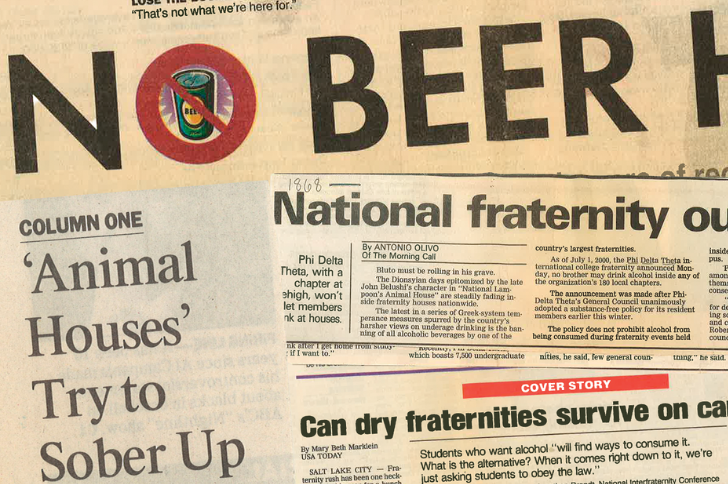
In 1997, Phi Delta Theta made a decision that would forever shape its future: the move to alcohol-free housing. At the time, it was groundbreaking territory that no other fraternal organization of our size had forged.
For some, it was controversial. For us, it was defining. Twenty-five years later, the students of today have never known Phi Delta Theta any other way.
Flashback to the Year 2000
On July 1, 2000, alcohol-free housing officially started, and Phi Delta Theta gained national attention. If you were in college then, you might remember the uncertainty. You might have heard that it was going to be the death of Phi Delta Theta. You may have even wondered, will this work? Fast forward to today; those same students are now in their forties, some with college-aged kids of their own. A lot has happened in twenty-five years.

A Change in Culture
The policy wasn’t just about removing alcohol from chapter facilities; it was about restoring the Fraternity’s focus to what the Immortal Six intended: Friendship, Sound Learning, and Rectitude.
In the mid-to-late 1990s, fraternities faced low academic performance, rising insurance costs, and declining alumni involvement due to an alcohol dominated culture on campus. Phi Delta Theta’s leadership at the time realized they needed to address these challenges head-on and replace them with a values-driven culture that would continue to shape stronger men and better versions of themselves. The Fraternity’s decision was supported by the fact that some students also wanted a change. In 1980, 20 percent of college students wanted an alternative to the status quo, something like alcohol-free housing; by 1990, 35 percent of the students wanted an alternative, and by 1995, 52 percent did.
“If you want to change your organization, don’t be afraid to take big steps; most decisions in organizations are made incrementally. The Greek movement was facing a serious issue with alcohol. It was the cause of every significant problem the Fraternity had: grades, quality of members, alumni participation, and quality of chapter houses. Additionally, parental support and Greek numbers were declining,” reflects Past President of the General Council, M. Scott Mietchen. Scott served on the General Council during the decision-making and implementation of the alcohol-free housing policy.
In 1993, a Phikeia at Auburn named Chad Saucier died from alcohol, leading the General Fraternity to take a hard look at the social aspect of fraternity, as it was attracting students who were more focused on the fun that you can have in college rather than the values of the organization. Alcohol was leading to the deterioration of facilities, assaults, and hazing incidents. General Headquarters staff and the General Council began to recognize that Phi Delta Theta was moving further and further away from its founding principles of Friendship, Sound Learning, and Rectitude, and the values of the founders and The Bond that Phi Delts all try to live up to today. In 1994, at the General Officers Conference, the idea of alcohol-free housing was discussed. General Headquarters staff presented, and students and volunteers were invited to participate. At the end of the conference, there was a vote on whether it should be taken up as a resolution at the 1996 Orlando Convention. As a province president at the time, J. David Almacy remembers the moment they voted. “I remember at GOC, they asked us for 100 percent support on moving forward with the alcohol-free housing initiative. We didn’t start the conference talking about alcohol-free housing, so it’s fascinating to see that as the two or three days went through, there was a lot of politicking and a lot of communication and education, and eventually, I remember on that last night, the lighting was a little bit dimmer in the room . . . the vote came through, and I remember looking around the room and seeing every hand raised, and I was so proud of the decision that we made. And in my view, we’ve become a better organization because of it.”
Phi Delta Theta’s accomplishments stem from the united front of the General Council and General Headquarters, with further support from house corporations providing grants and the Foundation funding scholarships. But it was also the local alumni and students. As General Council Treasurer Tom Balzer points out, “the local chapter members who embraced this and made this part of the lifestyle and showed really early on, you know, the critical mass that we started developing . . . that early success, I don’t know that we would have been able to make the groundswell that we got.” Tom served as the project coordinator for alcohol-free housing at General Headquarters and traveled to chapters in the US and Canada, educating and enforcing the new policy.
Even with early support, it wasn’t always an easy journey. Young leaders had to make hard choices. Educational Commissioner David Kovacovich recalls that going alcohol-free at Arizona State in the 1990s was not a smooth transition. The culture at ASU was very alcohol dominated on campus, especially in the Greek system. As chapter president, “We had to do some member reviews. We had to eliminate some people from the chapter. And that was a very difficult thing to do. But ultimately, what we tend to take for granted is that we go to college for an education. We go to college to create the format for our career. The social aspect is a complement to what we do after we’ve fulfilled our academic obligations. That was a little bit lost at the time when I was in college at Arizona State. Having alcohol-free housing helped us focus better on the genuine intent of our Fraternity, the Cardinal Principles of our Fraternity, and the real benefits of our Fraternity.”
By shifting the focus back to the Cardinal Principles and providing policies and education to keep our members safer, this has led to reduced property damage, injuries, and insurance claims, which in turn keeps costs stable and facilities in better condition for future generations.
A Lasting Legacy
Alcohol-related incidents, including deaths, sexual assaults, fights, hazing, and vandalism, had become alarmingly common in the Greek community. In 1989, a study showed that as many as 47 percent of students living in Greek housing identified as heavy drinkers. This is compared to 14 percent of students overall, indicating a significant gap in heavy drinking rates between those in Greek housing and the general student population. Of all insurance claims filed against Phi Delta Theta up to mid-1997, 53 percent were alcohol-related. Insurance settlements for these claims totaled over $5.5 million.
In 2004, when Michael Scarlatelli was General Council President, the Fraternity had between 6,500 and 7,000 undergraduates; now, Phi Delt has 14,200. Mike says this is due to the quality of members today. “The level of the undergrad in terms of participation, being able to discuss topics, presenting themselves, showing up on time, the way they come dressed to conventions and conferences is night and day. This has led to the growth of the Foundation by leaps and bounds from where we were. I mean, multiple times, not just two, three, or four times, because our alumni are looking at the value. They’re coming to our conferences, our conventions. They’re seeing the undergrads and interacting with them and seeing the quality of the students we’re bringing in. And that’s bringing in donations so we can fund more of these programs. So, the legacy over twenty-five years in terms of where we were with our Leadership College that began in August 1990, when we’d have maybe 200 and 300 students in one of the smaller conference rooms. Tio and Janell Kleberg saw the value this conference made on our students and invested $1 million in 2012 to support what is now called the Kleberg Emerging Leaders Institute. Their generosity means that we’re able to fund over a thousand students every August coming to Miami University in Oxford, Ohio. It has grown to have not just the main Kleberg track but also the Shaffer Honors College, and most recently, due to Mark and Shirley Craig’s $1 million gift, we have two more tracks that will allow even more leadership support for our members. What we’ve been able to implement with the Fraternity and the growth of the Fraternity with donor support—it’s been amazing.”
When alcohol-free housing began, it was a bold experiment. Today, it’s simply part of who we are. It has shaped a generation of Phi Delts who see the Fraternity not as a social club, but as a true value to their career and personal aspirations. When asked about living in the chapter house, Drew Annable, Widener ’26, said, “It’s been actually pretty nice having alcohol-free housing, having that safe space to go to be able to just hang out with brothers and chill and being able to bring PNMs (potential new members) into the house to showcase it and show them what we’re about. Also, working with our brothers to have events and recruitment events at different locations. Especially philanthropy events. That’s a big way we like to show off our Fraternity—those moments are, I think, key in our recruitment and advertise Phi Delta Theta.” Fellow Pennsylvania Mu brother Joe Walsh, ’27, confirms. “This is my first year staying in the house, and I’m really enjoying it. I feel like a big stereotype that we run into while recruiting is the belief that fraternity is about alcohol. A lot of the freshmen that I’ve talked to this year say that alcohol is the reason they don’t want to be in a fraternity. Their coach or the sports teams are really scared that being in a fraternity is going to take their time away from what they’re supposed to be doing. But I feel that rather than that, Phi Delt pushes our integrity of academics, and everything that you’re supposed to be doing as a student, like making sure your grades come first. That has helped change perceptions that fraternity can be more than being social and alcohol.”
Alcohol-Free Housing set a new standard for the fraternal world, but for nearly two decades, Phi Delta Theta stood alone in fully implementing the initiative. In 2017, Sigma Phi Epsilon passed a resolution at their Grand Chapter Conclave to achieve completely substance-free facilities by August 1, 2020. Shortly after, Beta Theta Pi and Delta Upsilon adopted similar policies. Their adoption showed that even our peers, once cautious, came to recognize the success of our approach.

The Next Twenty-Five Years
The fraternal landscape has changed dramatically since the year 2000. Many organizations still wrestle with questions of purpose, safety, and relevance. In the grand scheme of things, this initiative has only been implemented for just 14 percent of the Fraternity’s existence. Still, Phi Delta Theta is building on a quarter-century of proven results, preparing its members for the next twenty-five years and beyond. We hope to also promote future changemakers for the challenges we may face in the years to come.
“To do what ought to be done, but would not have been done unless I did it.”
“Implementing alcohol-free housing led to campuses requesting that we expand on their campus. As to our alumni’s reaction, some alumni were split. However, most alumni were extremely supportive of it. We got letter after letter from alumni and parents alike who were thrilled that we had removed the alcohol from the chapter house. Alcohol had not been in chapter houses for 150 years. It has only really been in the chapter houses to the extent that it was for 50 or 60 years. Alumni wrote letters talking about how they had overcome alcohol abuse. And then we had those who said we were going to ruin the Fraternity. And I think time told the tale that we didn’t ruin the Fraternity. And the decision that was made has allowed Phi Delta Theta to become what it is today,” concludes Scott Mietchen.
As a result of taking this big step, Phi Delta Theta became more than just a fraternity—it became the premier fraternal leadership society, known for developing men who lead on their campuses, in their communities, and their careers.
For the members of 2050, alcohol-free housing won’t be a ‘policy change’ they’ve heard about—it will be a tradition they’ve inherited. And that’s precisely what leadership decisions are meant to do: create a better future for people you may never meet.
Like any major policy change, it has been and will continue to be met with its challenges. Yet, Phi Delta Theta is a better international Fraternity today than it was twenty-five years ago. Phi Delta Theta chose to lead. Today, we tell the story and continue the legacy.
