

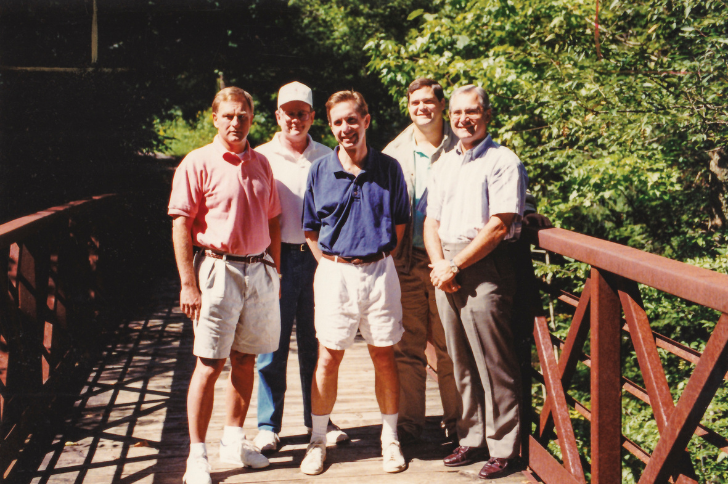
Letter to My Younger Self: Dr. Edward G. Whipple, PhD, Hanover ’74
As a Past President of the General Council and Trustee Emeritus of the Phi Delta Theta Foundation, I have gained a great deal from my Phi Delta Theta experiences. These experiences as an undergraduate and later as a volunteer in various roles have shaped both my personal and professional lives. I have been fortunate to work in education throughout my life, starting as a high school teacher and coach, then moving to college as a hall director, fraternity and sorority advisor, associate dean of students, dean of students, and finally, for the past thirty years, serving as a vice president for student affairs at five different colleges and universities. My Phi Delt experience taught me the importance of caring for others, understanding the ‘right thing to do,’ and then acting on it, as well as emphasizing the value of intellectual development in everyday life. This foundation, provided by my fraternity experience, became increasingly clear as I grew older.
As a twenty-two-year-old in my first year of high school teaching, I wish I could have read the points I am articulating below. Mistakes wouldn’t have been made, sadness and heartache may have been avoided, and possibly relationships that had gone awry would instead have been strengthened. These ‘lessons’ include:
Realizing the two most important things in life are one’s health and one’s family. Obviously, if a person’s health declines, that inhibits them from fully enjoying the many opportunities available in the world. Family does not necessarily mean blood family—I define family as a network of individuals who are there to support you at any given moment.
Being kind—while this seems simplistic and trite, it is amazing how much kindness is missing in the world today. Words hurt, and people are so free to use them and fail to realize the impact those words have on others and how that harm affects many other aspects of life.
Understanding what a work ethic is—social media has reduced people’s attention spans and caused many to jump from one activity or job to another without focusing on the quality of their work. The adage “work until the work gets done” no longer seems to apply to many people. Work is either not completed well or not completed at all.
Appreciating friendships—lifelong friends (and especially those made in the fraternity) are important, and it takes work to maintain those friendships, like any relationship. Fraternity friendships “are for life,” but maintaining them requires commitment on both individuals’ parts.
Standing up for what you believe—this is especially difficult in today’s world, where political lines are drawn, people don’t listen to each other, and ‘free speech’ has taken on a negative connotation. “Doing the right thing” applies to both personal and professional life.

I learned a valuable lesson as General Council President. Phi Delta Theta’s alcohol-free housing gave me an opportunity to test my ability to do what was best for the Fraternity, even though there were many who were not supportive of my leadership on this issue. The discussion about alcohol-free housing began during my term as General Council President, from 1992 to 94. At that time, alcohol was being served to volunteers at events like Convention and meetings between Conventions. As a college vice president for student affairs, I saw firsthand how alcohol abuse affected many undergraduates’ academic performance, campus leadership, and relationships with peers and college officials. I also clearly saw the link between hazing and alcohol abuse. When we started discussing this with chapter advisers and province presidents, there was tremendous pushback against even talking about no alcohol at events. My General Council decided to stop serving alcohol at events for volunteers and their wives or partners who attended. There was tremendous animosity on the part of a vocal group toward me and the other Council members; however, we knew it was the right decision for the survival and growth of Phi Delta Theta. It would have been easier to give in and avoid addressing the issue. Although it took four years, and it wasn’t until Dr. Bob Deloian’s 1998 Convention that Phi Delta Theta officially approved alcohol-free housing, I believe the 1992–94 General Council stood firm for what it believed was right and laid the groundwork for the 1998 adoption.
I wish I had better understood right after my undergraduate program the points I just articulated. However, we all know that real growth and understanding happen only through experiences, successes, failures, and relationships.
