

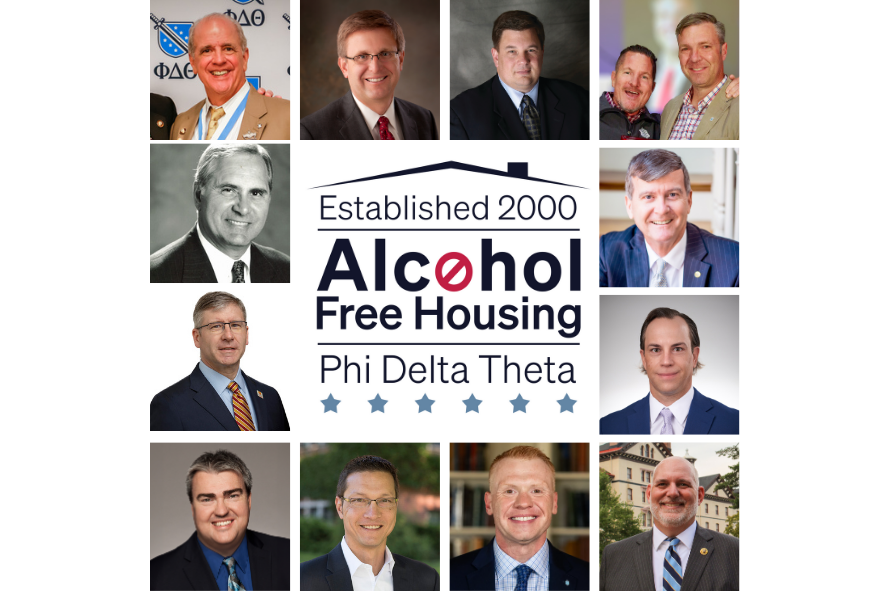
Twenty-Five Years Alcohol-Free: Reflections of Phis Who Led the Change
In 1997, Phi Delta Theta made a decision that would forever shape its future: the move to alcohol-free housing. At the time, it was groundbreaking territory that no other fraternal organization of our size had forged.
For some, it was controversial. For us, it was defining. Twenty-five years later, the students of today have never known Phi Delta Theta any other way. To reflect on this transformative moment, we sat down with members across generations—undergraduates, chapter leaders, alumni volunteers, and staff—each offering a unique perspective on what this change meant for them and for the Fraternity as a whole. Together, their stories capture how the entire organization played a role in shaping the organization we know today.
“We saw that 75 percent of our undergraduates were underage. And what we were doing as a fraternity and as a Greek system, we were providing places for them to break the law. And we decided that that wasn’t something we wanted to do. Fraternities and sororities are the only organizations on a college campus that have a pledge or take an oath to be better than the average student. And so we felt that there was something better out there. We wanted to provide a better opportunity, a better chance for learning what the Fraternity is all about, rather than having alcohol be the important factor.”
—Bob Deloian, General Council President, 1996–98
“You know, I think the one thing about Phi Delta Theta that is so unique is that we have a long history of adopting change initiatives that are industry-leading and make us who we are, and we’ve been able to embrace those differences. We’ve been able to implement those differences, and we’ve done so fearlessly.”
—Tom Balzer, Program Coordinator of Alcohol-Free Housing, 1997–2001
Because of alcohol-free housing, “The other key things that I’ve seen, growth in the Fraternity, recruitment numbers went up. Our insurance costs, as the broker and as the staff member at the time in charge of that, had a dramatic reduction. If we look now, today, our frequency of claims is down about 67 percent, and the severity of claims is down about 68 percent.”
—Marc Mores, Director of Chapter Services, 2000–04
“There was a lot of positive feedback, because you have to realize, you know, prior to, say, the late 1960s, our fraternity houses were alcohol- and substance-free, and they were like older alumni saying, ‘You finally figured it out. You’re getting back to the core principles of a fraternity: Friendship, Sound Learning, and Rectitude.’ As I like to tell people, reporters in particular, we’re getting out of the bar business, and we’re getting back into the fraternity business, and that was successful.”
—Bob Biggs, Executive Vice President, 1991–2016
“We wouldn’t be where we are without alcohol-free housing. It changed the quality of our members. It changed our parental engagement. It changed the university engagement and changed our alumni engagement. It helped us improve our chapter houses and helped our members focus more on what a fraternity is supposed to be. Nothing would be possible today, or we would not have the success we’re having today, without alcohol-free housing.”
—M. Scott Mietchen, General Council Reporter, 1998–2000
“When I went through recruitment in 1998, alcohol-free housing was a huge selling point for me to join the organization. When I saw the facilities and knew that it would be a safer and cleaner place, it really attracted me as an undergrad to want to join the organization, particularly since the other fraternities on my campus were not alcohol-free.”
—Joe Morel, initiated 1999
“I think it’s important to remember that the organization is what we’re here to protect in the long run. And being alcohol-free means the ideals of the organization can come to the forefront of everything that we do. From volunteering in the community to being a more impactful community member to being more academically driven and focused, it can really shift an organization to that perspective when alcohol isn’t the culture anymore.”
—Phil Cantrill, initiated 2000
“The policy was meant to reduce harm, to basically stop providing a mechanism for undergraduate members to hurt themselves. So, we’re twenty-five years down the line in enforcement. The reason the policy works is because when [a violation] comes to light, there’s rigorous enforcement, meaning we’re removing officers, we’re engaging in education, putting disciplinary controls on a chapter of social probation, then if necessary, charter suspension.”
—Rudy Porchivina, General Council Member-at-Large, 2000–02
“Phi Delta Theta has been able to initiate big strategic plans like Phi Delt 2020 and Phi Delt 2030 and live our values by doing big things to serve our communities. This includes our partnership with the Gruver Foundation and the advent of our Taking a Stand, high school education program, and the creation of the Iron Phi Foundation and the Live Like Lou Foundation. These efforts allow us to live our values in taking on causes a lot bigger than us. Because we’re focusing on our values, and not on our problems, we can focus on delivering best-in-class leadership programming, funding transformational scholarships, and investing our resources in those things.”
—Sean Wagner, chapter president, 2000–01
“We survived twenty-five years where some people thought we might last five by going alcohol-free housing. We proved some of the challenges that we have that we could overcome, and we can sell the idea, and people were willing to join an organization that had alcohol-free chapter houses. The one thing we challenged with people, that doesn’t mean we’re an alcohol-free fraternity; it means our chapter houses are alcohol-free. People can still join, they can still drink, and still have a good time if that’s what they want. It’s just not going to be in our chapter facility. So, I think the biggest thing is we’re still here; we’re still a viable group. [Alcohol-free housing is] a selling point on some campuses when we’re doing expansion presentations.”
—Charley Pride, General Council Treasurer, 2000–02
“Every one of our chapters doesn’t have to be alcohol-free, but they get to be alcohol-free, and there’s an important distinction there. Our chapter houses are our boardrooms. They’re our offices, our places of residence. And keeping that clean and organized is a heck of a lot easier when you’re not throwing humongous parties there. It’s pretty nice to visit a campus on parents’ weekend and not have your feet sticking to the floor. It’s pretty nice to bring a partner or prospective partner to your place of residence, to your fraternity house, and not have the place smelling like a barn. These are just general things that accompany our commitment to alcohol-free housing.”
—Dave Kovacovich, Chapter President, 1996–97
“But for me, specifically as somebody who was leading a group of men, having to wrap my head around fraternity without alcohol in the chapter house, and then communicate that [to others] . . . so navigating not being hypocritical, and making my own choices and what that means—there was a lot there, that I grew a lot during those couple of years.”
—Moe Stephens, Chapter President, 1996–98
“The greatest challenges [of implementation] were actually getting some of the alumni on board. When you think about it, you know, back in the late 1990s and early 2000s, when there would be homecoming games, tailgating generally, they were starting at their fraternity houses. Some fraternity houses were right there by the stadium. And of course, what was there? Alcohol. So that had to stop, and there was a lot of pushback from the alumni until they got used to not being able to have it on the property. And for the undergrads, their biggest problem was that a lot of the more recent alumni would show up at the house with a case of beer or something, and it was difficult to get them to say, ‘Hey, brothers, we can’t have that anymore in here. You need to remove that and take it outside.’”
—Mike Scarlatelli, General Council Member-at-Large, 2000–02
“And as a chapter president, I was terrified. After going to leadership conferences and such and learning about risk management and my own responsibility, if something were to happen under my watch, I would not want to be responsible for that. And so we did everything in our power to make sure that folks were safe at our own parties. And so I sort of think back about that, and then the plight of current chapter presidents and future chapter presidents and the quality of our membership. You know, if we were recruiting based upon actual brotherhood and Sound Learning and Rectitude and what it meant to be a family on campus who enjoyed social activities, certainly. But if all we shared was alcohol, then that wasn’t really a brotherhood in my mind.”
—J. David Almacy, Province President, 1996–2005
