

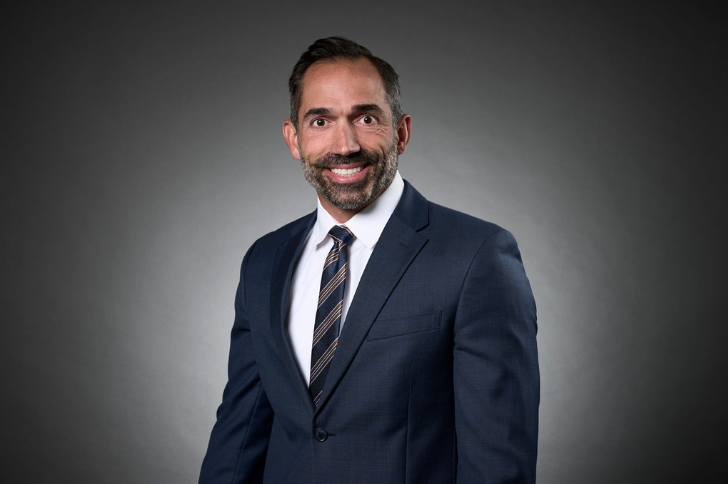
Volunteer Profile: Andrew McGuire, Southern Indiana ’08
Andrew McGuire, Southern Indiana ’08, graduated from the University of Southern Indiana (Indiana Lambda) with a BS in accounting in 2008 and later earned his MBA from Ball State University. At Indiana Lambda, he served three terms as chapter president, during which the chapter received the Founders Trophy in 2007 and the Kansas City Trophy in 2008. Andrew was chosen as a General Headquarters peer mentor in 2007 and was awarded both an undergraduate scholarship and a graduate fellowship from the Phi Delta Theta Foundation. Since graduating, he has continued serving the Fraternity, most recently as the Kappa South province president from 2014 to 2017 and again from 2020 to the present.
Professionally, Andrew is a senior accounting and finance executive at OneAmerica Financial Partners, a financial services company based in Indianapolis. In his free time, he enjoys weightlifting, playing golf, officiating tennis, and cheering for his hometown Indiana Pacers and Indianapolis Colts. He resides in Carmel, Indiana, with his wife, Abby, and their young daughter, Molly.
Tell me about your undergraduate fraternity experience. Why did you choose Phi Delta Theta, and do you have any favorite memories you would like to share?
Phi Delta Theta had a profound impact on my life as an undergraduate and continues to pay dividends in my personal and professional life today.
I attended the University of Southern Indiana on a tennis scholarship and was introduced to the Fraternity by a teammate and friend, Evan Luttrell. I was fortunate to join a chapter that was very active on campus and in the community, with a culture centered on leadership development, academic success, and community service. This standard of excellence pushed me outside my comfort zone, challenged me to grow as a leader, and inspired me to hold myself to higher personal and professional standards.
One of my favorite and most meaningful memories was attending the Kleberg Emerging Leaders Institute in July 2005—a first-class leadership conference. This experience was truly a game-changer in my life, as it opened my eyes to my leadership potential and instilled in me an enormous sense of pride and motivation to better myself and Phi Delta Theta.
The Fraternity played a significant role in shaping me into the man I aspired to become and continues to motivate me to exemplify our three Cardinal Principles throughout my life. Many of the strongest qualities and skills I possess today were developed or enhanced during my undergraduate years—many of which I attribute directly to Phi Delta Theta.
Who or what inspired you to become a volunteer?
Since graduating, I have continued to support the Fraternity, as I am forever indebted to Phi Delta Theta for the profound impact it has had on my life. My goal is to ensure that our undergraduate members are afforded even greater opportunities than I experienced—to grow, to lead, and to become the greatest versions of themselves.
I am constantly reminded of the pledge I made as a Phikeia: “I will strive in all ways to transmit the Fraternity to those who may follow after, not only, not less, but greater than it was transmitted to me.” That line inspired me as a Phikeia, and it continues to compel me to act upon it today.
To say that I am proud of this Fraternity would be an understatement—I am damn proud to be a Phi!
What would you tell someone who is considering volunteering for Phi Delta Theta?
There are many ways to volunteer with Phi Delt, and there’s almost certainly a role suited for everyone. I encourage having a conversation with a current volunteer to learn more about the different opportunities to serve. You can also fill out a volunteer interest form at www.phideltatheta.org/get-involved/, and a volunteer like me will reach out to guide that conversation.
Over the years, I’ve seen how volunteering not only shapes the lives of our undergraduate brothers but also reenergizes alumni by reconnecting them to the values and friendships that first drew us to Phi Delta Theta. And the best part—most roles require far less time than you might think, yet they provide a meaningful way to stay connected and give back.
