

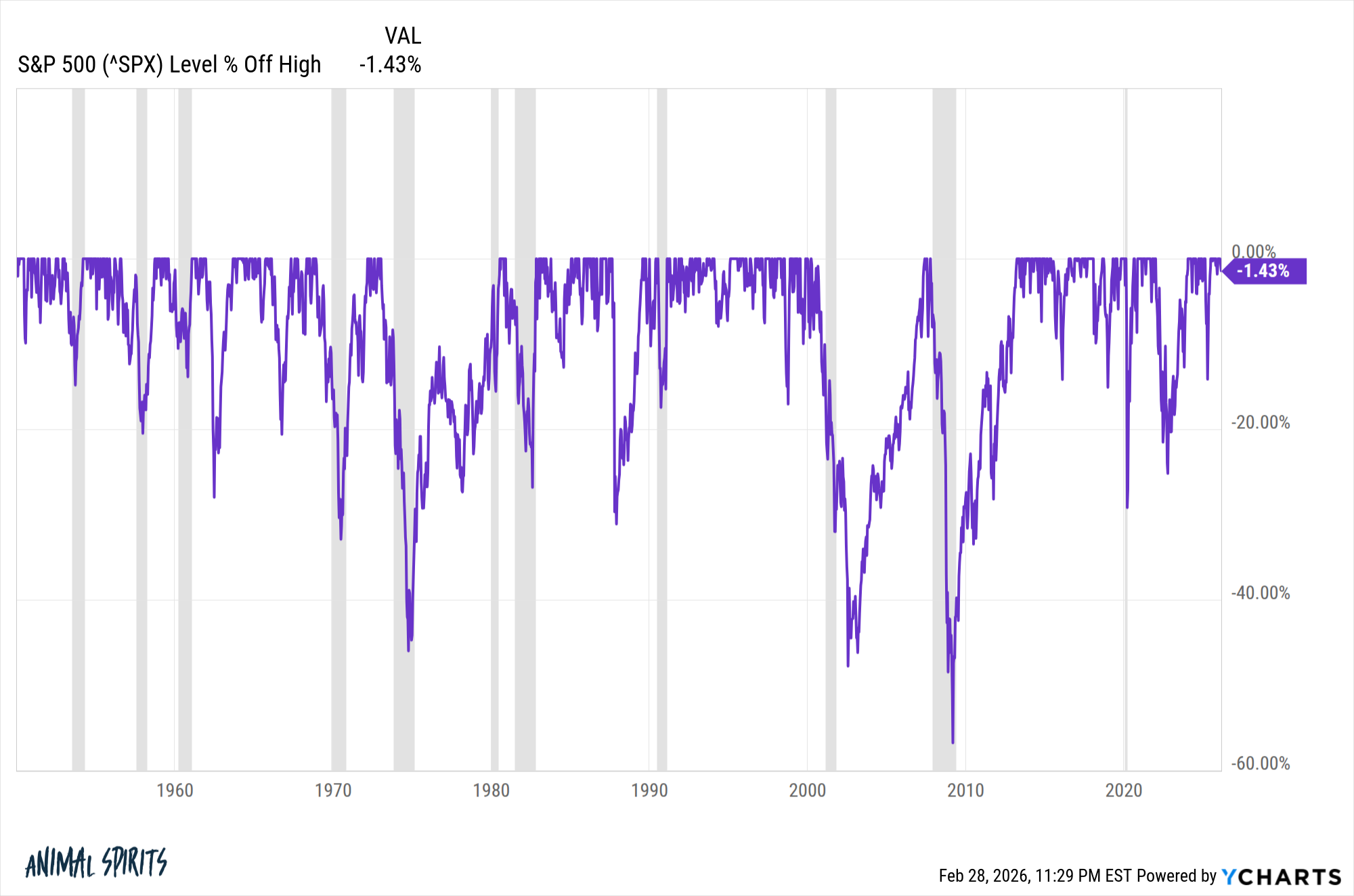
The future is always uncertain.
No one ever knows for sure what will happen.
But a period of rapid technological innovation, combined with heightened geopolitics at the moment, makes it feel like the ambiguity is through the roof.
I’m not gonna lie, these environments make me uneasy too. Life and financial planning would be much easier if we all knew what would happen in advance.
Alas.
I don’t claim to have it all figured out but how about a list of 10 things I try to remind myself during times of upheaval like we’re living through:
1. Certainty is inversely related to how right someone will be about the future. John Templeton once wrote, “An investor who has all the answers doesn’t even understand all the questions.”
Now is a time for more questions than answers.
2. The risk premium exists partly because of uncertainty. Will the Mag 7 blow up or continue to go up?
Will AI destroy every white-collar job available or lead to a Star Trek level of abundance?
Will the bull market carry on or end abruptly?
Will things get out of hand in the Middle East or end in short order?
I don’t know the answers to these questions. That’s risk for you.
3. The biggest risk is rarely the one everyone is planning for or talking about. Risk is typically what you don’t see coming.
If everyone knows about it the market has likely already priced it in.
4. Strong opinions, loosely held. Teams are already being formed around the impact of AI.
I’m team AI! Oh yeah well I’m yeam anti-AI!
I prefer to wait to see what the data and evidence show rather than put a stake in the ground before the outcomes are apparent.
Keep an open mind. You don’t have to choose a side right now.
5. Be skeptical, not cynical. A healthy dose of skepticism is warranted during times of abrupt change. But cynicism is a terrible trait as an investor.
It just leads you to believe nothing is worth investing in.
6. Discipline matters more than optimization. I believe perfect is the enemy of good when investing and building financial plans.
That’s true in times like these too.
You don’t have to thread the needle to survive.
7. Focus on what you can control. It’s scary to admit you’re hands are not on the steering wheel, but an illusion of control does you no good.
Paying more attention to the news won’t change what happens.
The late Peter Bernstein once said, “The essence of risk management lies in maximizing the areas where we have some control over the outcome while minimizing the areas where we have absolutely no control over the outcome and the linkage between effect and cause is hidden from us.”
8. Timing the market won’t help. The temptation to time grows with each new headline, news alert and anecdote.
Giving in to the temptation of market timing doesn’t make it easier to navigate times like these.
9. If all else fails, simplify. Einstein supposedly said the five levels of intelligence are smart, intelligent, brilliant, genius and simple.
As the world gets more complex you have to fight harder to keep things simple.
The solution to complexity is not more complexity. It’s simplicity.
10. Doing nothing is a decision. I don’t plan on making any changes to my investment plan. My circumstances haven’t changed. My risk profile and time horizon are still the same.
So I’ll continue making 401k contributions twice a month when I get paid. I’ll make my monthly contribution to my IRA, 529 plan and high yield savings account. My brokerage account will see money added to the account on the 15th of every month.
No portfolio changes. Asset allocation stays the same. Savings rate intact.
I do nothing when my plan calls for it because that’s how you follow a plan.
Further Reading:
The 20 Rules of Personal Finance
