

Here’s an email I recieved recently:
I’ve been doing some experiments by taking questions that you and other online financial personalities answer and asking various AIs. Its answers are very good, more thorough, and often better than the ones the human “experts” provided for the exact same questions.
Not only that, but I can import every financial document, my personal information, and my feelings about risk or market downturns, and any other thoughts I have for the AI to tailor an investment plan exactly for me–instantly. I can then ask questions (many of which I might be embarrassed to ask a professional) about anything and everything. Further, I can have it adjusted and recalibrated whenever I want, in an instant! It shows expertise in seemingly every area–retirement withdrawals, tax implications, inheritance, etc. It even provided info about my teacher pension that I hadn’t known or considered before.
I know you’ll say people want “face-to-face” human interaction, but financial advising seems like perfect prey for AI to take over almost immediately.
When you put it like that it does sound bleak for financial advisors.
I do agree that AI will make it easier for many people who have questions and don’t know where else to look for answers. The tools for do-it-yourself investors have never been better and AI will only continue that trend.
Some would I’m biased because I work in the wealth management space but I don’t necessarily agree that this means the end of financial advisors.
The world of advice will be better for DIYers and financial advisory clients alike.
Allow me to explain.
I know an advisor who got his start in this business in the 1980s and 1990s. Back then the job was basically picking mutual funds on behalf of your clients. That’s it.
You would never be able to compete as a financial advisor today if all you did was select funds on behalf of your client. Robo-advisors do that for a fraction of the cost and they’re much more efficient about it.
So why didn’t robo-advisors put financial advisors out of business?1
Trust is a big part of it. Humans like working with other humans. Finance is a service-based business that sells both tangible and intangible assets.
Some people are willing to ask AI all of the questions and upload all of the statements and create a plan and then implement that plan themselves. But that’s a lot of work and others would prefer to outsource and get on with their lives.
It’s also important for some people to have a team in their corner. What happens if there’s a problem with the IRS? Or you lose your money in transit from one financial institution to the next? Some people need accountability.
You can make the most customized workout plan you want right now. Some people still prefer using a personal trainer. Information is useless if you don’t act on it.
Clients will also expect more tools and services going forward.
Goals-based financial planning came after the mutual fund slingers. That’s a big part of the process but it’s also true that advisory clients rightfully expect a lot more services than goal-setting and portfolio management.
Since I joined Ritholz back in 2015, we’ve added a tax practice, insurance services, estate planning (including an in-house lawyer), a family office division, corporate retirement planning and institutional investment management. We also continue to add new tax-aware investment platforms that aid in the financial planning process.
Technology has played a role in that growth but it also meant a lot more people. More customer service reps, more traders, more advisors, etc., because you need someone to explain how this all works. Someone needs to interact with the systems to ensure they work with the other systems.
In fact, one of our biggest challenges is now managing more people. We went from under 10 employees when I joined to almost 90 now.
Will AI make our practice more efficient in the future? Definitely. It already is in some ways and we’ll certainly implement more AI-based efficiency tools over time. But AI isn’t going to fix people problems and people problems are eternal.
Some think AI will allow advisors to serve more clients which could lead to some consolidation in the space. That’s possible for the type-A advisors. But many in the industry will simply become better advisors to the clients they’re already serving.
And if your job becomes more efficient, you could also simply spend more time with family or relax a little.
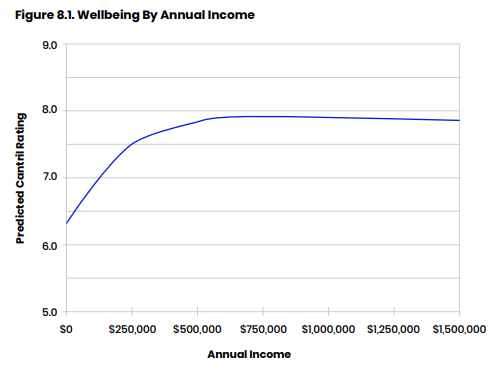
A Kitces Report study on advisor well-being found that more money does improve well-being but it plateaus:
A bigger client load and more money might not be as appealing as more free time.
There doesn’t necessarily have to a zero-sum game with winners and losers.
The DIY investors who were likely never going to use a financial advisor will now have more personalized advice and a better platform for asking questions.
Advisory clients will get more tools, more services, improved reporting software and a better client experience.
And advisors themselves will be able to better serve their client base while also becoming more efficient in the process.
It’s a win-win-win.
I was in Miami this week for Future Proof Citywide and all the talk at the event was about AI in the wealth management space. We had a big dinner the first night in town with a bunch of people from the industry and I asked Michael Kitces for his thoughts on AI potentially displacing financial advisors.
He had some very strong opinions backed up with data.
So Michael and I asked him to come on our live Animal Spirits to share his thoughts on the subject:
We also had Phil Huber from Cliffwater on the show to talk about what’s going on with private credit plus a bonus Animal Spirits roast at the end of the show.
Subscribe to The Compound so you never miss an episode.
Further Reading:
My 10 Years at Ritholtz Wealth Management
Now here’s what I’ve been reading lately:
Books:
1Read Josh’s piece about robo-advisors vs. human advisors here.
