

I always am excited to be on these calls, on these webinars, because I get to meet new folks from the team, over at VFC and colleagues from around the country. So this is always an exciting, webinar opportunity for me.
So, as far as what we have for you all today on our agenda, we’re done with the introduction. So we’re halfway there. Just kidding. we are going to talk a little bit about setting the stage on coalitions, because coalition
Work is so essential to the work that, you all do on campuses and can really help you in terms of thinking through your voter friendly campus plans. And then we have our wonderful panel where we will have a Q&A with them, and then we
Will turn it over to ask every student to talk about some additional resources that you all have at your disposal. So, and then we will, of course, leave time for questions, from you all at the end.
So if you will hold those, we will have time for that at the end of our time together. So with that, I will turn it over. so we’re super excited for this conversation. We truly think that building a team to manage the student voting work on your campus is huge.
So we really think that building a coalition to drive the student voting work is so important, so important for many, many, reasons. And I think all of us could talk about this for a very long time.
But I think three of the key things that we really see as a value, is that building a coalition really helps build the bandwidth of the student, the voting work on your campus, and really provides an opportunity to make sure that this work is not just sitting with one person.
Building and coalition also, also allows you to engage different skills, backgrounds, experiences. So your coalition really should be representative of your campus. And it should include people that have different skills, have different mindsets, and just bring bring different things to the table because that diversity and skills and back
To back the backgrounds can really make this work more powerful. And then finally, when you have a large team and large can be very different from campus to campus. But when the student vote voting work is led by a coalition instead of just one person, it really can increase the awareness across campus.
So if and for someone from, you know, Greek, Greek life, someone from houseing someone from different departments are part of that coalition and they highlight and promote that to people within their own spaces. It can really increase the visibility of your work.
So, additional pieces as you think about why, why should I build this coalition on my campus? Well, one, you can really increase the impact of your work. Ten people on the coalition most often is more powerful than one person. And can also help you find out.
And, affects where there are challenges, where there are gaps on your campus. If, if this work is happening in silos, then is your campus coalition being as effective? And the answer is and, and could be more effective and finally, one of the major pros to building
A strong coalition is it really helps build leadership with your students. The coalition should not just be a group of staff people, or the coalition shouldn’t just be a group of students. It should really be people that have a stake come from all all different, offices. departments and positions and just being representative.
But when you have students on this coalition, it’s giving them an opportunity to grow their skills and be a part of something bigger. and as we’ll hear from our, two, two members of our panel, the work that they did in college really helped prepare them for the jobs out there.
And now, and I’m not going to dive deep into types of coalition members, my colleagues, Sithara, they have, really great coalition building resources. And she’ll talk a bit about like, coalition mapping. but we just really want to recognize members of your coalition. Listen, we will all have different levels of involvement.
So, I would like to introduce, my colleague from North Carolina, who will moderate a panel. and we do have five questions that, that are prepared. And then if we do have time, we’ll take questions from the chat. So I’ll pass it to Amanda. Thank you. Chuck. I have to apologize in advance.
I just had a coughing fit. I am pollens getting me right now, so if I have to dip out for, second excuse me. so I’m going to our moderator panel, and I have a few questions for, Jaylin and Sithara.
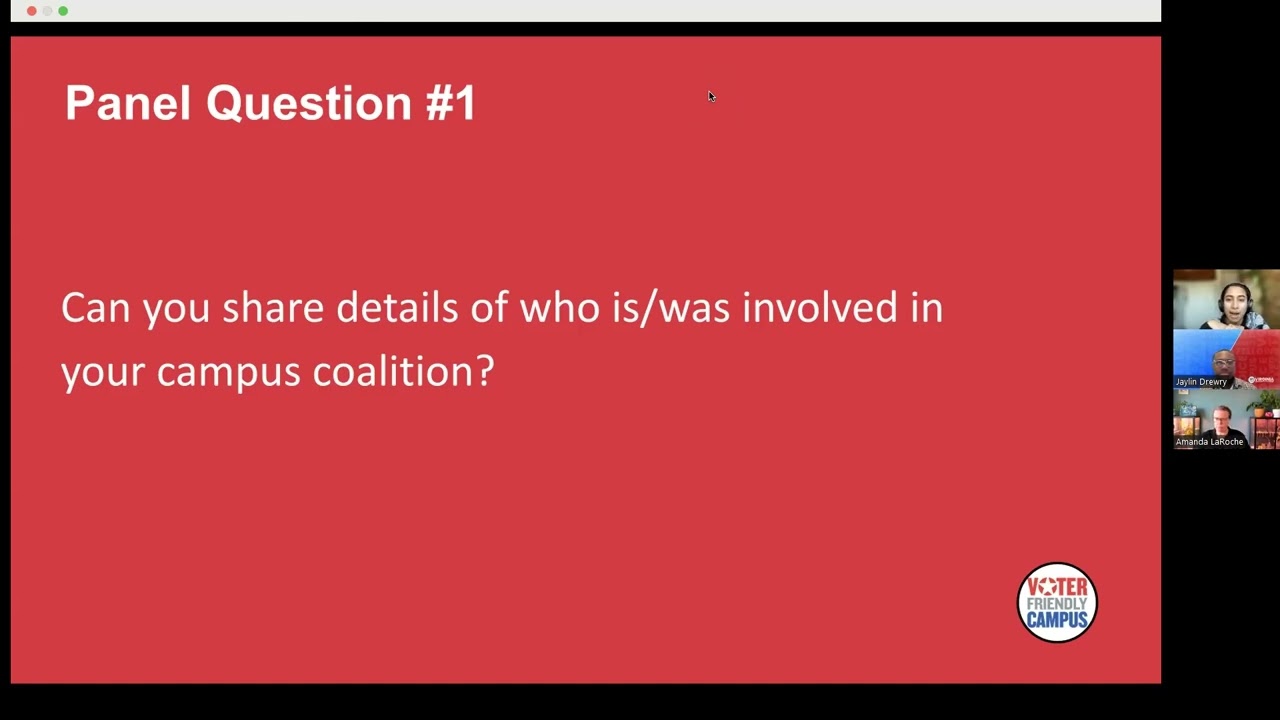
So, can either of you talk about, share the details of who is or was involved in your campus coalition from your experience? Yeah, I’ll take that. I’ll go ahead and take that question first. Thanks, Amanda. thinking of back a few years ago when I was a democracy fellow on my campus and obviously
University, and also I am a recent graduate of Norfolk State University as of May 2023 with my bachelor’s in political science. And so I’ve been involved in this work for a little bit around five years now. And thinking back to a few years ago, it wasn’t just students, right?
It wasn’t just student organizations, but it was faculty and staff. It was community partners as well. organizations that surrounded the campus community. but then also administrators, partners on campus as well, all who had a stake in, civic engagement efforts, which is really important.
And so I remembered how important it was to really involve those different voices in that coalition. ahead of the 2020 election, which we all know was a really important election, and it made a huge difference in the impact of who was involved in civic engagement on campus and
How we was getting people, to show up to vote and want to register people to vote on campus as well. With our. I’ll pass it over to you. Awesome. I think for a lot of contacts before I share some details about campus coalitions, some,
Some of my background that might be helpful to help understand this is I first got involved doing student voting work as a student myself, like Jaylin, on my, my campus, getting involved with organizing my peers and our campus coalition, as well as after graduation.
And I’ve worked with several different nonprofit organizations in this space to organize students and train them on doing this work on their own campuses. And now I work at the National Coalition, the Students Learn Students Vote Coalition. So I think over the course of all of that experience, one thing that’s really stood
Out to me is how the coalitions that are most successful on campuses can really vary depending on the type of campus in the institution. So I definitely am happy to share some of the folks that really stood out to me as key partners.
But I think one of my my biggest takeaways from this work is how important it is to really tailor your coalition to your unique campus context. I think some of the most successful coalitions that I’ve worked with have been really intentional about involving partners that represent historically disenfranchised and currently underrepresented
Communities on their campus, which can really vary depending on the campus demographics. And so I think that can involve, you know, organizations that represent racially marginalized groups, such as black student unions, Latino student unions, and similar organizations
Or campuses that have a lot of commuter students making sure to engage folks from that population, campuses that don’t have residential populations. And really thinking about who on your unique campus is not being represented, and making sure you’re personalizing those efforts to those communities on your campus.
I think some, some examples, though, of specific types of folks that can really help with that, that I would share. I think one is involving faculty, making sure that you’re involving faculty, especially of underrepresented majors on your campus.
There are some really great reports in data, such as the National Study of Learning, voting, and Engagement that can help you recognize what majors are turning out to vote at lower rates. So I’ll say, at the campus where I went to school, we had really low voting rates of
Especially Stem majors, which is really common on a lot of campuses. And so one of the coalition partnerships that was really effective for us was involving faculty from science majors and helping them be a part of our coalition.
So we could really build that relationship and buy in with them to be able to then share personalized information to those students to make sure that they were hearing it from someone that represented, you know, the field that they were interested in going into and could give them really personalized engagement information.
I think another community that can be really helpful to engage that we worked with in some of the coalitions that that I’ve been a part of is Greek life. I think especially on campuses that have, divine nine organizations, the historically Black sororities and fraternity, those can be really excellent partners because those
Are organizations that have historically done a lot of the work to organize around voting rights and the importance of voter registration, and can be really great partners on campus, not only to mobilize the community that oftentimes has increased barriers to voting, but have
A lot of the like historically and institutional knowledge of doing this work and can contribute a lot of really valuable capacity and scale to your coalition. So I think those are some of the folks that were involved that I think I would really, really recommend to people.
But in the big picture, really focusing just on your individual campus and who is who is missing and who are the communities that are really prevalent on your campus that are missing from the conversation? Thank you. Both. Jaylin and Sithara.
I, I think both of you really hit on how important it is to to get that faculty involvement. because a lot of faculty members can work’s, become incredibly helpful in advocating for the students, because their student voices are, despite being a college campus, aren’t
Always the ones that are centered when it comes to doing this work. so great observations. Thank you. you both have been involved in this for a long time. both as students personally and now professionally. and you’ve seen a lot of different sides and the amount of work that this takes, so often.
So, sorry, could you explain, how do you balance the work so it doesn’t fall just on one person? I think my most helpful advice with balancing the work is involving people early on in the process that you want to partner with.
I think involving folks in your coalition, in the planning process and giving them a chance to give input on what is actually happening, early decision making can really make it so that initially, the plan that you make is going to reflect the capacity of the people
That are actually going to be doing the work and can also help build the relationship with folks so that they know what is going on. They know that they have a say and are then going to be a lot more willing and able to
Contribute to actually implementing everything in the long run, because they know that it’s something that reflects their own ideas and can also know that they are a core part of the conversation. So I think one really great opportunity to do that is through the action planning process.
So any campuses that are working on their action plan can make sure that the partners that they’re trying to involve in the coalition are participating in the process of developing the plan themselves, so that they can then be, you know, more ready to actually participate in, in doing the work.
I think the other side of this, too, especially when you’re working with students, is that a lot of student leaders oftentimes need additional support in just learning how to balance the work that they’re doing and learning how to balance, you know, their school, their job
And the work that they’re doing in student voting. Because for a lot of folks, it can be really overwhelming. And oftentimes a new experience learning how to balance all of these workloads, independent early. So I think additionally, making sure that student leaders are being given that extra
Guidance and just knowledge that they can take a step back and ask for help and have other people support them is really crucial, because I know, at least from my experience, both as a student and working with students, that oftentimes student leaders want to be
Doing everything possible and just need to hear from someone that it is okay to take a step back and pass things off and ask for help. Thank you. Jaylin, I’m going to pass the same question onto you?
I want to add just a little, caveat that maybe you could get into a little more as well. because you attended an HBCU. as we’ve talked about before, as students there certainly carry a lot more load when it comes to almost acting like administrators.
So could you talk about that as well as just how do you keep that balance as a student? Yeah. Great point, Amanda. And also I agree with everything that Sithara said as well. And on that point about student leadership specifically when it comes to HBCUs, to your
Point, many times tonight, those student leaders are acting as administrators or staff on their campuses. And so they may think that they have the capacity to do everything under the sun, but they they really don’t because they’re burnt out. As a former SGA president, I experienced that myself.
And so I totally understand how that how that goes. But I also want to add to, I think is important when creating these coalitions to define specific roles and responsibilities of each member of the coalition, that will overall ensure
That, you know, task and the purpose of the coalition, is understood and everyone is understanding of what the overall goal is of the coalition. So that’s dividing into smaller committees or working groups to focus on specific task or initiatives.
I experienced, you know, that while I was on campus doing undergrad, but also now working in a space, at CVP, we realize how important it is to have, specific committees and working groups when planning our own summits as well.
And it’s a key thing to make sure that we have specific, roles and responsibilities so that everyone is in becoming overwhelmed, because at the end of the day, everyone has other roles at the organizations and that they’re institutions that they’re representing.
And so we want to make sure that everything is fair across the board. Thanks, Jaylin and then, question number three, and I will let you guys decide who wants to answer first. But, can too many people make a coalition ineffective?
Usually when we’re in this space, we’re, desperate to just try to find enough people. But at times, we do find a lot more people who are focused. So, too many cooks in the kitchen. is that always can that become ineffective? And how do you address that?
I’m happy to jump in on this one. I would say that there certainly can be, you know, I think drawbacks to having too many people, but I think that there are ways that you can really address it. And I think like overall, in general, more support is usually going to be more helpful
As long as you’re figuring out some ways to manage that. And I think one of the biggest things that I’ll encourage for folks is to think about the different models of coalitions that were touched on at the beginning of this.
I think thinking about how you structure your coalition and how specifically people are engaging can really help you, especially when you’re leaning towards having a lot of people involved. So I think one thing that I’ll share for folks is that it can be helpful to have different
Levels of engagement in your coalition that people can decide to be a part of. So having a lot of people that are involved in the everyday, like leadership and decision making of the coalition, can oftentimes be difficult.
And so having a couple of people or a few organizations that are in charge of really like facilitate meeting, bringing people together and having other organizations have the opportunity to participate at a lower level, depending on their capacity, such as just participating
In events or just signing on to the coalition or just being called in when there are specific asks for the things that they can provide, the coalition can really help manage things. When you have a lot of people.
And I think one thing that I’ll share from my experience that has been really helpful is that when you are approaching people to join your coalition, have an honest conversation with them about their capacity and what they can provide, and then offer them different
Options of how they can get involved based on that. So I think I really recommend having like a low level ask, a medium level ask, and a high level ask that people can choose because then when you’re having that conversation,
You can then set yourself up to have responsibilities that match what people can do and can make it so that you’re not trying to get everyone to do every single thing. Which I think is where too many people can make things less effective. Yeah.
And I’ll just add one thing and I agree with everything that’s that. I said, of course, the only thing I’ll add is I think it’s important to, make it clear of the decision making process in a coalition as well. Making that clear earlier on, like Sardar said, it’s preventing from having to have
These issues. I think too many cooks in the kitchen is could always be an issue in different spaces, but specifically we want to come to coalitions making clear at the beginning what the expectations are, but also the decision making process.
So that way down the line, when it comes to coming to a consensus, building a consensus, but also voting on certain issues and coming to a common ground on certain things that you’re working on in your coalition, that won’t be a problem. Thank you.
Jaylin and Sithara, I think I would probably add to that is, looking at it a little bit differently in the decision making process. This is why it becomes so important to have faculty and staff that are really supportive of the students.
Because sometimes the response obviously they get is going to be a little bit different than a peer. and can sometimes also be much more comfortable making some of these decisions on who is or isn’t included in some of that.
So it’s a coalition within the coalition, so to speak, to, to help all of this work. and so we’ll move on to our next question. for you, I know you all are familiar. Most people on this call are obviously familiar with, one of the big things we look for when
We’re talking about our voter friendly campuses is, that there are succession plan so things don’t get get dropped in the process. so how do you plan for succession if your coalition leaders would no longer be able to carry the work? and, Jaylin, actually, I’ll pass this off to you first and then we’ll
Go over to Sithara. Yeah. Thanks. Amanda, this is a great question. And it’s really important in this space to make sure you have succession planning, whether it’s from the students perspective or the administrative perspective, but also us here in the civic engagement space as well. Having those succession plans are really important.
And I think looking at it from a perspective of what will happen if, let’s just say everyone has to leave the coalition, what will happen if for some reason everyone is fired at the institution wouldn’t happen? But there’s a possibility anything could happen, right?
And so really thinking about, documenting the processes, what was the whole original goal of why we created this coalition of workers first place, making sure that it’s documented and planning, excuse me, documenting every single thing that went into the planning of
That coalition, how it was developed, the processes of establishing who was going to be on that coalition as well. Then what should happen if someone were to leave the coalition? and how you came about developing those plans as well?
Also establishing, key leadership of the coalition as well, and also partners on campus is key as well. Let’s say, a VP of Student affairs leaves, you know, who is the next contact for that for that role as well. And so making sure all of those things are documented.
So that way when it comes to someone leaving, you won’t have to worry about, you know, figuring out information. Yeah, I completely agree. I think those are really excellent points. I think documenting the work is is one of the most important parts of this.
I think a couple other things that I’ll add is making sure that you have multiple people in your coalition that are aware of their sort of role in terms of succession. So I think really communicating to folks like for both in the short term succession, you
Know, who is going to step in and if the leader or chair of the coalition is just has to take a short term leave, having sort of a like clear process of who is going to be the person that takes things on.
I think with students as well, when you’re planning for the succession of students, because students, of course, graduate, having students who are different years can be really helpful. So if you have a lot of, you know, juniors and seniors or other students who are going
To be graduating soon, making sure that you make an effort to recruit younger and new students who can go through and build up that knowledge so that when some of your students leave, you have others who are already involved and can take things on.
The one other thing I’ll share is that the SLSV coalition pulled together a working group of folks on this specific topic. and we put together a transition management resource that I’ll put in the chat, for everyone. So this is a really long tool guide to everything that you should document for your coalition.
I will preface this by saying, I know it’s very long. We really designed this to be overly comprehensive, and you can really take what you need and leave the rest, but it walks through a lot of the different areas that we recommend documenting,
As well as areas that folks can look to if they are new and they don’t have resources to get started. So I’ll put the link to that in the chat for everyone. But I recommend, as you’re starting to think about your succession plan, taking a look
At that to see what are the types of things that you should document to pass on to a potential successor. Oh, thank you both. and then I think we’re are coming in our last question here, you guys definitely have had
Some more recent experience with coalitions of students in the now in your professional, lives. So is there a particular story or example you can share of what makes our major coalition, meaningful and go ahead to pass that to Jaylin first? Yeah. Thanks, Amanda.
I’m thinking about a time a few years ago where, I was on campus during my undergraduate time at Norfolk State University and, we had a senatorial debate on our campus between, Senator Mark Warner and also, Republican candidate Doctor Daniel Gade, who is now the secretary of Veterans affairs for the state of Virginia.
And it was because of the coalition that we were able to do that. If we hadn’t built that coalition at Norfolk State and having that network of support of student led organizations and administrative, support and also community partners, that senatorial debate wouldn’t have happened.
And it was also televised across the state of Virginia. And it was the coalition that really organized and put that together, along with some local officials as well. And so there truly is power in developing coalitions, especially if they’re done the right way. so, yeah. Can I share two stories? Okay.
Just checking if we have enough time for that. So the first story I’ll share is from when I was a student, when I did my, undergrad, I worked with our coalition on campus, and we work primarily as a lot of coalitions do
During the election season to do voter registration, voter education, the pretty standard typical events. But I think one thing that our coalition was able to do that was really meaningful was post-election transition, our work into a little bit of relationship building and advocacy to set up for future elections.
So, the specific instance that I’m thinking about was in 2018 and after the 2018 midterm election, our coalition met to discuss everything that was happening. And typically that was sort of the wrap up meeting that the coalition would have and would sort of go into dormant mode.
But we realized that there were a lot of issues on campus that students were facing and increased barriers, and we’re able to transition the work that we were doing into working with our local elections officials at the county level and our state level elections officials
To give input on new policies and programs that were being developed that eventually resulted into having an on campus polling place and same day voter registration available to students, which was able to set up a new system that made all of the work the coalition was doing
Far easier, and also allowed it to really use its resources in a new way. And so the coalition really gave us flexibility and the ability to really adapt and change and make sure that we were setting up better voter access programs for students, in addition
To just the things that we were doing during the election. But the work that we were doing to initially engage everyone in primarily voter registration, allowed us to have those relationships and connections to be able to really quickly respond and transition to the new policies that were passed and those existing relationships made
That possible. Because we wouldn’t have been able to turn that around and make it happen without having already established all of those relationships with partners on campuses. the other really quick story I’ll share is the work that I was doing when I was organizing, Florida State University.
We were able to build a multi campus coalition. so when I worked at Florida State in Tallahassee, we work to build a coalition with the local community college, Tallahassee Community College, and another university in Tallahassee, Florida Agriculture and Mechanical University.
And so our campuses were able to work together and partner together during the 2020 election, when all of the campuses really had a lack of resources and resources. And we’re really trying to understand how to do remote voter engagement work and do voter engagement work during the Covid pandemic.
And so partnering across universities and colleges in the city really allowed everyone to work together and add capacity to do things that definitely would not have been possible, as each campus was trying to figure out how to operate in a completely new dynamic. During the first major election of the Covid pandemic.
And so I think that cross campus partnership was really, I think, the key thing that allowed us to be able to do most of the work that we were doing on campus. Thank you. Jaylen. And especially that was, both of those stories are incredibly helpful.
I will say, on my end here in North Carolina, as we’re talking about the cross campus coalitions, or multi campus coalitions, is there’s been a as many places have had a high administrator and staff turnover in the last four years.
And one of the things that has been helpful is for these schools that are in contact with each other, able to sort of at least get a little bit of, background in, in what’s going on in the area, especially for campuses that are close to each other. so thank you both very much.
Are there any other questions that anybody has? Well, I think at this point, if you have any questions, you can go ahead and drop them in the chat. But I’m going to go ahead and go pass it over to staff at this point.
But just want to take a moment to both Jaylin and Sithara. Thank you for your time. and some really valuable insight on this. I’ve been lucky to work with both of them. in fact, for, a couple of years now, and, and, there’s any question in how our student
Voter leaders, what they turn into professionally, there’s two very great examples on this call. So thank you guys very, very much. Thank you. Amanda. and yeah, so at this point I wanted to also share some additional resources that Chuck touched on at the beginning to help folks with building their, campus voting coalition.
So I will put the link to this into the chat. But as folks are working on building coalitions, I really wanted to provide you guys some of our coalition building curriculum from the Ask Every Student program. So whether you are starting a brand new campus voting coalition from scratch or building
Upon or diversifying an established coalition, the Ask Every Student Coalition building curriculum has a variety of tools that can support you with wherever you are in the process. So I wanted to highlight a couple of different resources here that can be helpful for folks.
So if you don’t have a coalition on your campus and want to start one for the very first time, there is a resource called the Getting Started worksheet that can help you assess your campus landscape and help you develop a coalition.
You know, walking you through identify your coalition goals, gaps in your campus voting programs, and your purpose. as well as if there are folks that already have existing coalitions and you want to expand or strengthen or diversify, we have a partnership mapping worksheet, which is perfect for identifying
Partners that you want to engage and focus your outreach efforts on, especially potential partners that can address any gaps or barriers in your current student voting efforts. and there’s many, many more resources in this, coalition building curriculum, including case studies of existing campus coalitions, a facilitator guide to facilitate a coalition building activity.
So, for example, if you have an existing coalition and you want to engage those partners in figuring out the next steps for engaging even more people in your coalition, you can facilitate the coalition Building partnership mapping activity for your coalition meeting.
But essentially wherever you are at in the process, there are a variety of different worksheets and guides that you can use to help you with your efforts so that you don’t have to start from scratch or reinvent the wheel. We can help you move through this process.
And so if we go to the next slide, all of these resources are part of the Ask Every Student initiative’s ask every student toolkit. so everything in this toolkit, including the coalition building curriculum, where created by campus partners who have been doing the work.
So, you know, these are things that have worked on other campuses and are supported by current best practices and our student voting movement. so the Ask Every Student toolkit has a ton of other resources, too, that I would encourage folks to to check out.
In addition to this coalition building curriculum that can support folks in moving towards the vision of the Ask Every Student program, which is, like the name suggests, to ask every student on campus to participate in the democratic process and achieve full student voter registration.
And then if we go to the last night that I have here, in addition to the resources in the Ask Every Student toolkit, Ask Every student also offer support for campuses through opportunities like connecting with similar campuses, support from our team Life open hours and trainings
And funding opportunities which we are currently offering to campuses in the form of our implementation grants. So I just wanted to give everyone here, a quick mention that that funding opportunity is open for campuses to apply to until April 26th.
If you’re interested in learning more about, ask a student how to get involved and how to apply for grants while they’re open. You can learn more at Student voting.org. I’ll put the link in the chat as well, or by reaching out to us.
But, the voter friendly campus is one of the members of the ask every student steering committee. And so we really love to see how campuses in the program can compare what they’re doing with ask every student.
And so really hope that folks will check out some of the resources that we have here, include this work in your action plans and reach out to us if you have any questions about getting involved. so I will put the information for this in the chat as well.
I’m happy to to provide my email for folks who have questions. but that is all that I have on the coalition Building resources. so I would like to thank Sithara. we always enjoy, when we can have friends outside of campus. Vote and naspa come on our events.
So just to close this out, I do want to sharing remind y’all, that we do our VFC webinar on the forth Monday of every month. our next one will talk about, the diverse student population and, and really thinking about the impact of the student voting work on them.
So I encourage you to mark your calendar registration is up, and we hope to see you there. but are there any questions that anyone has for myself or any member of the panel or Jill? Also, several of us, our teachers.
So like, we can just sit this, but we’re not but we do really appreciate, people coming out. We do hope this this was helpful. we will share a copy of the slides and the were recording, and it will be made available in the upcoming videos in this letter as well.
If there are any further questions, you can feel free to contact any member of our team. But with that, we thank you for coming and enjoy the rest of your day.
source
