

A Legacy of Service: Honoring Phi Delta Theta Veterans
For generations, members of Phi Delta Theta have answered the call to serve. Whether serving in active combat or heading the call to defend democracy worldwide every day, Phis have stood together in moments of courage, sacrifice, and leadership. This Veteran’s Day, we visited the Phi Delta Theta archives to highlight stories and photos from World War I and World War II to honor our brothers who served during these pivotal periods in history. Today, we recognize military Phis past and present and celebrate the enduring legacy of service within our brotherhood.
A Fraternity That Follows the Flag
Even in the midst of war, Phis found each other.
In the spring of 1945, as Allied forces closed in on victory in Europe, a group of brothers stationed in Paris organized what is believed to be the first Phi Delt banquet on the European continent. Presided over by military leaders like Maj. Gen. Paul R. Hawley, Indiana 1912, and Brig. Gen. Edwin C. McNeil, Columbia 1916, the gathering drew members from fourteen chapters spanning forty-four years of history. Summoned through a simple bulletin posting, brothers traveled from posts across the city to honor fellow Phi Elmer Davis, head of the Office of War Information.
With victory imminent, they jokingly predicted their next meeting would be as the “Army of Occupation Chapter.”

Ranked by Maj. Gen. Paul R. Hawley, Indiana ’12 and Brig. Gen. Edwin C. McNeil, Columbia ’16, the brothers who made this a memorable occasion in PDT annals are pictured above.
Reading from left to right around the table are: Lt. Col. John W. Hill, Columbia ’11; Lt. Col. Warren W. Shaw, Washburn ’31; Col. George W. Shirk, Oklahoma ’34; Lt. Col. Herbert A. Hall, Michigan ’27; Capt. Paul H. Whitney, Wabash ’35; Capt. Gordon L. Murray, Chicago ’40; Capt. Frank A. Reker, Chicago ’40; Lieut. Neil E. Humphreville, Washington-St. Louis ’42; Maj. Lewis R. Morris, Oregon ’36; General McNeil; Mr. Davis; Col. William A. Ganoe, Dickinson ’02; General Hawley; Col. Herbert B. Wright, Wisconsin ’20; Col. Ralph E. Stone, Allegheny ’32 and Maj. Ferdinand G. Angeny, Arizona ’33.
Alumni Chapter Afloat
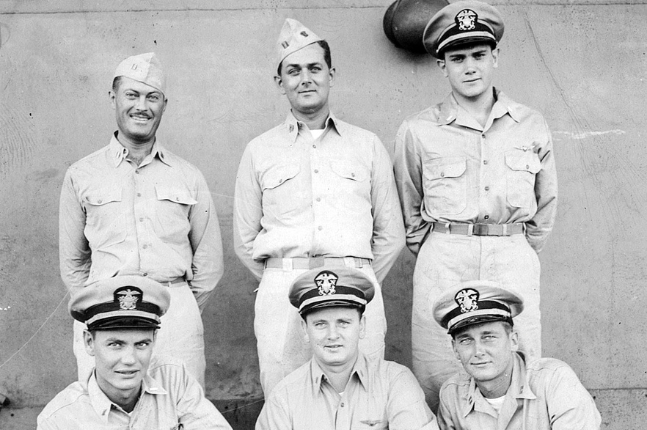
On ships in the Pacific, small groups of Phis forged alumni chapters of their own. Four lieutenant junior grade officers—a demolition specialist, a battleship gunnery officer, a destroyer-transport officer, and a scout-observation pilot—claimed to be “the fightin’est alumni chapter afloat” during the capture of Peleliu Island. On a US aircraft carrier elsewhere in the theater, six more Phis serving as fighter and dive bomber pilots found themselves united by The Bond.

From left to right are: Lt. (j.g.) Warren L. Rockwell, Miami ’42; Lt. (j.g.) A. B. Herndon, Jr., Florida ’42; Lt. (j.g.) L. L. Fergus, Louisiana ’42; Lt. (j.g.) James R. Nuzum, West Virginia ’40.
Training America’s Armed Forces
Phi Delts could be found across the nation’s service academies and training camps:

At West Point in the 1920s, brothers distinguished themselves in athletics, leadership, and cadet ranks.
Standing: Joseph M. Dye, Westminster ’29; Wilbur O. Townsend, South Dakota ’32.
Seated: Russell H. Griffith, Vermont; Donald C. Little, Kansas ’29; James W. Gurr, Georgia ’28; Walker W. Milner, Whitman ’28; Houston P. Houser, Georgia Tech ’28.

Front row, left to right: James W. Dupree, Florida ’46; J. H. Berry, Iowa State; J. E. Weatherly, Davidson; Victor V. Sharpe, Duke ’47; Charles D. Summitt, Vanderbilt ’46; Donald P. Harvey, Nebraska ’46.
Second row, left to right: Philip D. Shutler, Union College ’47; John A. McCamont, Akron ’47; Andrew L. Frahler, Oregon State ’45; Mark H. German, Florida ’45; William F. Wagner, Georgia ’47; Henry Ortland, UNC-Chapel Hill ’44; John A. Walsh, MIT ’45.
Third row, left to right: Cecil G. Duffee, Alabama ’46; William H. Jagoe, UNC-Chapel Hill ’46; Richard M. Middleton, Stanford ’44; Duke J. Rose, Duke ’45; Richard D. Maxson, UT Austin ’45; David L. Hartshorn, UNC-Chapel Hill ’46; Leslie D. Kelly, Vanderbilt ’45; Alfred F. Bridger, Iowa Wesleyan ’44.
Missing when picture was taken: Edward S. McGehee, Auburn ’45; George R. Lemmon, UT Austin ’46; M. S. Bowman, Maryland; J. Fischer, Washington (and Brother Wagner writes, “possibly a few others whom we were unable to contact”).

At the US Navy Midshipmen’s School at Notre Dame, classes of more than thirty Phis at a time rotated through compressed wartime commissioning schedules.
Front row, left to right: Richard C. Emmelman, Franklin; Edward W. Rhodes, Wash.-St. Louis; John J. Doyle, Washburn; Stephen L. Rusk, Duke; Norman D. Alexander, Franklin; Charles L. Davis, Washburn; Robert H. English, Georgia Tech.
Second row: Charles H. Hoestmann, Duke; Leonard J. Smith, Duke; Floyd D. Michael, Franklin; Elliott L. Maguire, Florida; Heys E. McMath, Jr., Emory; John M. Rider, Franklin; Loy Lewis, Florida; Huston M. Prout, Duke.
Back row: Robert L. Hoke, North Carolina; Fred E. Camrherzell, Syracuse; Claude W. Beal, Gettysburg; Philip B. Craig, Florida; Warren C. Winkler, Allegheny; Theodore W. Sellin, Centre.
Missing from picture were seventeen other Phis, from several chapters, who were on watch duty.

At Quantico, eleven brothers earned commissions as Marine officers—the largest Marine cohort of Phi Delts ever trained together.
Lower, left to right: Edward Bryan, Syracuse ’40; George Vaughan, North Dakota ’40; James Herbold, UCLA ’39; Leonard Reid, Georgia ’39; George Smith, Georgia ’39.
Upper, left to right: Lawrence Rulison, Syracuse ’38; William Lowery, Oregon State ’40; Richard Reich, Iowa ’39; William Oliver, Missouri ’40.
Missing from picture: James Rathbun, Duke ’40; Arthur Goat, Duke ’40.
Courage in the Air
Military flight training was notoriously demanding. At Randolph and Kelly Fields in 1934–35, four Phi cadets entered a US Army aviation program with a graduation rate hovering around 35 percent. All four graduated—each earning the coveted silver wings of a pilot. From Texas skies to the front lines overseas, they embodied the discipline and rigor of early military aviation.
These men who did their best to keep PDT at the top are: John L. Du Frane, Oregon State ’32, cadet lieutenant, and active athletically; Lee B. Coats, UCLA ’33, cadet first captain; Clarence T. Edwinson, Washburn ’33, active in athletics, captained post basketball team at Kelly Field; and George S. Buchanan, Stanford ’32, cadet non-commissioned officer, and member of the “Caterpillar Club.” Coats and Edwinson are former All-American football players.

Left to right: Du Fraae, Coats, Edwinson, Buchanan.

Standing, left to right: Lt. Harold R. Ten Eyck, Colorado College ’22, aircraft maintenance; Lt. Bill J. Harris, North Dakota ’33, dentist; Lt. (j.g.) James K. Steele, Miami ’44, fighter pilot.
Kneeling, left to right; Lt. (j.g.) William R. Jemison, West Virginia ’42, dive bomber pilot; Lt. (j.g.) Jacob F. Price, Randolph-Macon ’41, dive bomber pilot; and Lt. Jack S. Kitchen, Missouri ’39, fighter pilot, who sent the picture to The Scroll.

Phis Training as Flying Cadets, Army Aviation School, Brooks Field, Texas.
Left to right: Charles T. Browne, Washington ’28; Richard B. Taylor, Washington-Lee ’28; Ludo G. Wilkins, Columbia 1924; John Yeomans, Williams ’26; Charles R. Kurtz, Penn State ’27.
Leadership Under Fire
One of the most decorated Phi veterans of the European Theater was Col. Thomas H. Nixon, Gettysburg ’15, chief ordnance officer for General George Patton’s Third Army. With seven battle stars and over thirty-six months overseas, Nixon earned the Distinguished Service Medal for solving unprecedented logistical challenges during rapid armored advances across Europe. Patton presented the medal personally—his last official act before his fatal accident.

Col. Thomas H. Nixon, Gettysburg ’15, as he was awarded Distinguished Service Medal by his chief, the late General George Patton. Col. Thomas H. Nixon, chief of ordnance for the European Theater, was awarded the Distinguished Service Medal by the Late General George S. Patton, Jr., on December 8, 1945, at Bad Neuheim, Germany.
Brothers Everywhere
In camps, academies, barracks, and even summer installations like Camp St. John’s in Wisconsin, Phis formed temporary chapters—some humorous in name, all serious in purpose. Whether called “Delafield Zeta” or simply the “E.T.O. Chapter,” these gathering points offered fellowship, familiarity, and fraternity in moments of uncertainty.

Left to right, front row: Paul Baldwin, Missouri Beta; Jim Petit, Georgia Delta; Allen Starr, Illinois Alpha; and Garland Weed, Kansas Alpha.
Standing: Jay Ocken, North Carolina Alpha; George Mathews, Georgia Delta; Jordan Haines, Kansas Alpha; Charles Bunschu, Missouri Alpha; and Dan Gealey, Texas Delta.
The Bond Endures

From infantry to aviation, and from the Navy’s decks to the Army’s European command posts, Phi Delts have served with duty, honor, and quiet excellence. These archives are only snapshots of a broader legacy—tens of thousands of brothers who wore their nation’s uniform.
To our veterans: Thank you for your sacrifice, your leadership, and your example.
