

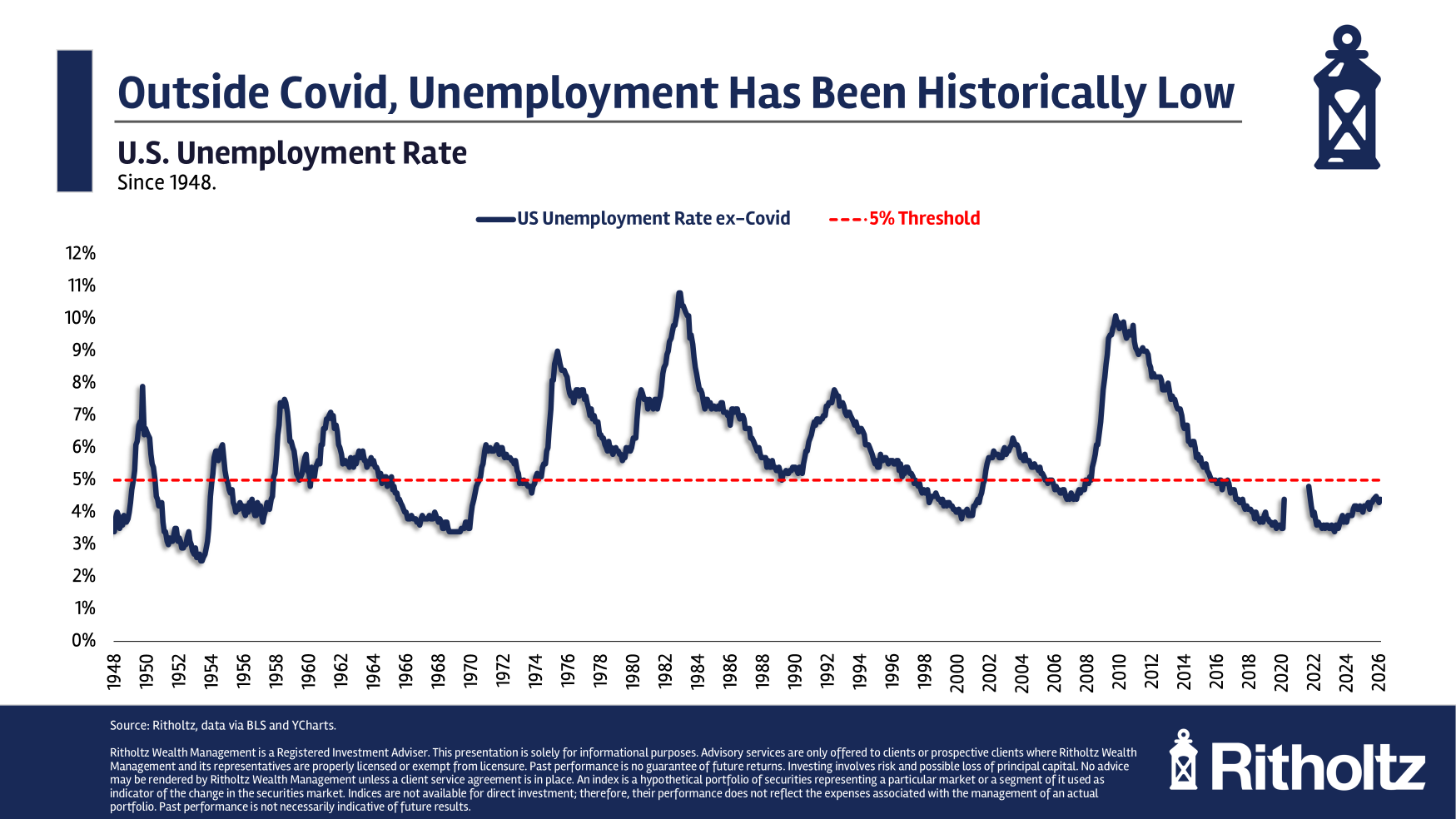
From March of 1965 through July of 1970, the unemployment rate spent every single month below 5%.1
That’s the longest streak on record in modern economic history…until now.
Since the fall of 2015, the unemployment rate has been below 5% for 125 consecutive months:
OK fine this chart is not technically true.
The unemployment rate spiked to 14% during the first few months of Covid. But that was not a real recession. There was no credit cycle. It was man-made. People on unemployment insurance were being paid to not work. Businesses were being paid by the government to stay open.
The labor market essentially recovered immediately.
Sure, some would argue maybe the economic cycle would have run its course if the pandemic hadn’t caused governments to spend trillions of dollars. That’s a fair rebuttal.
But I think it’s a legitimate argument to call this the longest economic expansion in history.
There hasn’t been a real recession since 2009.
There’s been no credit cycle in that time either.
No financial crises to speak of.
The stock market has experienced just two down years out of the past 17. The S&P 500 is up nearly 14% per year since the beginning of 2009.
The economy has continued to grow despite 9% inflation, the Fed raising rates from 0% to 5% in a hurry, tariffs, wars, energy shocks and more.
At the very least, this is the most impressive economic expansion given everything that’s been through at it.
This economic boom hasn’t always been perfect. There are certainly parts of the economy that have struggled. Not all households have benefited equally.
At some point the cycle will turn. I don’t know when or why. No one does.
Everyone who has been predicting the downfall of the economy since the end of the Great Financial Crisis has been wrong, often spectacularly so.
The economy just keeps chugging along.
Further Reading:
Some Things That Didn’t Happen
1Then from the start of 1974 through the spring of 1997, the unemployment rate remained above 5% for 279 consecutive months.
This content, which contains security-related opinions and/or information, is provided for informational purposes only and should not be relied upon in any manner as professional advice, or an endorsement of any practices, products or services. There can be no guarantees or assurances that the views expressed here will be applicable for any particular facts or circumstances, and should not be relied upon in any manner. You should consult your own advisers as to legal, business, tax, and other related matters concerning any investment.
The commentary in this “post” (including any related blog, podcasts, videos, and social media) reflects the personal opinions, viewpoints, and analyses of the Ritholtz Wealth Management employees providing such comments, and should not be regarded the views of Ritholtz Wealth Management LLC. or its respective affiliates or as a description of advisory services provided by Ritholtz Wealth Management or performance returns of any Ritholtz Wealth Management Investments client.
References to any securities or digital assets, or performance data, are for illustrative purposes only and do not constitute an investment recommendation or offer to provide investment advisory services. Charts and graphs provided within are for informational purposes solely and should not be relied upon when making any investment decision. Past performance is not indicative of future results. The content speaks only as of the date indicated. Any projections, estimates, forecasts, targets, prospects, and/or opinions expressed in these materials are subject to change without notice and may differ or be contrary to opinions expressed by others.
The Compound Media, Inc., an affiliate of Ritholtz Wealth Management, receives payment from various entities for advertisements in affiliated podcasts, blogs and emails. Inclusion of such advertisements does not constitute or imply endorsement, sponsorship or recommendation thereof, or any affiliation therewith, by the Content Creator or by Ritholtz Wealth Management or any of its employees. Investments in securities involve the risk of loss. For additional advertisement disclaimers see here: https://www.ritholtzwealth.com/advertising-disclaimers
Please see disclosures here.
