

A reader asks:
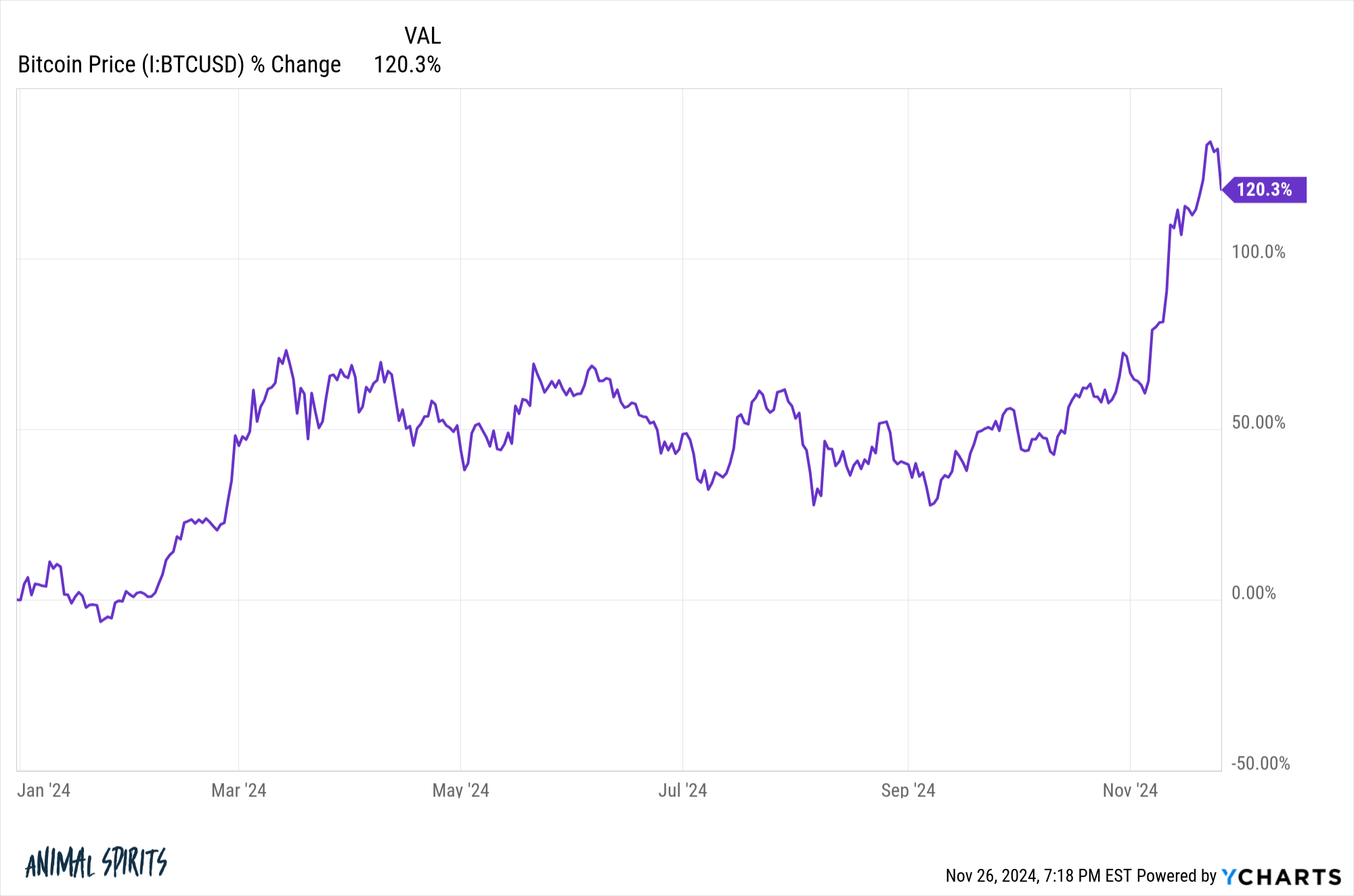
I’m thinking of adding bitcoin to my portfolio via one of the new ETFs but it feels like I’ve already missed the boat with the insane run-up this year. Is it too late to add? I don’t want to be a muppet.
I have many thoughts on this question but first a story from my book Don’t Fall For It:
Isaac Newton’s contributions in mathematics, astronomy, physics, alchemy, theology, engineering, and technology make him arguably the most important figure of the scientific revolution. Not only was the man a world-renowned scientist, but he also took part in debates on monetary policy within the government and helped pursue counterfeiters in his work with the Royal Mint.
Newton died a rich man as his life’s work paid well but no one remembers how much money Newton made or squirreled away. The only story anyone knows about Sir Newton when it comes to money matters was his experience losing a boatload of cash investing in the Sea bubble.
Newton is widely attributed with the quote, “I can calculate the motion of heavenly bodies, but not the madness of people,” after losing his shirt in South Sea Company shares. This is the chef’s kiss of behavioral finance quotes. It’s been used countless times because it makes the perfect point that even one of the smartest people on the planet can succumb to his emotions when money is involved.
Unfortunately, Newton likely never said the first part of the quote. He is on record responding to a question about the ever-rising price of the South Sea stock price by saying, “I could not calculate the madness of the people,” but the “calculate the motion of the heavenly bodies” part was likely added in later by other writers to beef up the narrative. Regardless of where the entirety of the quote originated, Newton’s experience is still worth revisiting because investing in the South Sea Company provides lessons for the rest of us who will never be one of the most influential minds in recorded history.
Newton died a wealthy man with an estate valued at roughly £30,000, but lost anywhere from £10,000 to £20,000 from his foray into the beast that was the South Sea bubble. That £20,000 would be the equivalent of roughly £20 million today. By all accounts, Newton was a conservative, shrewd, and successful investor before the South Sea stock caught his fancy, investing prudently in mostly stocks and government bonds.
The South Sea Company was an innovative experiment at the outset so the fact that Newton was an early investor made him something of a venture capital pioneer. He began buying up shares in 1712, just a year after it was incorporated, and a full seven to eight years before the madness of the crowds took the price to the stratosphere. Newton saw some nice gains in his trading account on the initial price surge and proved to be a momentum trader by making six more purchases as the price continued to rise. A majority of those purchases were at prices higher than where he ended up selling out but he was still able to take some gains and nearly double his initial investment. Yet after he sold the price kept right on rising as the bubble really took off as he sat with his cash was on the sidelines.
To quote Michael Corleone (Al Pacino) in The Godfather, Part III, “Just when I thought I was out, they pull me back in!”
The ever-rising share price sucked Newton in hook, line, and sinker. After selling out of his entire stake, Newton would jump back in just a few short weeks later at double the price he sold. It was a panic buy, most likely caused by greed’s best friend, the fear of missing out. FOMO quickly turned into the fear of being in, as Newton was looking at a loss of nearly 80% on his capital by the end of 1723.
Researchers believe Newton is the only large investor who initially took profits on his investment in the South Sea Company, only to jump back in at a later date and lose the bulk of his money.
For the rest of his life Newton claimed he couldn’t bear to mention the name of the company that caused him such grief and losses. John Blunt’s pump-and-dump of massive proportions had snagged one of the most intelligent people to ever walk the earth.
OK, back to the question at hand.
Jeff Foxworthy voice: If you become interested in Bitcoin at $100,000…you might be a performance chaser.
If you weren’t interested in Bitcoin at $20k, $30k, $40k, $50k, $60k, etc., I would be concerned if it’s only appealing to you now at $100k.
That’s not to say it couldn’t work out for you. The price might keep going higher. No one knows how high Bitcoin will go when it’s on a heater like this. You could certainly make some money riding the momentum train.
My biggest question is this: Why now?
The ETF came out in January when prices were much lower. Why didn’t you buy it back then?
I would be worried about the behavioral profile of any investor who is only looking at Bitcoin as a buy candidate around $100k. That sounds like a pure FOMO play and it rarely works.
Now, maybe you tell yourself it’s only a trade or you’re now a convert to crypto. Fair enough. Maybe you can dollar cost average into a position if you’re really interested in investing.
The problem is no one is immune to the siren song of FOMO. Even the most brilliant people in the world can be blinded by money emotions.
This has nothing to do with the prospects for Bitcoin and everything to do with human nature.
I discussed this question in further detail on the latest episode of Ask the Compound:
On this week’s show we also touched on questions about diversification as a younger investor, a pep talk for younger generations, financial planning with Chat GPT and paying down your mortgage vs. investing in fixed income.
Further Reading:
Why I’m Selling Some Bitcoin
