

I write a lot.
Sometimes people ask how I write so much.
One requirement is that you need a general set of theories about how the world works. This doesn’t mean you have it all figured out but having an overarching philosophy allows you to apply it to whatever is happening in the moment.
This also doesn’t make it any easier to predict the future but it helps me better understand the present and use the past to provide context.
Sometimes you’re forced to change your theories because the world is not static but more often than not, the big things don’t change.
This is not an exhaustive list but here are some of my working theories:
Bad things will happen but it still makes sense to invest for the long run. You don’t get the reward if you don’t take the risk.
You have to be willing to put up with the bad to get the good, which is not always so easy.
Sometimes you just have to be OK with losing money to make money.
No one can predict the direction of interest rates. I had a boss tell me this early in my career. It’s still valid and just as hard as predicting the direction of stocks.
Guessing the reasons for rate moves isn’t all that helpful either.
Rates are down so we must be heading for a recession!
Rates are up so the bond vigilantes must be punishing us!
Sometimes you need to take a breath to see how things play out.
I prefer to view yields through the lens of risk and reward rather than trying to translate or forecast them.
Incentives and career risk drive most decisions. Charlie Munger once said, “I think I’ve been in the top 5% of my age cohort all my life in understanding the power of incentives, and all my life I’ve underestimated it. And never a year passes but I get some surprise that pushes my limit a little farther.”
Most people are more intelligent and well-intentioned than you think. The biggest reason people make irrational decisions in their jobs is career risk and mis-placed incentives.
You will get stuck behind a minivan in the drive-through. It will take forever. Their order will be ridiculously long. They’ll be asking silly questions and making numerous requests and modifications.
You will slam your hands against the steering wheel in protest.
You just have to wait it out.
Recency and hindsight bias are everywhere you look. This thing just happened! It’s important! It must mean something!
That thing that just happened was obvious! I knew it was going to happen!
We all think this way because the past feels clear while the future is always messy.
Government debt and spending are going to keep rising. I’m not saying I agree with it. I’m not saying it’s a good thing.
But do you really think politicians are going to cut back?
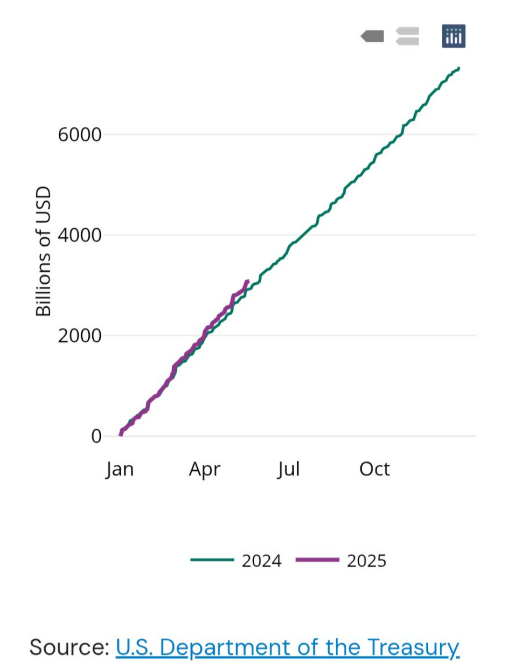
Elon Musk said he would slash $2 trillion of government spending with his DOGE initiative. Guess what? The U.S. government is spending just as much money this year as it did last year:
The new tax bill is going to increase the deficit. If we ever get another recession that will increase the deficit too.
Only the party that’s out of power seems to care about government debt…until they come back into power.
Maybe voters or the bond market will force politicians to rein it in eventually. It’s possible.
But my assumption is no one really has the stomach for less government spending until they’re forced to.
Who knows when that will happen so it will likely keep rising.
Rich people will probably get bailed out. Wealthy, powerful people almost always win. It can be infuriating but it’s true.
The world is always getting better but it feels like it’s getting worse. This is the double-edged sword of the information age.
We all know more and it’s bad for our perception of progress.
Social media is making it worse.
Most people won’t change their minds. You can’t save everyone and that’s OK.
Sometimes the stock market goes down but most of the time it goes up. Get used to it.
Most of the time things work out and the world doesn’t come to an end. A cottage industry of crash-callers was born out of the 2008 financial crisis.
Everyone wanted to be the next John Paulson or Michael Burry.
The problem with a once-in-a-lifetime financial crisis is they don’t come around that often.
Betting on the end of the world can make you feel smart but it won’t make you any money.
Further Reading:
The Difference Between Market Timing and Risk Management
