

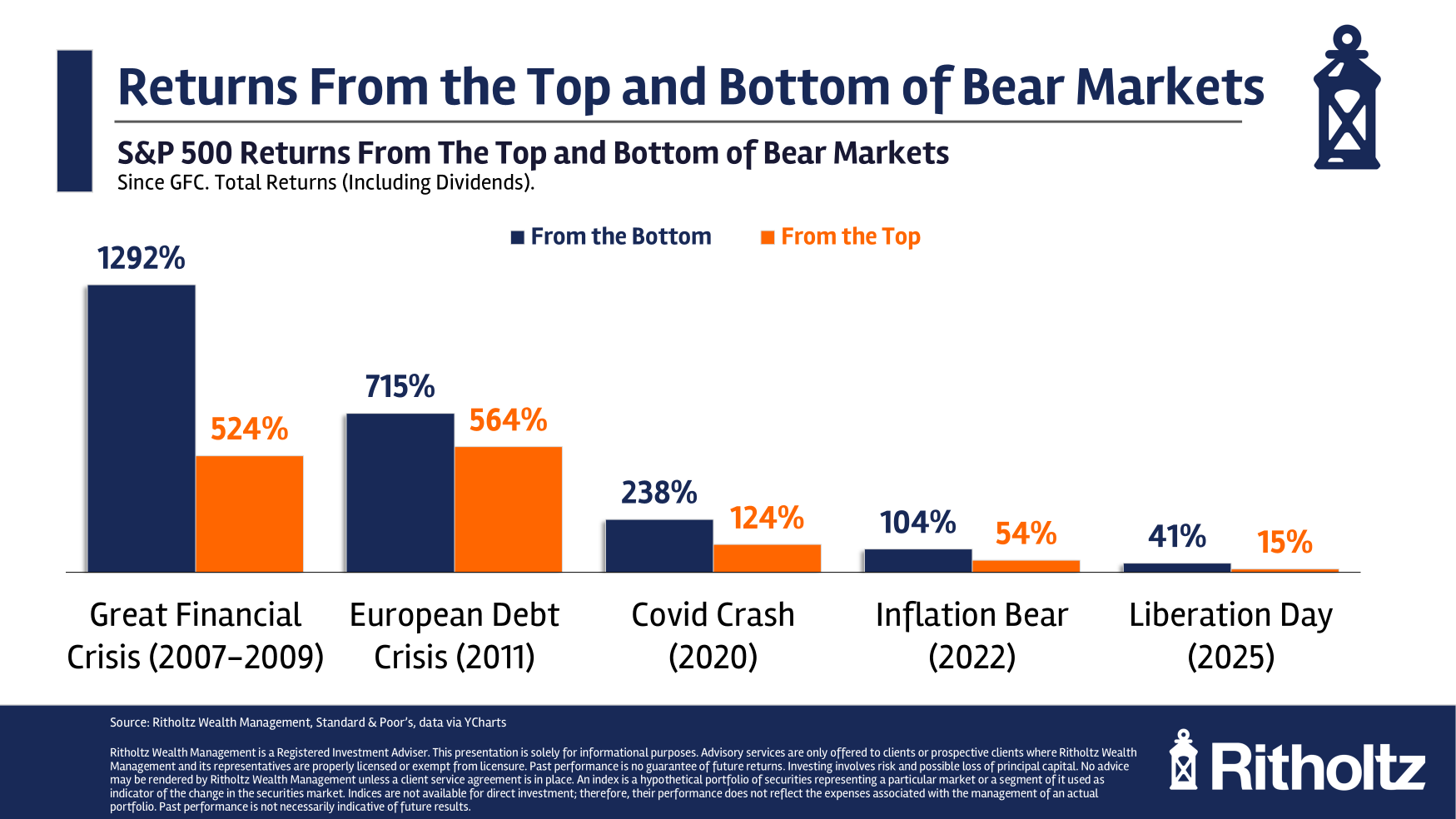
From the bottom of the Liberation Day sell-off around a year ago the S&P 500 is up 41%.
From the bottom of the 2022 bear market the S&P 500 is up 104%.
From the bottom of the Covid Crash in March 2020 the S&P 500 is up 238%.
From the bottom of the mini-bear market in 2011 the S&P 500 is up 715%.
From the bottom of the Great Financial Crisis in March 2009 the S&P 500 is up 1,292%.
Sure, buying at the exact bottom of a bear market leads to good returns when followed by a bull market. Duh.
What about the tops?
From the peak just before the start of the Liberation Day sell-off the S&P 500 is up 15%.
From the peak just before the start of the 2022 bear market the S&P 500 is up 54%.
From the peak just before the Covid Crash the S&P 500 is up 124%.
From the peak before the 2011 double-dip the S&P 500 is up 564%.
From the peak in October 2007 before the onset of the Great Financial Crisis the S&P 500 is up 524%.
Not as good but still not bad considering those peaks were followed by drawdowns of -19%, -25%, -34%, -19% and -57%, respectively.
Here’s a visual summary:
Of course, no one is lucky enough to invest at the nadir of the market in a downturn. And no one has enough bad luck to invest only at the peak of the market right before a huge decline (save for Bob).
Most people invest at different points along the way. Sometimes it’s near a top or bottom. Most of the time, it’s somewhere in between.
The important part of this data is to recognize that picking tops and bottoms doesn’t matter nearly as much as you think.
Your time horizon is more important than your ability to forecast market turning points.
Further Reading:
How the Stock Market Performs After a Correction
This content, which contains security-related opinions and/or information, is provided for informational purposes only and should not be relied upon in any manner as professional advice, or an endorsement of any practices, products or services. There can be no guarantees or assurances that the views expressed here will be applicable for any particular facts or circumstances, and should not be relied upon in any manner. You should consult your own advisers as to legal, business, tax, and other related matters concerning any investment.
The commentary in this “post” (including any related blog, podcasts, videos, and social media) reflects the personal opinions, viewpoints, and analyses of the Ritholtz Wealth Management employees providing such comments, and should not be regarded the views of Ritholtz Wealth Management LLC. or its respective affiliates or as a description of advisory services provided by Ritholtz Wealth Management or performance returns of any Ritholtz Wealth Management Investments client.
References to any securities or digital assets, or performance data, are for illustrative purposes only and do not constitute an investment recommendation or offer to provide investment advisory services. Charts and graphs provided within are for informational purposes solely and should not be relied upon when making any investment decision. Past performance is not indicative of future results. The content speaks only as of the date indicated. Any projections, estimates, forecasts, targets, prospects, and/or opinions expressed in these materials are subject to change without notice and may differ or be contrary to opinions expressed by others.
The Compound Media, Inc., an affiliate of Ritholtz Wealth Management, receives payment from various entities for advertisements in affiliated podcasts, blogs and emails. Inclusion of such advertisements does not constitute or imply endorsement, sponsorship or recommendation thereof, or any affiliation therewith, by the Content Creator or by Ritholtz Wealth Management or any of its employees. Investments in securities involve the risk of loss. For additional advertisement disclaimers see here: https://www.ritholtzwealth.com/advertising-disclaimers
Please see disclosures here.
