

A reader asks:
Have you ever written about the national debt? That’s the one that gives me pause. It’s pushing $40 trillion and it just seems it has to end badly. Of course I was saying that when it was a charming little $10 trillion and everything has done nothing but get better since then.
People have been worried about government debt well before it was $40 trillion or even $10 trillion.
In Snowball, Alice Schroeder discusses the many times Warren Buffett’s father, Howard, railed against government debt and deficits in the 1940s.
Howard once said, “America could not endlessly spend borrowed money without consequences.” He favored a return to the gold standard over fears that America would end up like Weimar Germany, where people carted wheelbarrows full of money down the street because of hyperinflation.
At the time, government debt was around $50 billion.
One of my favorites is the 1972 Time Magazine cover story:
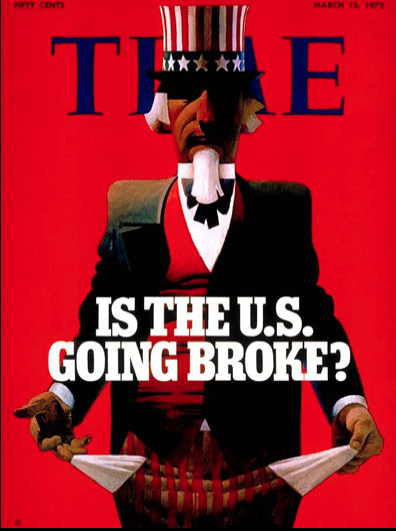
This sounds like it could have been written today:
Debt service is now the third highest public expense, exceeded only by spending for defense and education; most of the money goes to banks, which are the major buyers of bonds that governments at all levels sell to cover their deficits. Moreover, debt functions as a wrong-way income redistribution device, channeling tax money that is paid in large part by the poor and the middle class into the pockets of wealthy holders of trust accounts or stock in banks.
When this cover was published, government debt was roughly $430 billion.
Today it’s fast approaching $40 trillion in total.
There has been a never-ending parade of people shouting at the top of their lungs about the perils of government spending, debt, and deficits ever since the Great Financial Crisis.
None of them has been right, but the debt keeps on rising.
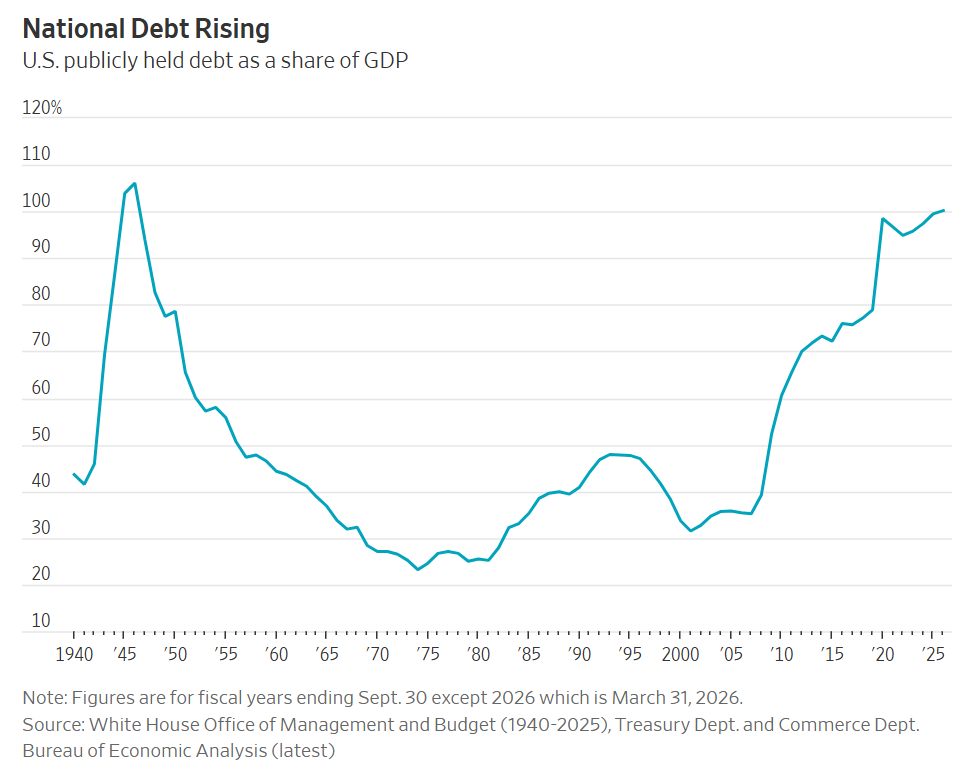
The Wall Street Journal shows that publicly held debt to GDP is now 100% for the first time since WWII:
Is this a case of the boy who cried wolf yet again? Or will ridiculously high government debt levels actually cause the crisis so many people have been warning about for decades?
Here’s the trillion dollar question — why have none of the government debt crisis predictions come to fruition?
I like how Steve Eisman described this situation on The Compound & Friends:
I am in full agreement here.
There are two big mistakes people make when they predict a catastrophe from U.S. government debt levles:
1. Conflating U.S. government debt with household debt. Government debt is not like a mortgage that needs to be paid back. As long as the economy keep growing, debt levels will likely keep rising.1 Plus, the U.S. government has the ability to print the global reserve currency. You can’t print more dollar bills in your basement.
2. The government’s liabilities are someone else’s assets. Treasuries are bonds owned by pensions, insurance companies, fund managers, and households. It’s the largest, most liquid bond in the world and there isn’t an alternative.
I’m not going to give oxygen to the doomer narrative that government debt is going to cause a crash in the dollar and the end of the financial system as we know it. These people always say this and they are always wrong.
So what would make me worry about government debt levels?
The biggest risk of large deficits and government spending is inflation.
When you consider the amount of government spending done during the pandemic, it’s almost surprising we didn’t have even higher inflation before falling back towards the long-term average:
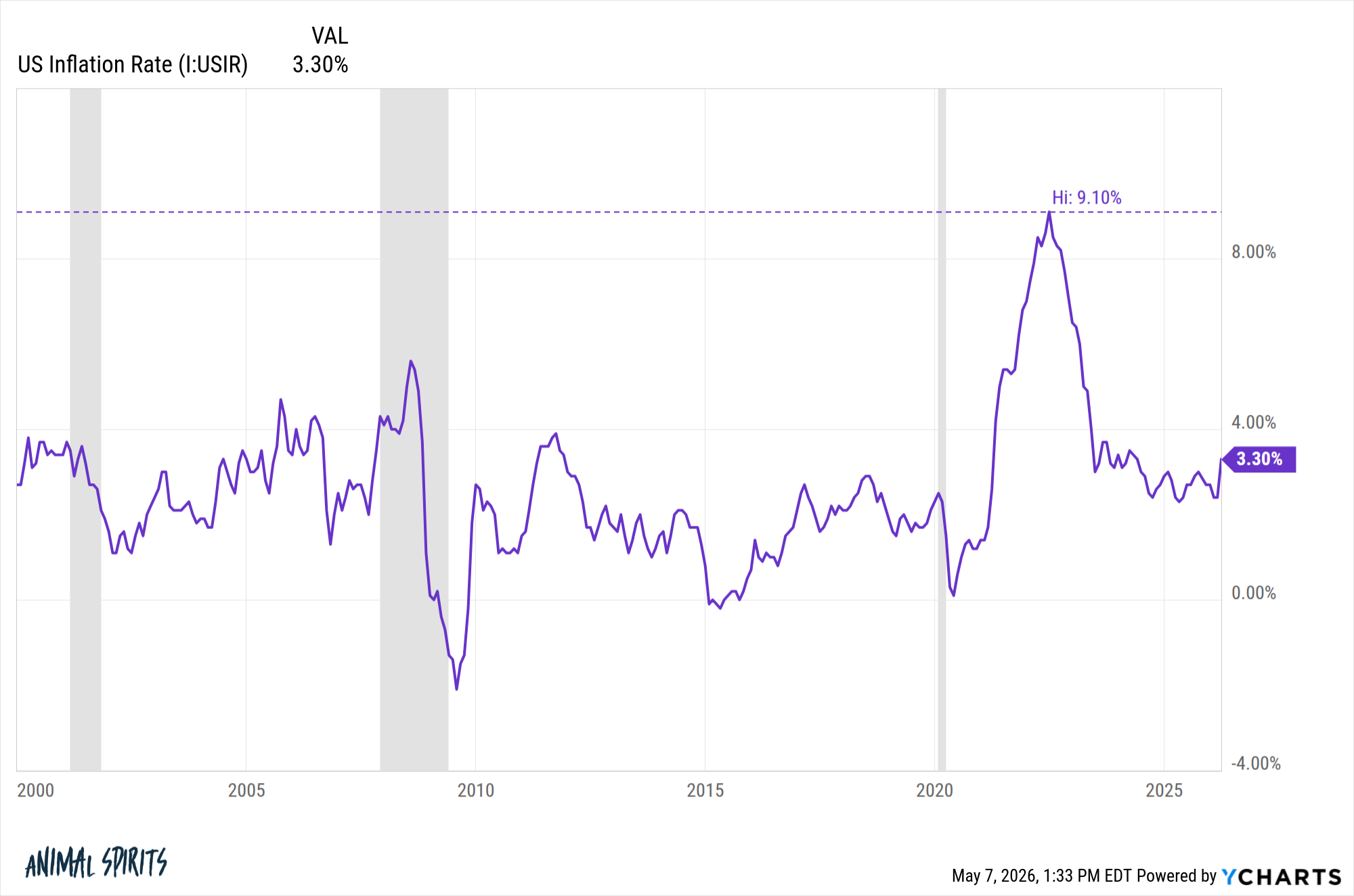
Publicly held government debt went from around $22 trillion at the end of 2019 to more than $39 trillion now. But this is not the 1970s by any means. If inflation remained elevated that would be a good reason to worry.
Continuously rising interest rates would also be cause for concern.
If you look at the Treasury yield curve, bond yields did have a rapid rise off the Covid floor:
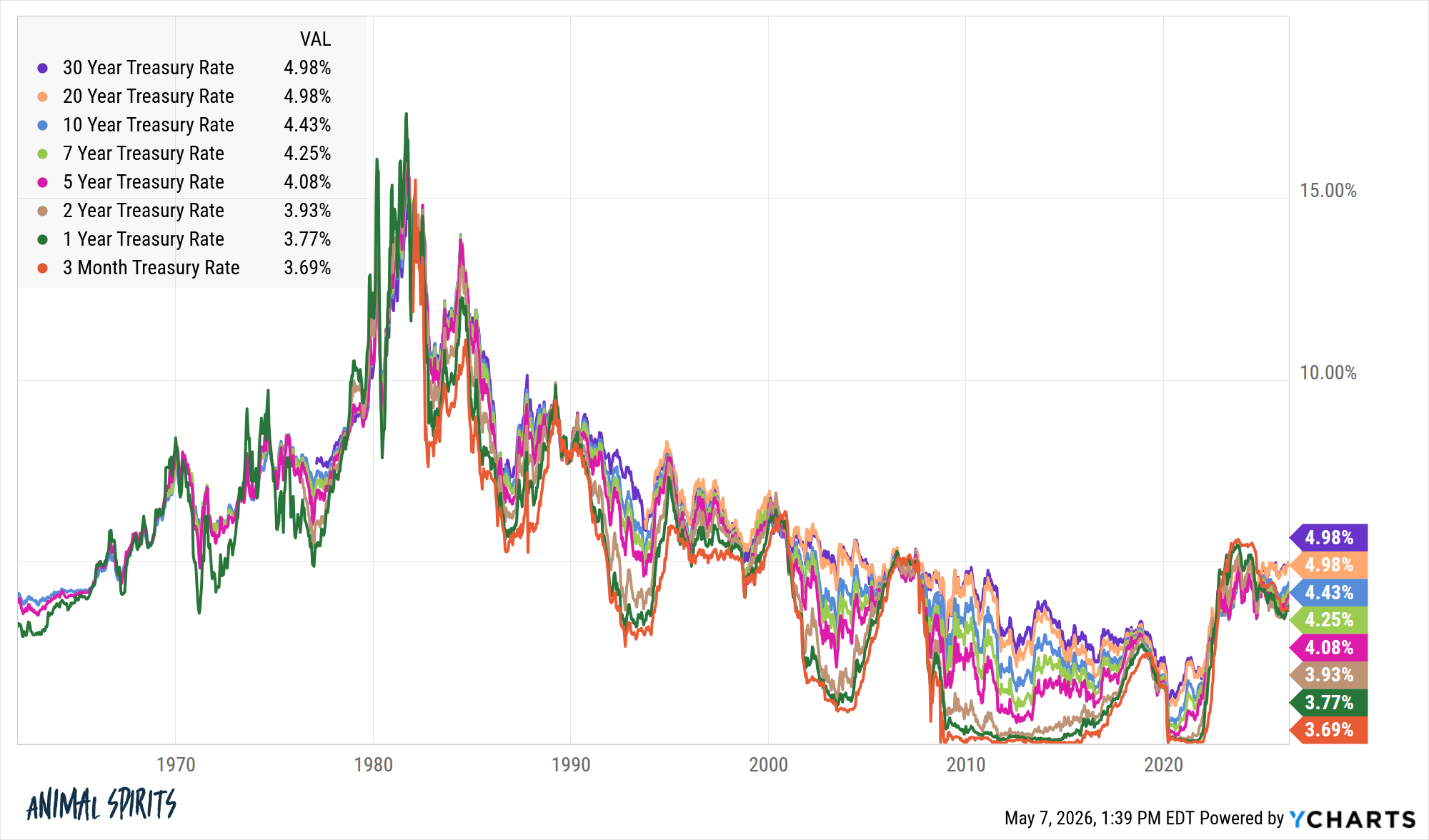
Now we’re back around long-term averages for rates too.
But these yields would have been considered low in the pre-2008 days.
Another concern is the fact that interest expenses are becoming a larger share of the government’s budget. Here’s a good look at it from JP Morgan:
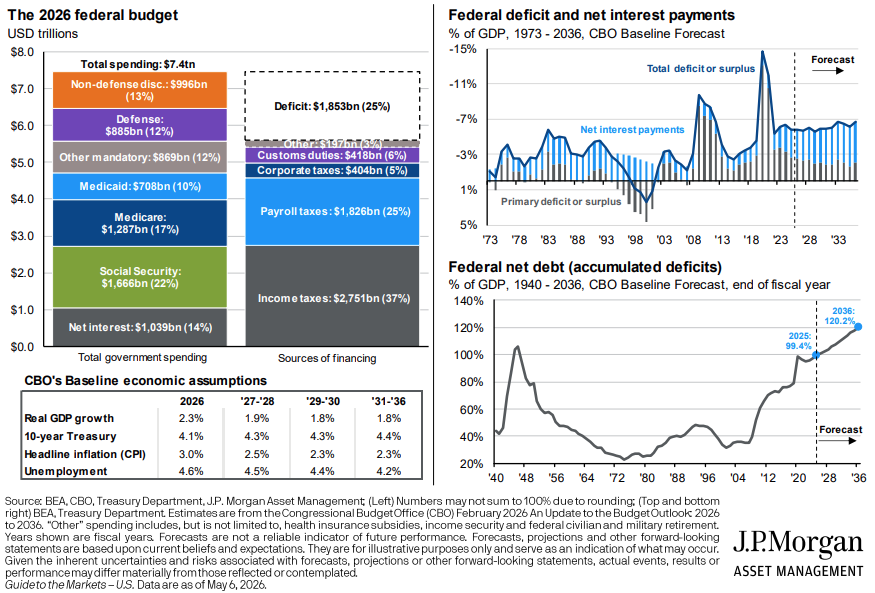
Interest expenses now exceed the defense budget.
The good news is that interest expense as a percentage of GDP is at 1980s levels:
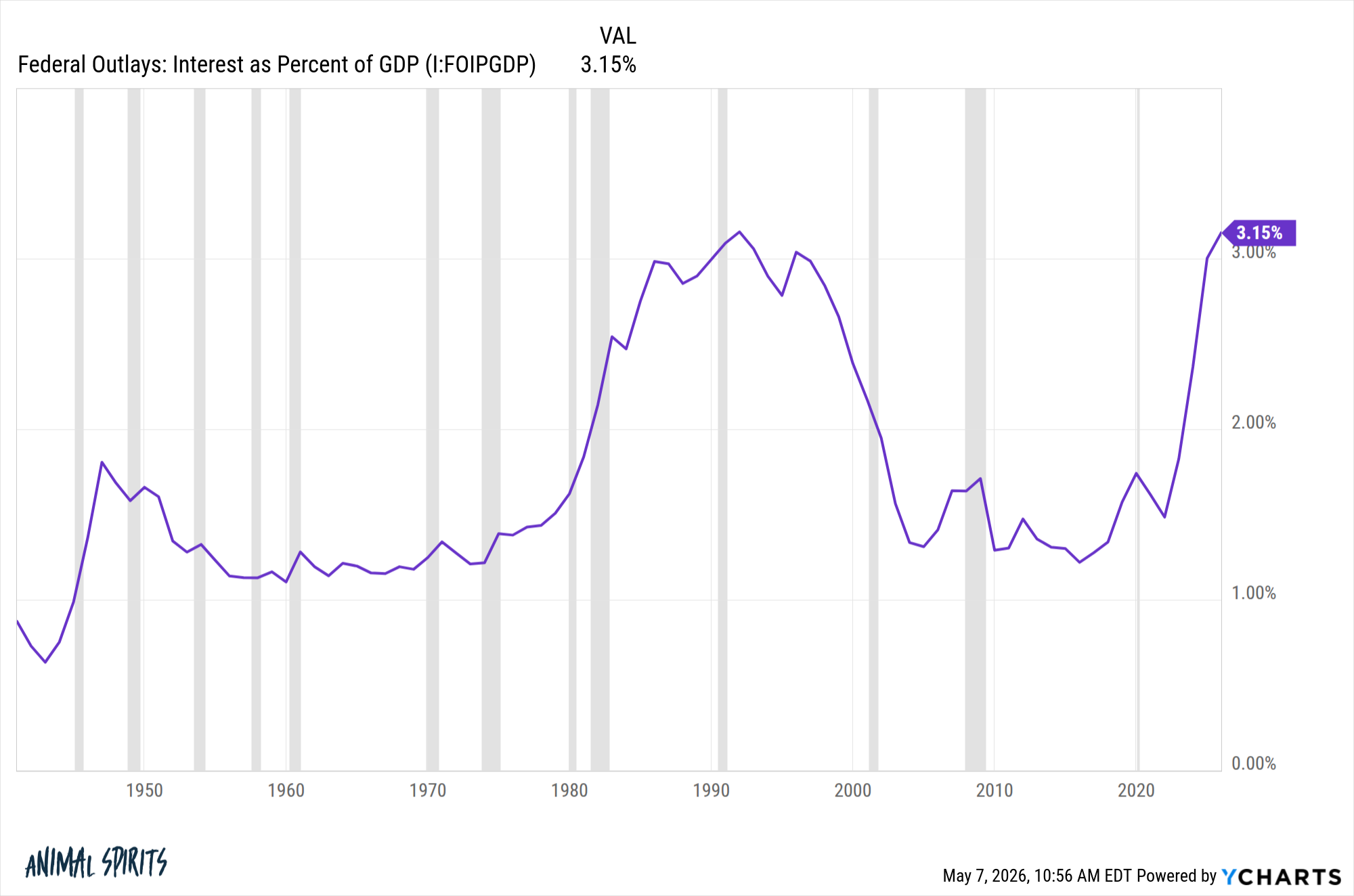
The bad news is that it has risen like a rocket and rates were a lot higher back then.
Does higher government debt have to end badly?
I don’t think it’s a foregone conclusion. It hasn’t ended badly yet despite decades of warnings.
Does this mean never-ending spending is a good thing?
Of course not, especially if it leads to higher levels of rates and inflation. It’s also not great if interest expense eats into other government initiatives.
Is there a line in the sand where a government debt crisis automatically kicks in?
No one knows.
Barry Ritholtz hopped on Ask the Compound with us this week to discuss this question:
We also covered questions about money and happiness, how to invest a pile of cash for a down payment, when to sell concentrated stock positions and how much you should have in your company’s stock.
Further Reading:
When Does the Federal Deficit Matter?
1Unless we want austerity. Ask Europeans how that went for their economies.
