


In December 2024 I wrote that international stocks were the most hated asset class in the world.
Foreign stocks have gone on a nice little run since then.
I’m not taking credit here. Sentiment has become harder than ever to crack. But I’m getting similar vibes today in fixed income.
The most hated asset class in the world right now has to be bonds.
There are a lot of intelligent investors who have been making the case against owning bonds. That case makes sense in a lot of ways.
The government debt train seems to be unstoppable. We have the largest deficit outside of a financial crisis in history. Inflation remains higher. Nominal GDP growth is still high.
Interest rates have been rising. You could make the case that given the current environment, they should be even higher. I’ve talked to a number of fixed income portfolio managers who are surprised bond yields aren’t more elevated.
From a fundamental perspective, bond yields seem to have nowhere to go but up. It seems obvious. Just own other asset classes besides bond.
Here’s the problem — predicting the direction of interest rates, the magnitude of those moves and their timing is very hard.
Shorting bonds might feel obvious but you could also make the case that the easy money has already been lost in fixed income.
The Fed raised rates from 0% to more than 5% in the span of 12 months in 2022 and 2023 and bonds got killed:
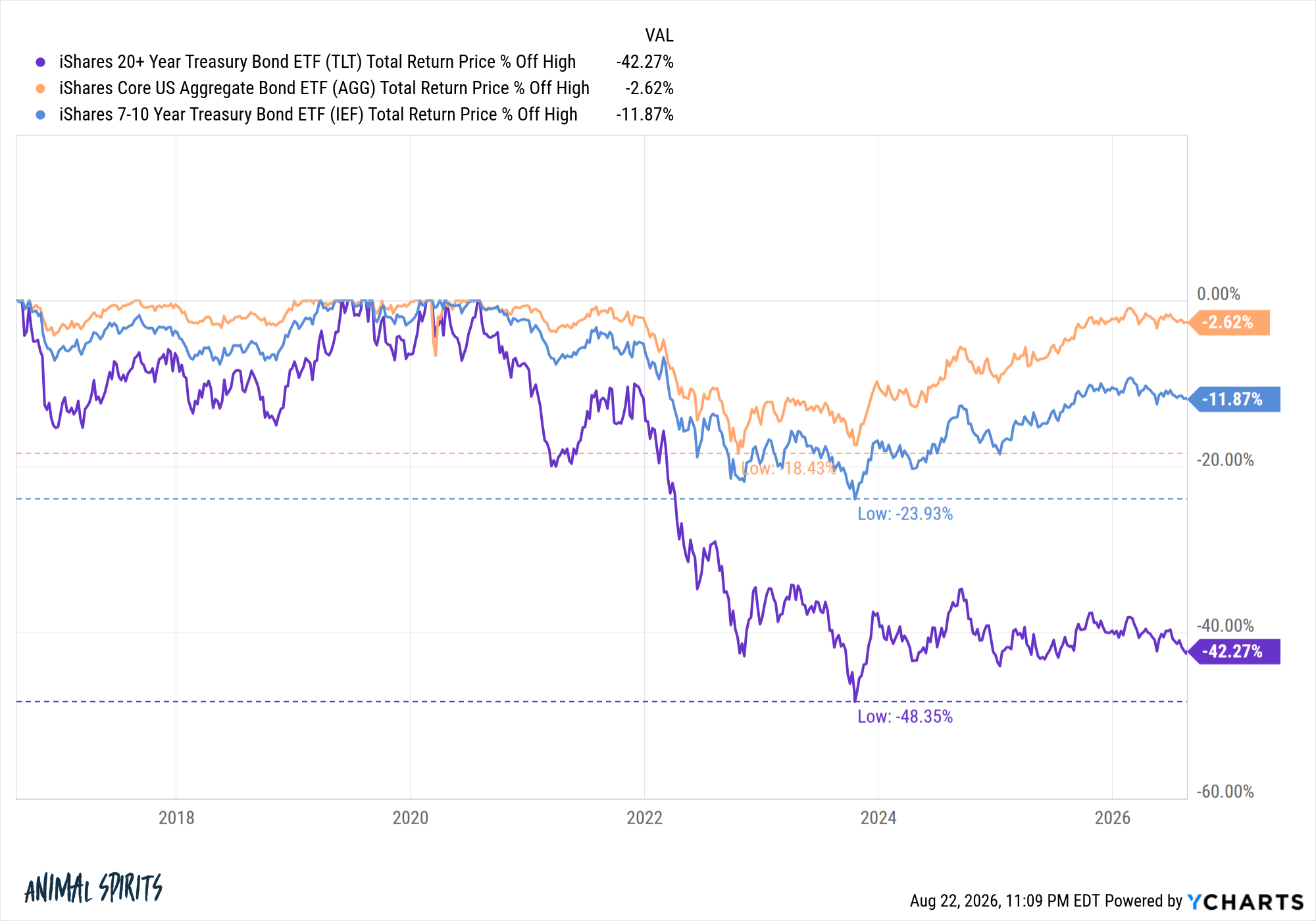
Long bonds got annihilated and haven’t even come close to regaining those losses. The Agg fell almost 20%. The 10 year Treasury also got crushed.1
This was the worst bond market crash in history. Things are even worse if we include inflation.
There’s a very good case to be made that the pain in bonds will continue. Rates might keep going up. Inflation might keep going up. Both of these things would be bad for bonds in the short-run.
I always like to look at both sides of these things to let’s think about the glass-is-half-full case for bonds.
For one thing, bond yields are much higher than they’ve been a very long time. In fact, long bond yields haven’t been this high since 2007, right before the Great Financial Crisis.
Investors in the 2010s and early-2020s would have killed for today’s yields. There’s a bigger margin for safety now.
Although interest rates have risen this year, those higher yields have helped keep the losses for bonds in check:
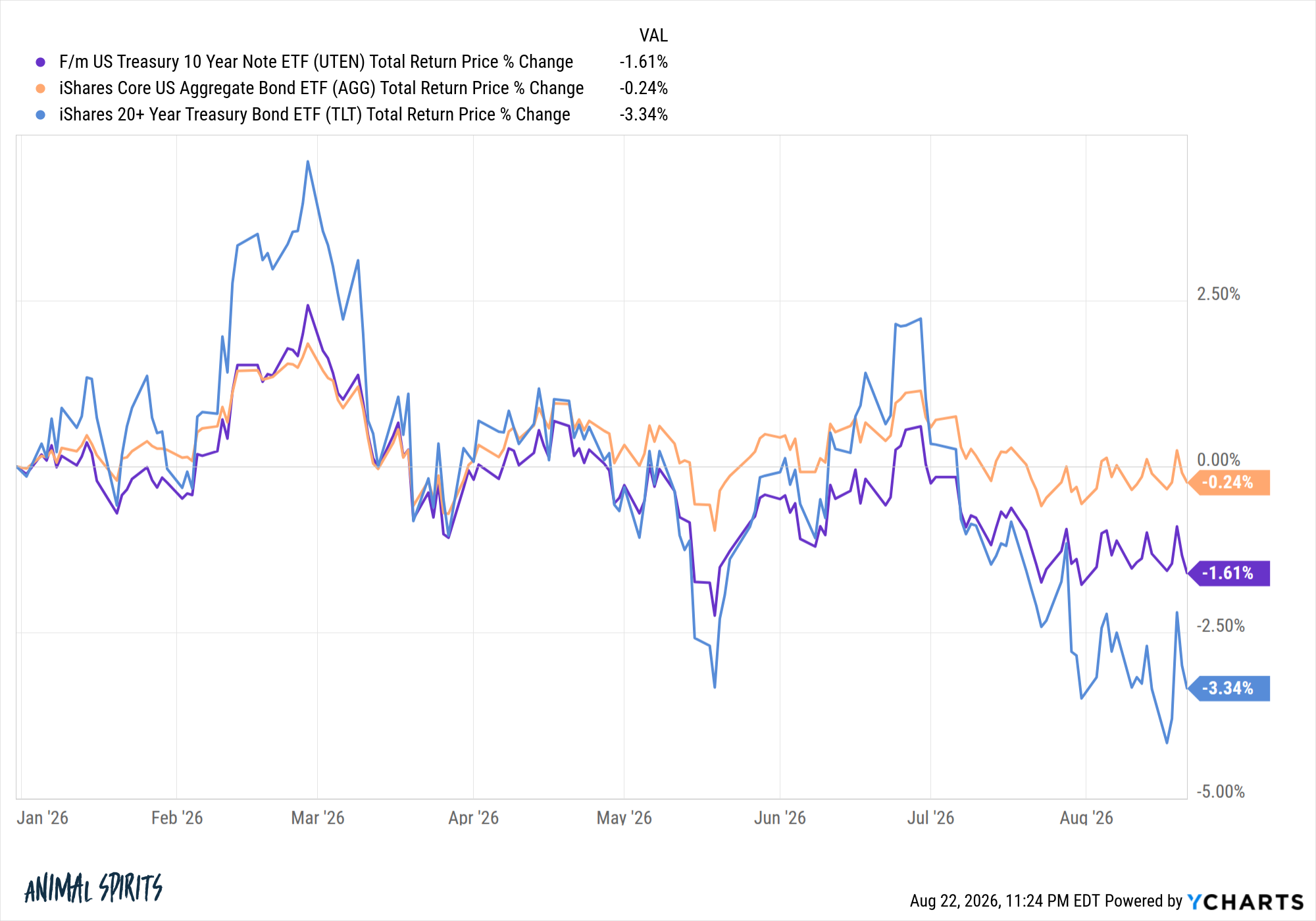
The Agg is essentially flat on the year because yields are almost 5%. Ten year Treasuries are down slightly. Even long bonds, whose long duration makes them much more sensitive to rate changes, are down just 3% or so.
If bond yields do continue to rise, that will cause some pain in the short-run but those higher yields will mean better returns in the future.
It’s also possible bond yields could stay where they are or even fall from current levels. Crazy, I know.
Maybe the war ends and inflation drops. Or maybe the economy slows and that causes rates to fall. We might even have a recession again. If this should happen, bonds will see a nice boost from the combination of higher starting rates and falling yields.
As a reminder, bond yields and bond prices are inversely related. If interest rates rise (fall), bonds prices fall (rise).
This is why every hedge fund manager and macro tourist on the planet wants to short bonds right now. They assume rates are going higher and prices are going lower.
But here’s the interesting thing about bonds — the move down in prices from an increase in rates is smaller than the move up in prices from a decrease in rates.
In finance nerd speak, we call this convexity.
My friends at F/m Investments have a cool tool that allows you to see what happens to bond prices of various maturities if rates rise or fall:
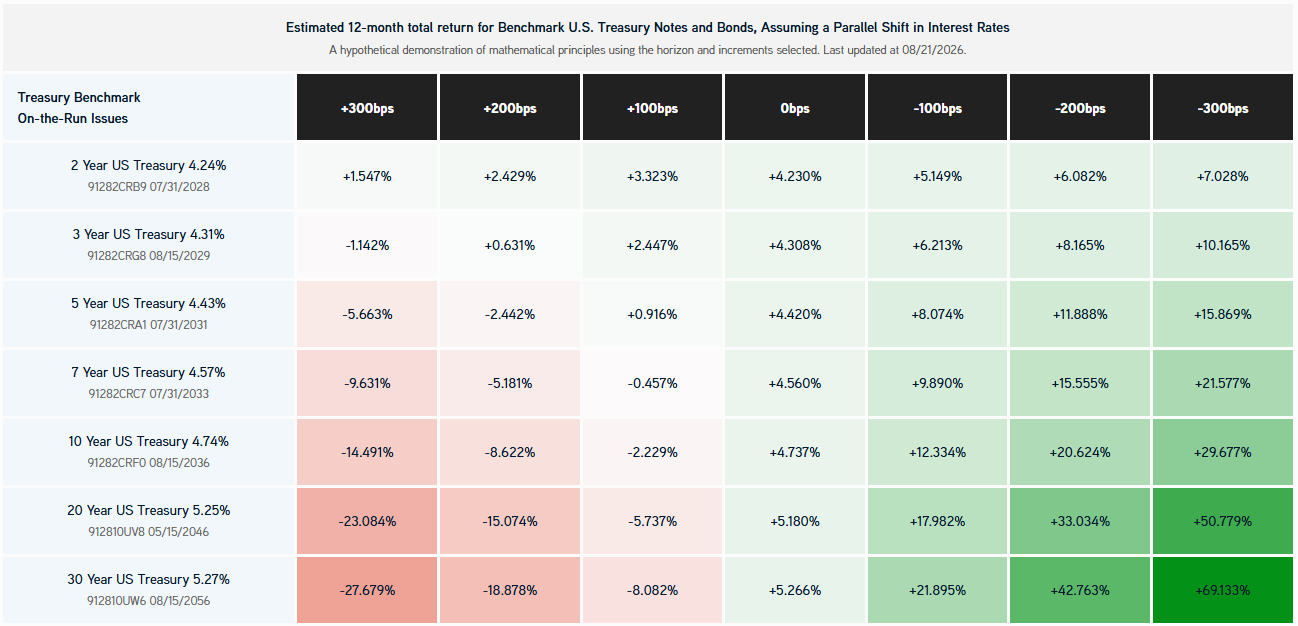
This convexity is not set in stone. It can change over time as bond yields change.
But right now, the gain you would receive from interest rates falling would be far superior to the loss you would experience from interest rates rising.
For example, take a look at the 10 year Treasury. If interest rates were to drop 1% (100 bps), you could expect the 10 year Treasury bond to go up 12% or so in the next 12 months (that’s price appreciation plus the income from the bond).
On the other hand, if bond yields were to rise 1% from current levels, you could expect to lose a little more than 2% over the next 12 months.
The other nerd term for this is an asymmetric return profile. The gain you would receive for an equal-sized move in rates would be larger than the loss from yields rising.
I understand why no one really cares about bonds right now. We’re in a bull market. Who cares about 4-6% yields in fixed income when the stock market is going up 20% every year.
Maybe all of the pundits are right and we are in a new regime of higher inflation and ever-rising rates that will cause a world of pain for bond investors.
But investors will be reminded of the need for bonds during the next recession or bear market. Rates will fall. Bonds will rise.
Everyone will wish they owned more high quality bonds.
There will be stories written about how stupid it was for people to pile into AI stocks when bonds were yielding so much.
Can you believe 5% yields (or 6% or 7% or whatever) were just sitting there and everyone hated bonds!?
No one has time for bonds in a bull market.
Bonds will earn their keep eventually.
I just don’t know when it will happen.
Further Reading:
Why Investors Are Holding More Cash
1It’s important to note these drawdowns include the income eanrned on the bonds.
