


A reader asks:
What are top 10 prudent indicators a retail investor needs to know before stepping into equities?
Well there are no indicators in the stock market that are foolproof so I’m going to give you 10 things you need to know about the stock market before investing.
I included 50+ charts and data tables in Risk & Reward so let’s make this a visual list.
Here are 10 things you need to know about the stock market:
1. Stocks mostly go up but sometimes they go down. The U.S. stock market has been up 3 out of every 4 years on average since the late-1920s but most years have a double-digit peak-to-trough drawdown at some point along the way:
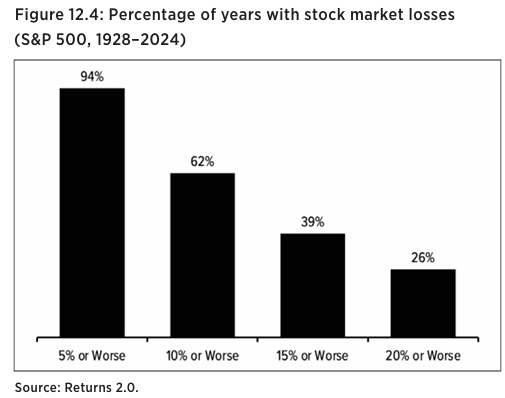
Occasional downturns in the stock market are perfectly normal. You have to get used to losing money if you want to survive the stock market.
2. Returns are lumpy. Life would be easier if you could clip a consistently high return year in and year out. Alas, the stock market doesn’t work like that:
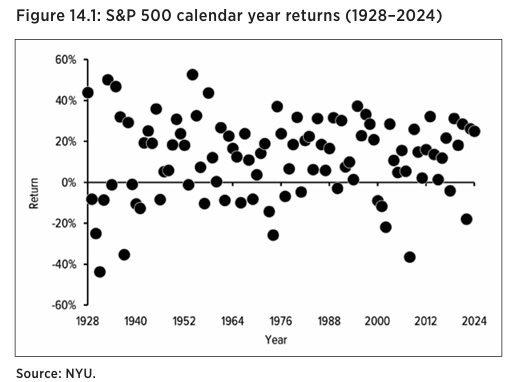
Returns from year to year are all over the map. The up years tend to be really good while the down years can be a painful reminder that it’s called a risk premium for a reason.
Investing in the stock market means getting used to an uneven return stream.
3. Volatility can be bone-crushing. In the book I look at the worst days, months and years in stock market history. These are the worst monthly returns:
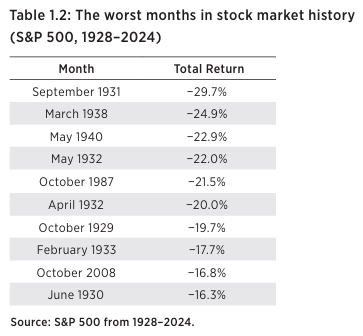
The speed of loss you can experience in the stock market is something that takes time to get used to.
Downturns can happen in a hurry.
4. Bad times are usually followed by better times (and vice versa). Now here’s what happened after those awful months:
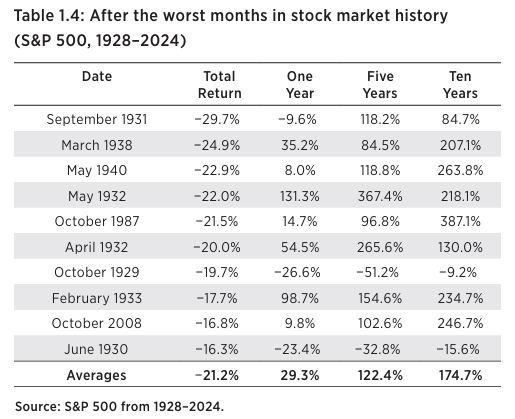
There’s no guarantee that bad returns will immediately lead to good returns. But most of the time terrible declines signal higher expected returns.
And eventually, the good returns lead to bad returns.
It’s the stock market circle of life.
5. Trends can last longer than you could imagine. I was there in the aftermath of the Great Financial Crisis. Literally no one predicted we were about to embark on one of the great bull market runs of all-time.
In fact, people were predicting a new normal of lower returns.
These secular cycles can trend for much longer than you think…in both directions:
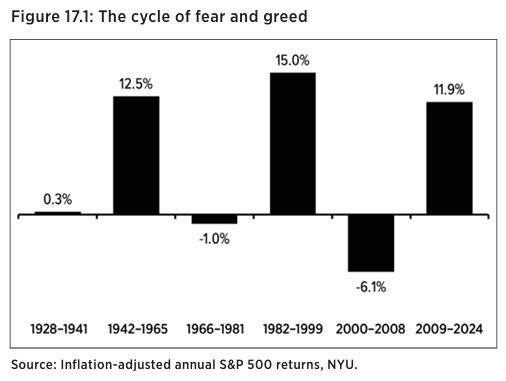
Periods of above average returns and periods of below average returns can last much longer than most people realize.
6. There is no such thing as average. In the past 100 years or so the U.S. stock market is up 10% per year. But you basically never get a 10% return in a given year.
This is the distribution of stock market returns:
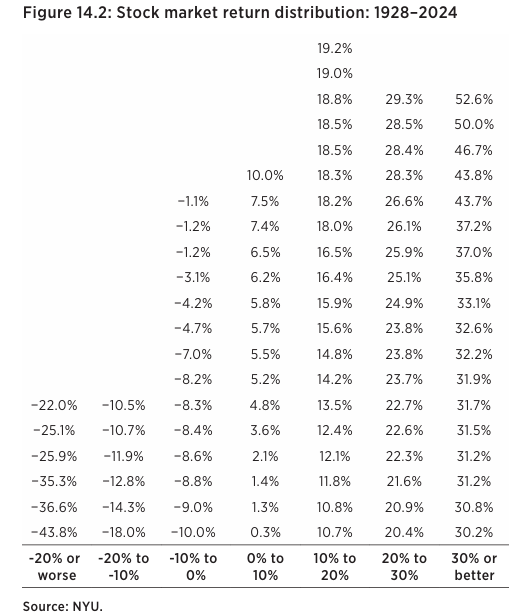
The long-term average rarely happens over the short-term.
There is no such thing as an average experience in the stock market until you’ve been investing for a very long time.
7. There are always caveats and exceptions. Now show Japan is pushback I’ve been dealing with for over a decade.
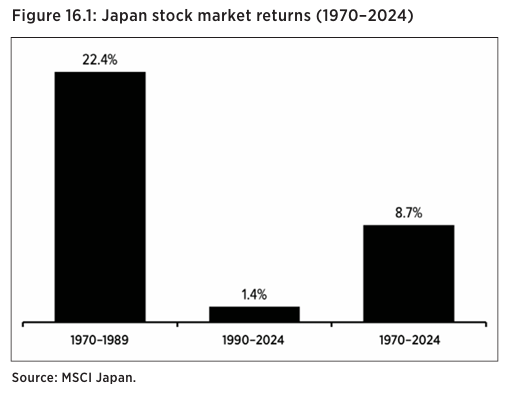
Nothing works always and forever.
No one outperforms all the time.
Every investing rule of thumb has exceptions.
It has to be this way because that’s how risk works.
8. Stock markets haven’t been around very long. This is one of my favorite charts from the book:
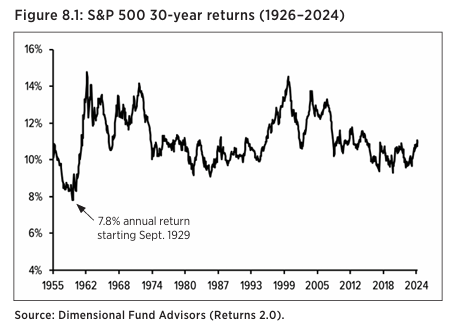
It shows rolling 30 year annual returns for the U.S. stock market starting in 1926. I’ve highlighted the worst 30 year annual return of all-time which is 7.8% per year.
It’s kind of amazing to think that the worst 30 year return over the past 100 years was a gain of nearly 850% in total.
But if you think about this another way, there have only been three non-overlapping 30 year periods in modern stock market history.
Historical data is the best we can do but the stock market is still relatively new in the grand scheme of things. This is why things that have never happened before seem to happen all the time now.
The market loves to keep you on your toes.
9. Stocks don’t always win. These are the major asset class returns by decade going back to the 1930s:
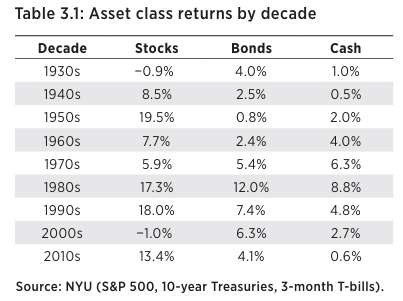
Government bonds have outperformed the U.S. stock market over two different decade-long periods. T-bills have outperformed stocks in three different decades.
The stock market is your best bet for higher expected returns over the long haul but you can still underperform other asset classes over relatively long time frames.
10. It pays to be optimistic. Long-term returns are the only ones that matter and the longer you invest in the stock market, the higher your odds of walking away with a gain:
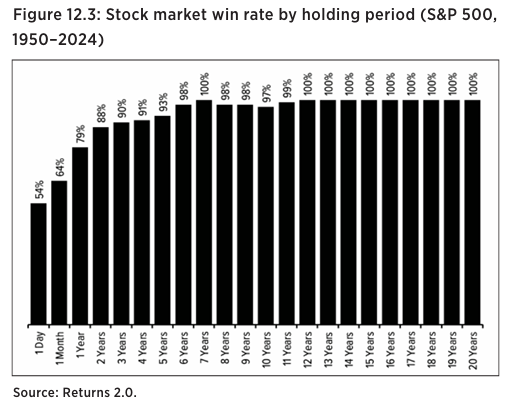
The stock market remains the best casino ever invented.
I answered this question on an all-new episode of Ask the Compound:
Bill Sweet helped us answer other questions about the best way to transfer old retirement accounts, managing a variable income, how to create a checklist for financial planning purposes, when to sell stocks in your child’s college fund and hardware vs. software.
Further Reading:
Risk & Reward
