


Through the end of September, these are the annual returns over various time frames for the S&P 500:
- 3 years +22.9%
- 7 years +16.2%
- 10 years +15.3%
- 15 years +15.7%
- 20 years +11.2%
- 30 years +10.3%
- 40 years +11.5%
- 50 years +11.9%
The average annual return over the past 100 years or so is 10% per year.
Everything from 20 years to 50 years are pretty close to the long-term average. But 15 years and down the returns are squarely above average.
Eventually above average returns lead to below average returns because, well, math. But mean reversion can take longer than you think. Just ask all of the people who have been screaming about high valuations since the mid-2010s.
Look at the rolling 15 year annual returns for the past 100 years of data:
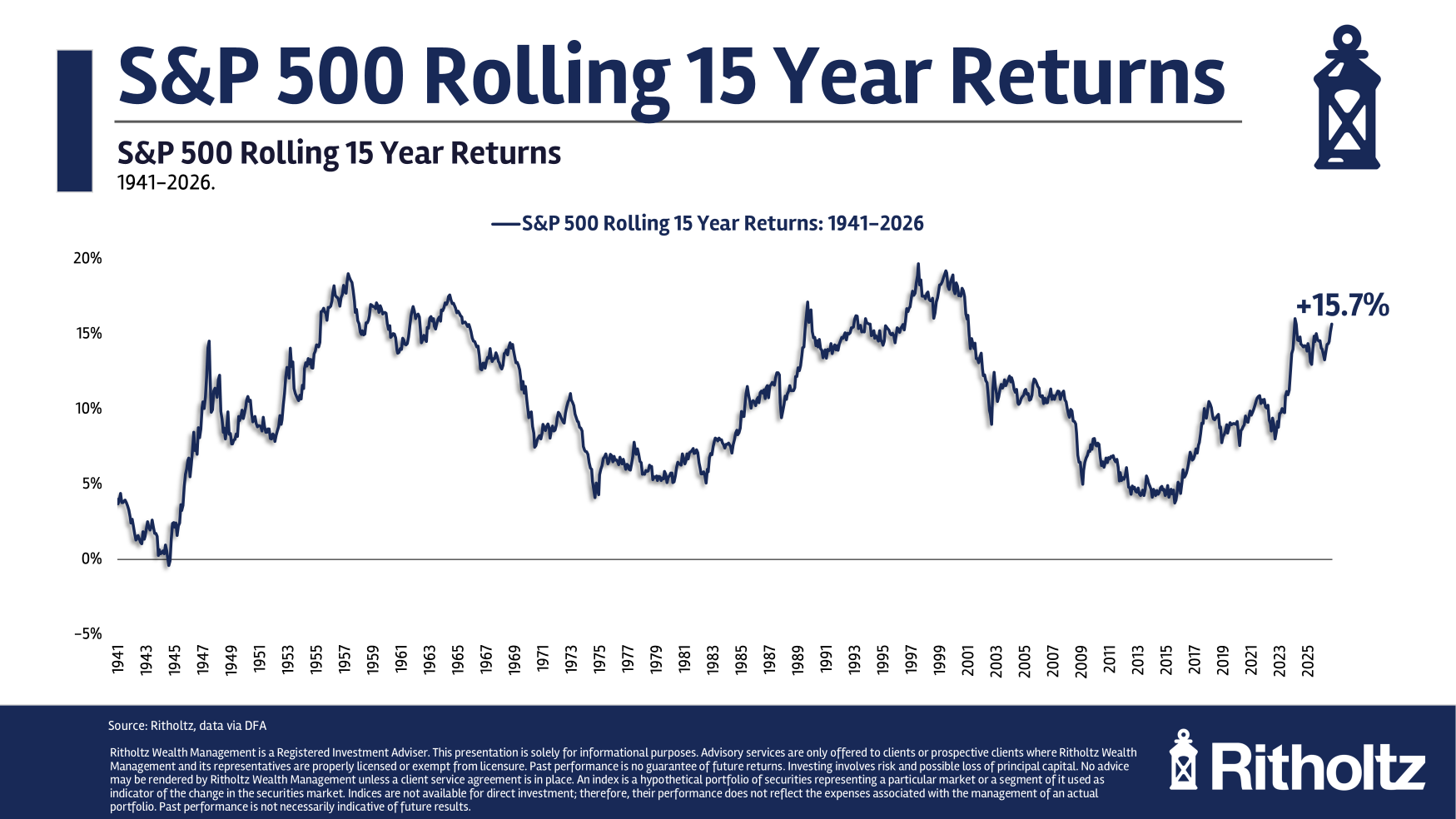
The longer-term cycles are pretty clear here. It’s like a wave that moves from good returns to bad returns.
The good and bad cycles can take some time to play out.
The natural follow-up here is how much longer will the current cycle of above average returns last?
The only honest answer is nobody knows.
But it is worth providing some context in terms of historical precedent. This thing could keep going even higher. The AI boom could take us to the dot-com or post-WWII heights.
It wouldn’t shock me.
This is the S&P 500 from 1995-1999:
- 1995 +37.2%
- 1996 +22.7%
- 1997 +33.1%
- 1998 +28.3%
- 1999 +20.9%
And this was at the tail-end of a two decade-long bull market.
Now look at the returns since 2019:
- 2019 +31.2%
- 2020 +18.0%
- 2021 +28.5%
- 2022 -18.0%
- 2023 +26.1%
- 2024 +24.9%
- 2025 +17.8%
- 2026 +12.8% (so far)
Not a perfect one-for-one but we’ve had a pretty good run. Maybe we have a melt up coming our way.
It’s also worth pointing out the sample size here is very small. We’re essentially talking about three gigantic bull markets (including the current iteration) along with three bone-crushing secular bear markets.
Maybe the cycles will happen faster in the future or these return streams will be more uneven.
We shall see. These things aren’t written in stone.
For well over a decade there have been investment professionals telling you to expect lower than average returns in the future.
The opposite has happened.
However, it’s not the worst thing in the world to rein in your expectations for future returns, even if the bull market still has some years left to go.
Lower expectations in your investment plan gives you a bigger margin of safety.
If bad things happen, you’re prepared.
If good things continue to happen, it’s a nice surprise to the upside.
Win-win.
Further Reading:
When is Mean Reversion Coming in the Stock Market?
This content, which contains security-related opinions and/or information, is provided for informational purposes only and should not be relied upon in any manner as professional advice, or an endorsement of any practices, products or services. There can be no guarantees or assurances that the views expressed here will be applicable for any particular facts or circumstances, and should not be relied upon in any manner. You should consult your own advisers as to legal, business, tax, and other related matters concerning any investment.
The commentary in this “post” (including any related blog, podcasts, videos, and social media) reflects the personal opinions, viewpoints, and analyses of the Ritholtz Wealth Management employees providing such comments, and should not be regarded the views of Ritholtz Wealth Management LLC. or its respective affiliates or as a description of advisory services provided by Ritholtz Wealth Management or performance returns of any Ritholtz Wealth Management Investments client.
References to any securities or digital assets, or performance data, are for illustrative purposes only and do not constitute an investment recommendation or offer to provide investment advisory services. Charts and graphs provided within are for informational purposes solely and should not be relied upon when making any investment decision. Past performance is not indicative of future results. The content speaks only as of the date indicated. Any projections, estimates, forecasts, targets, prospects, and/or opinions expressed in these materials are subject to change without notice and may differ or be contrary to opinions expressed by others.
The Compound Media, Inc., an affiliate of Ritholtz Wealth Management, receives payment from various entities for advertisements in affiliated podcasts, blogs and emails. Inclusion of such advertisements does not constitute or imply endorsement, sponsorship or recommendation thereof, or any affiliation therewith, by the Content Creator or by Ritholtz Wealth Management or any of its employees. Investments in securities involve the risk of loss. For additional advertisement disclaimers see here: https://www.ritholtzwealth.com/advertising-disclaimers
Please see disclosures here.
