


A reader asks:
I’m 16 months out from retirement and am looking at shifting my dozen or so mutual funds with Vanguard to a firm that invests in stocks that pay dividends. The idea is to draw enough off the dividends without having to sell the stock. They design a portfolio based on my risk tolerance, a % of my assets that I would be willing to lose, for me that’s 10 to 15%. So the overall yield with that risk tolerance would probably be lower. By not selling the stock I don’t need to be so concerned if the market is up or down at any particular time. Over time the market does go up so in theory I could go 5 yrs or 10 yrs without having to sell and during that time the market should go up for those stocks. The portfolio is 70-90 stocks and some bond funds. It’s actively managed and they charge 0.6%. Just wanted to get your opinion if this is a good strategy. I have about $540k in assets and am thinking of putting about $400k into this.
This is the retirement dream.
Live off the income. Never touch the principal.
Dividends from your stock portfolio can be a useful part of your retirement plan but these parameters make it sound like more of a pipe dream to me.
First of all, when a company pays a dividend the share price tends to drop by that amount. If you own a stock that trades for $100 and they pay you a $2 dividend the new share price will likely be more like $98 after payment.
How could it not? The company now has less cash on it’s balance sheet.
Dividends aren’t free money.
It is true that dividends can provide you with a different type of income stream than bonds or other types of fixed income. The reason for this is that dividends tend to grow over time.
This is S&P 500 rolling 12-month dividend growth since 1950:
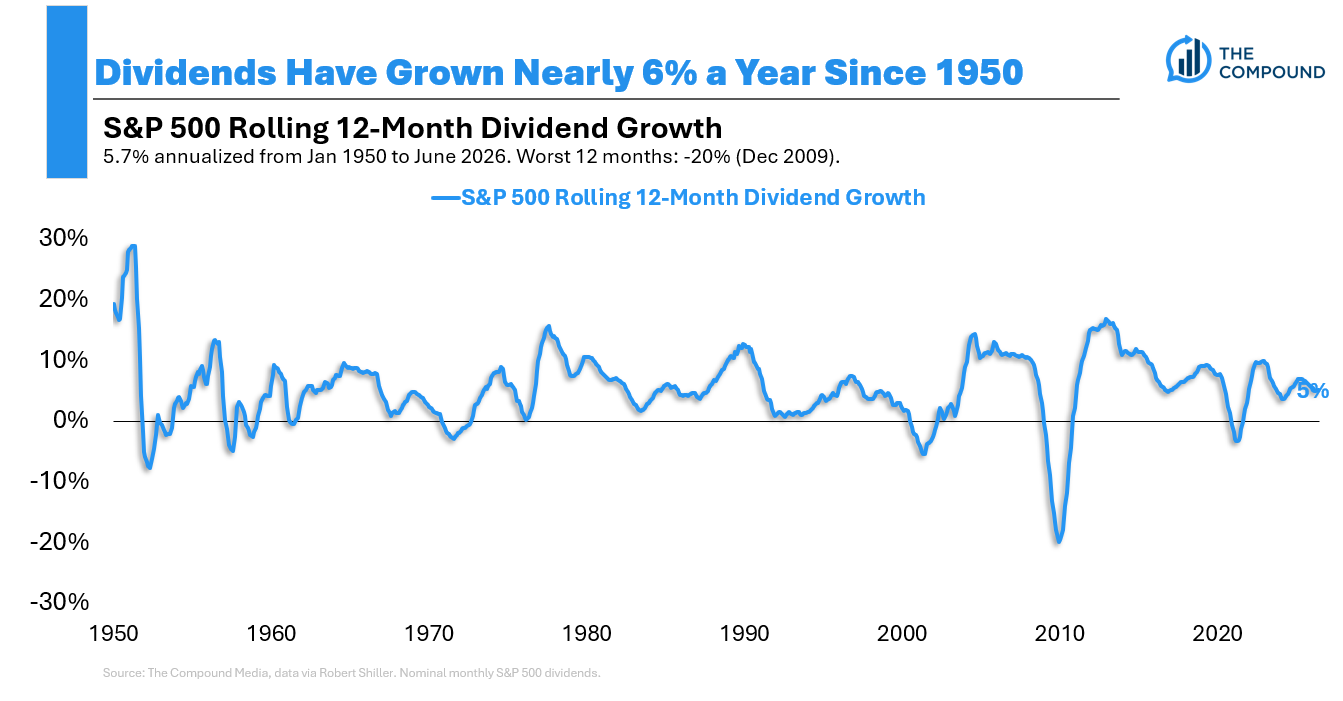
The annual growth rate of 6% in this time outpaced the average 3.5% inflation rate. Having an income stream that can grow faster than the rate of inflation is a good thing, especially in retirement.
Unfortunately, dividends don’t always rise. You can see there have been a number of times when dividends fell, most notably in the Great Financial Crisis.
Here’s another way to look at the drawdowns in dividends in this time frame:
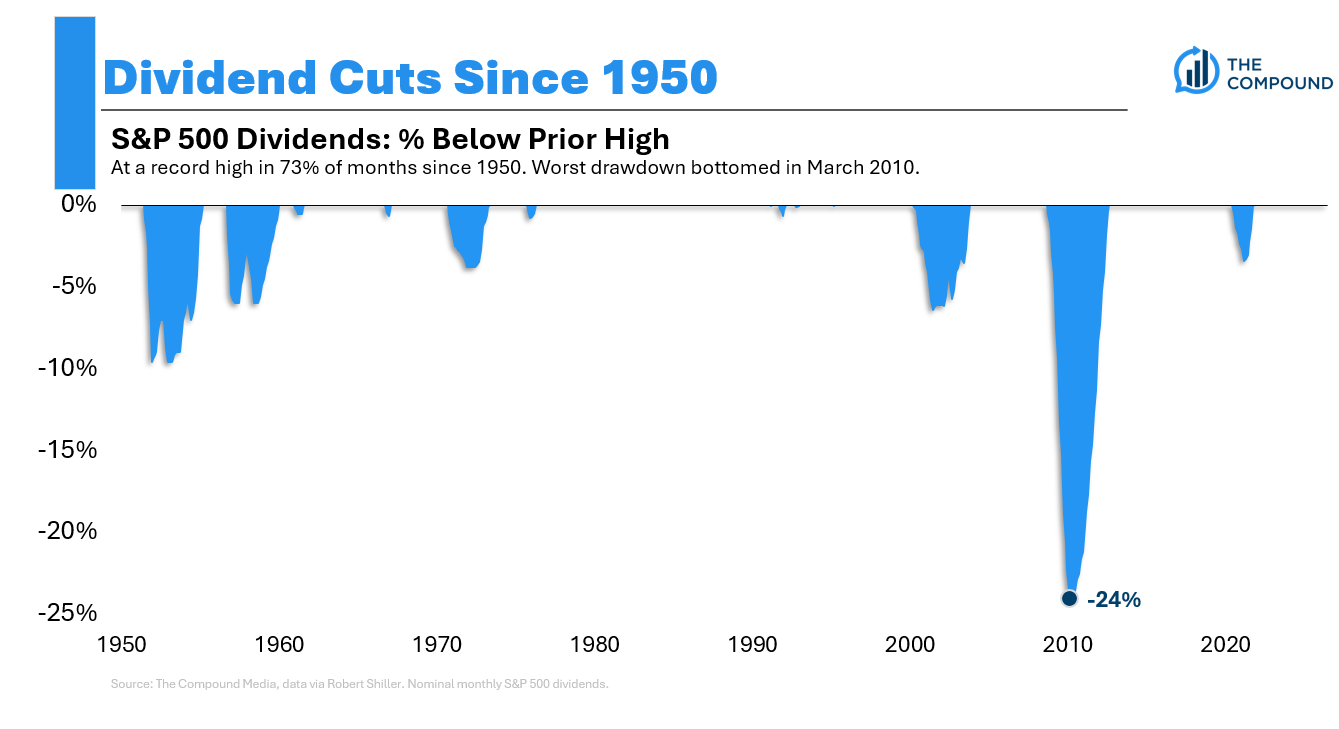
The good news is that cash flows have a much better drawdown profile than stock prices. The stock market dropped 33% in a week following the 1987 crash. Dividends didn’t fall at all.
When the S&P 500 crashed 56% in the financial crisis, dividends fell by just 24%.
It’s no fun to see your income go down by one-quarter but dividends tend to have more durable downside protection than the stock market as a whole.
The biggest problem here is not utilizing a dividend investment strategy. The problem is the drawdown expectations.
A risk appetite that states you want to keep your drawdowns to 10-15% while holding mostly dividend-paying stocks is simply not reasonable.
You either need to take less risk (by owning more cash or bonds) or live with more volatility than that.
These are the drawdowns for three of the biggest dividend ETFs:
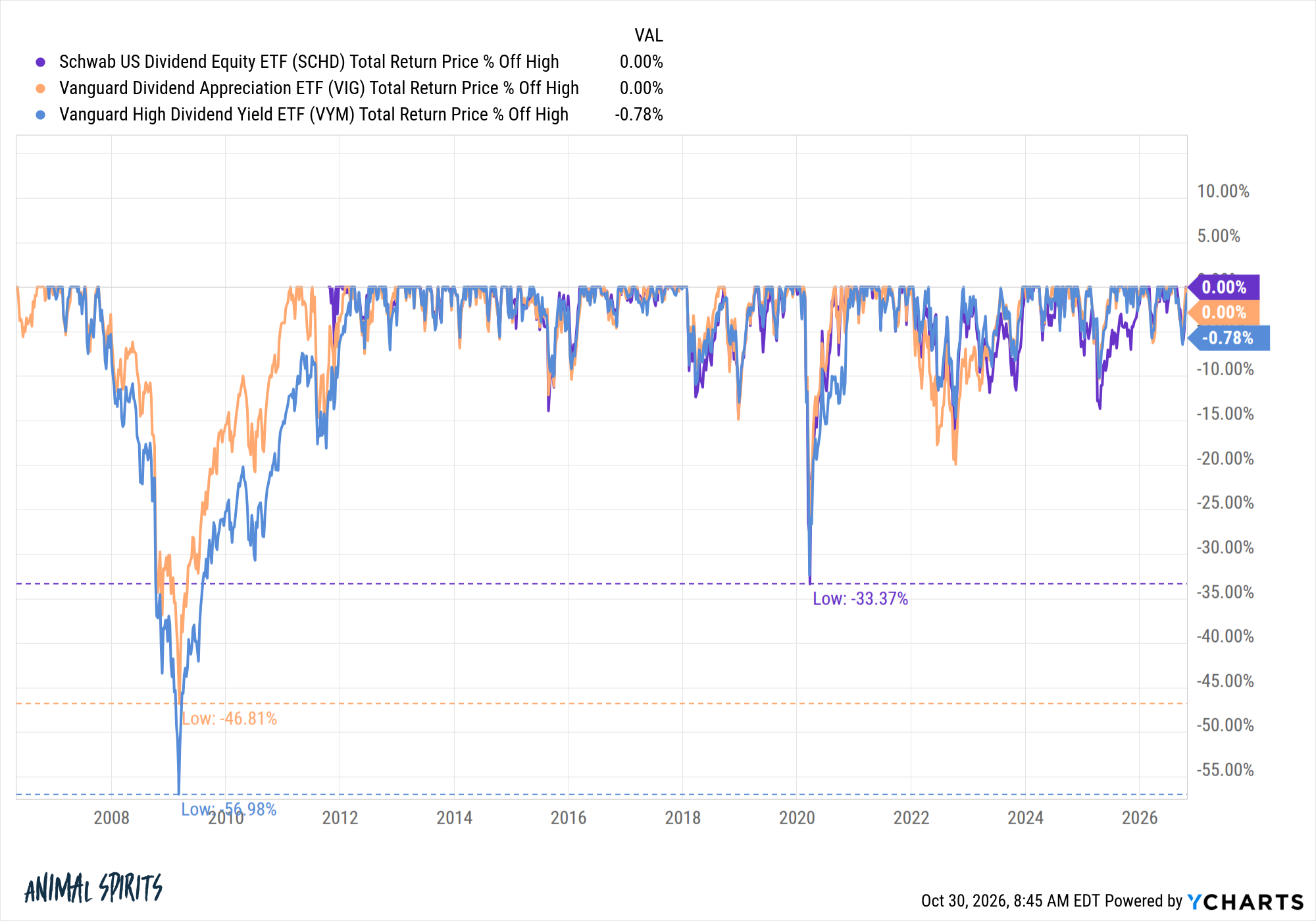
Maybe this advisor has a different approach to dividend investing. There are certainly many stocks that pay out higher yields and grow their dividends at a higher rate than the S&P.
But dividend stocks are still stocks. They have drawdown risk. Losses of 10-15% simply aren’t reasonable.
Income is great and all but total return is really the only thing that matters over the long run so you should hope for some growth in these companies too.
You should also ask this investment advisor what else they can do for you.
Are they just building you a portfolio?
Or are they also providing financial planning advice?
Are there tax considerations?
You need to understand what you’re getting for the fee you’re paying. A portfolio is not the same thing as a plan.
Every investor would love to find portfolio nirvana. All of the upside none of the downside. Living off the income in your portfolio without a care in the world.
Most investment plans don’t fail on paper. They fail when reality diverges from expectations and you overreact by abandoning your plan at the worst possible time.
Can you live off your dividends?
Maybe.
But if you want a high portfolio yield you need to become comfortable with some volatility.
This is the nature of risk and reward.
I covered this question on an all-new episode of Ask the Compound:
We also discussed questions about when to shift into bonds, simple vs. complex portfolios, saving for a down payment, investing clubs and more.
Further Reading:
Can You Live Off Your Dividends?
