

I love this passage from Bill Gurley’s new book Runnin’ Down a Dream about a commencement speech from Jerry Seinfeld:
“I can’t imagine how sick you are of hearing about following your passion,” he said. “I say, the hell with passion.”
He suggested letting go of the notion that you absolutely must find “this one great thing” that inspires you to tear open your shirt and heave like Marlon Brando in A Streetcar Named Desire. “It’s embarrassing,” he said. “We don’t need the heavy breathing and the outstretched arm from your passion. It makes coworkers uncomfortable in the cubicle next to you.”
Instead, Seinfeld suggested a different word.
“Find fascination,” he told the audience. “Fascination is way better than passion. It’s not so sweaty.”
Find your passion is a cliche at this point.
I certainly didn’t have a passion I could turn into a paycheck. I had no idea what I wanted to do when I graduated college.
An internship turned into an entry level analyst position that made me realize I had a lot to learn. So I dove headfirst into every investing book I could get my hands on — One Up on Wall Street, The Intelligent Investor, The Warren Buffett Way, Poor Charlie’s Almanack, etc.
Reading about the markets grew my fascination. I quickly realized markets go way beyond numbers and data. Markets are about people, behavior, incentives and emotions.
I didn’t have much experience investing so studying market history, legendary investors and financial crises gave me a crash course.
That led me to read more about psychology, history and biographies. Reading fiction helps too from a storytelling and creativity perspective.
The secret sauce of bettering yourself in the finance industry is some combination of communication, sales, analysis and process.
I’ve had some amazing mentors but reading was by far the biggest supercharger for my career. Reading helped me become a better writing, talking and thinker about the markets.
I found my fascination through reading books.
Unfortunately, reading is becoming a lost art for a lot of people.
The Atlantic recently had a long piece called The End of Reading is Here:
According to the National Endowment for the Arts, which conducts the most comprehensive survey of the nation’s reading habits, fewer than half of all adults reported having read a book of any kind in 2022. Only 38 percent read a novel or short story. A study analyzing 236,000 responses to the American Time Use Survey found that the proportion of Americans who read for pleasure on any given day fell from 28 percent in 2004 to 16 percent in 2023. (The study looked at people who had read a book, magazine, or newspaper; listened to an audiobook; or read an e-book.) Gambling has become a more common leisure activity than reading a book: Last year, 57 percent of Americans placed a bet.
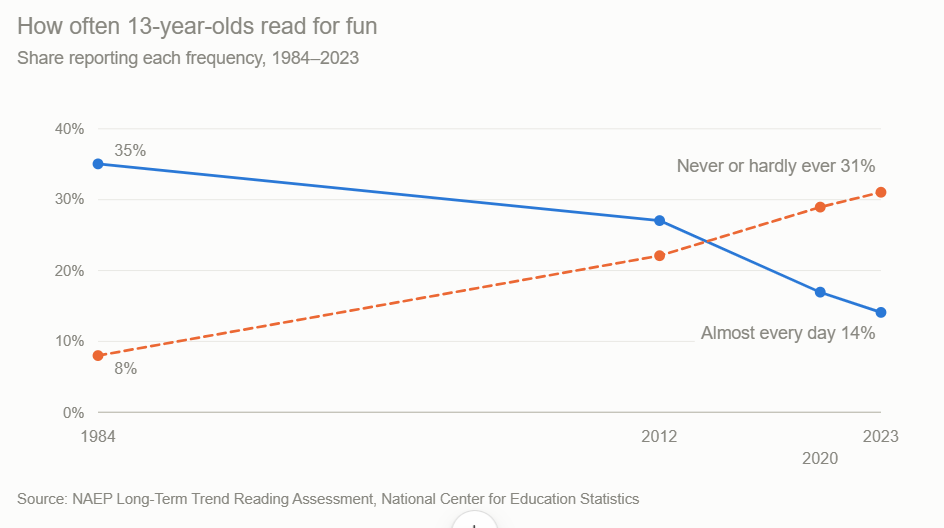
This is especially true for young people:
I understand there are plenty of other ways to learn today than in the past. You can listen to podcasts, watch YouTube or chat with an LLM.
But those are shortcuts in many ways. There is still value in reading books.
Want to become a better writer? Read more books.
Want to become a better communicator? Read more books.
Want to become more knowledgeable about your field? Read more books.
I truly believe you can still gain an edge over others by simply reading more.
Reading helps you find your fascination.
Further Reading:
Chauffeur Knowledge
This content, which contains security-related opinions and/or information, is provided for informational purposes only and should not be relied upon in any manner as professional advice, or an endorsement of any practices, products or services. There can be no guarantees or assurances that the views expressed here will be applicable for any particular facts or circumstances, and should not be relied upon in any manner. You should consult your own advisers as to legal, business, tax, and other related matters concerning any investment.
The commentary in this “post” (including any related blog, podcasts, videos, and social media) reflects the personal opinions, viewpoints, and analyses of the Ritholtz Wealth Management employees providing such comments, and should not be regarded the views of Ritholtz Wealth Management LLC. or its respective affiliates or as a description of advisory services provided by Ritholtz Wealth Management or performance returns of any Ritholtz Wealth Management Investments client.
References to any securities or digital assets, or performance data, are for illustrative purposes only and do not constitute an investment recommendation or offer to provide investment advisory services. Charts and graphs provided within are for informational purposes solely and should not be relied upon when making any investment decision. Past performance is not indicative of future results. The content speaks only as of the date indicated. Any projections, estimates, forecasts, targets, prospects, and/or opinions expressed in these materials are subject to change without notice and may differ or be contrary to opinions expressed by others.
The Compound Media, Inc., an affiliate of Ritholtz Wealth Management, receives payment from various entities for advertisements in affiliated podcasts, blogs and emails. Inclusion of such advertisements does not constitute or imply endorsement, sponsorship or recommendation thereof, or any affiliation therewith, by the Content Creator or by Ritholtz Wealth Management or any of its employees. Investments in securities involve the risk of loss. For additional advertisement disclaimers see here: https://www.ritholtzwealth.com/advertising-disclaimers
Please see disclosures here.
