

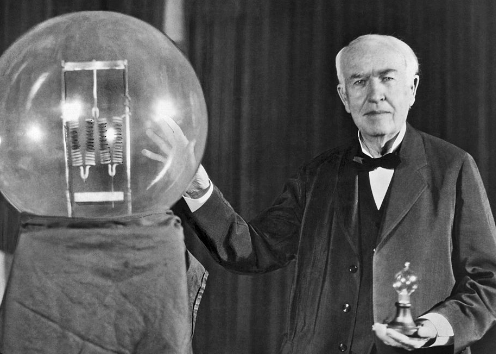
Thomas Edison was once called, “the world’s greatest investor and the world’s worst businessman.”
A magazine editor dubbed Edison “the most difficult husband in America.”
No one has it all, I guess.
Edison helped push forward the light bulb, phonograph and motion picture camera. By most accounts, he was also a complex person who put his work above everything else in his life.
One story came from a friend who happened to be walking by Edison’s lab late one night. He found Edison dozing off at his desk in the lab.
“What time is it?” asked Edison.
“Midnight,” replied the friend.
“Is that so?” replied Edison who was still waking up from his nap. “By George. I must go home, then. I was married today.”
The guy was in the lab on his wedding night.
Here’s another story from The Wizard of Menlo Park that explains how difficult it was for his wife to get him to leave the laboratory:
A man who did odd jobs around the Menlo Park lab, for example, tells a story of how Mrs. Edison managed to get Mr. Edison home, where she “dolled him up in a fifty-dollar suit.” Edison stayed put for a short while “looking pretty,” then fled for the lab. In the tale, Edison was found at the lab two weeks later, still wearing the same suit, having not been home the whole week.
Edison probably didn’t need to work as hard as he did to achieve his goals. But his personality was such that cutting back on his work simply wasn’t an option. The traits that helped him excel as an inventor also made him a terrible husband.
When I was younger these kinds of stories about people who worked around the clock to create something magical were inspirational. Now that I’m older and my priorities have changed I find these stories sad.
I respect the accomplishments and innovations, but I don’t envy the person anymore.
Don’t get me wrong, I enjoy working. Striving to get better and work on interesting or challenging projects is important to me. But spending your entire life focused on work seems like a waste.
Maybe it’s a personality thing (I am not a type A at all) or just the stage of life I’m at with young children. I can’t imagine making work my sole priority in life.
Patrick O’Shaughnessy had Michael Ovitz on Invest Like the Best recently. Ovitz is the founder of CAA, the most dominant talent agency ever created in the entertainment business. Ovitz talked about what it takes to be a good founder:
I don’t know a founder that I’ve worked with anywhere that isn’t driven like the snow. And if you can’t keep that pace up for 20 years, and I mean that, there’s no business I’ve ever seen that can get up and running in under seven to 10 years. I don’t know why it’s that number. But if you look around and start seeing when did businesses hit critical mass, it’s seven to 10 years.
And if you don’t have the energy and the desire and that burning sensation in your gut and the fear of failing and a desire to make it for the right reasons, and it can’t just be financial, by the way. You got to want to do something with your gains that’s socially important. That’s a very important item for me, don’t do it, don’t do it, don’t do it. I’ve been blessed with meeting really great founders and working with some of the brightest young people in our country.
I think that if you don’t want to put the time and effort in and you don’t have a belief — if you don’t believe in your idea, don’t start a business. And if you can’t do momentum, I did 250 calls a day.
Ortiz talked about working 7 days a week, day and night, for 20 years straight to build his business.
This was a theme in Ovitz’s biography Who is Michael Ovitz? as well. I went back to my Kindle notes1 from the book and this passage stood out to me on review:
In 1979, when I was thirty-three, Ted Ashley at Warner Bros. took me aside and said, “I’m going to give you some great advice.” He grinned ruefully. “And, knowing you, you’re not going to take it. But here it is: I could have worked ten percent less, and it wouldn’t have made a difference in my professional success. But I would have been a lot happier.”
Ted was absolutely right on both counts–it was great advice, and I didn’t take it. I see now that I could have worked as much as 20 percent less, and it wouldn’t have cost me. If I’d worked even 10 percent less, across thirty years, that’s three whole extra years of life I’d have enjoyed.
The problem for type-A personality people is they probably can’t dial it back because their hard-charging nature is what got them where they are in the first place.
In his book, Ovitz shared a passage from his friend and former client, the late Michael Crichton:
If you want to be happy, forget yourself. Forget all of it–how you look, how you feel, how your career is going. Just drop the whole subject of you…People dedicated to something other than themselves–helping family and friends, or a political cause, or others less fortunate than they–are the happiest people in the world.
That’s great advice.
Unfortunately, Ovitz told Patrick that Crichton had trouble taking his own advice:
It’s a very, very difficult thing to address, and I’ll tell you why. Michael said that as advice to other people. The one thing about Michael is he was often in his own head and didn’t take his own advice.
It’s easy to be envious of uber-successful people but it’s important to remember no one has it all figured out.
Like most things in life, success is often in the eye of the beholder.
Luckily, there are many different definitions when it comes to finding success. You just have to find the one that suits your personality and circumstances.
Further Reading:
Everyone Struggles
1This is one of the reasons I love reading on my Kindle Paperwhite. You can view every passage you highlighted in the past when you invariably forget most of the books you’ve read like I do.
