


I wrote about new all-time highs in the stock market recently. There have been nearly 1,400 new highs on the S&P 500 since 1950.
That’s 7% of all trading days in this time.
If you’re a long-term investor, you’re going to be living through a ton of new all-time highs in your investing lifecycle.
However, you’ll also spend a lot of time in a state of drawdown. If 7% of all trading days have been new highs, that means 93% of the time the market would have down from all-time highs.
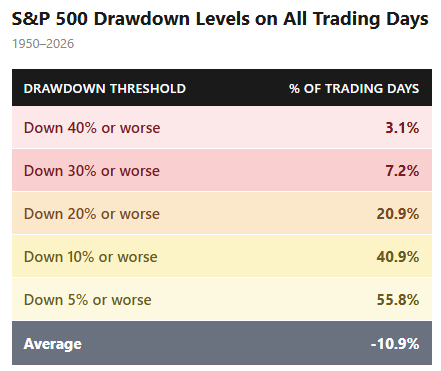
If you take all trading days — from new highs to crashes and everything in-between — on average you would have been in an 11% drawdown over the past 75 years or so. On 56% of all trading days, you would be down 5% or more from all-time highs. More than 40% of the time the stock market has been in a double-digit drawdown since 1950.
Here’s the data:
Assuming the future plays out like the past (not a guarantee obviously) there are a few different takeaways from this data.
One is what I’ve been preaching here for well over a decade — the drawdowns will always sting but as long as you’re patient the new highs will come eventually.
But I also look at this data through a pain-minimization lens. Right now we are trading at or near all-time highs. Most of the time this will not be the case.
Since losses hurt twice as bad as gains make you feel good, this means you should avoid looking at your portfolio value on a regular basis. The more you look the better chance of seeing a drawdown from a previously high level.
That could induce mistakes in your investment process if volatility in markets causes volatility in your emotions.
I wrote about this in Risk & Reward using Richard Thaler’s idea of myopic loss aversion to show why the stock market makes you feel worse the more you look:
- The stock market has nearly as many down days as up days – 56% up days versus 44% down days.
- Loss aversion makes those losing days sting twice as bad as the up days feel good.
- If the gains give you one unit of pleasure while the losses give you two units of pain, when you look at your performance on a daily basis, the bad feelings will completely wipe out the good feelings and then some.
Not looking can be difficult in the information age because it’s so easy to login to your accounts, check in on your stocks and look at fund performance.
Here are Ben’s hard and fast rules for how often you should check your portfolio:
Never check the value of your portfolio during a bear market. It’s only going to make things worse. If you need to make a change, sure, login. But don’t put yourself through unnecessary pain if you don’t have to.
Only check your portfolio values during a bull market. I’m old school. I have a spreadsheet that lists all of our investment accounts — IRAs, 401ks, 529 plan, brokerage accounts, etc. Once every six months I update the values of those accounts to see where we stand.
I skip this exercise during a nasty bear market. I have a decent idea where things stand based on market performance anyway. I only want to see market values when things are going well to avoid bear market emotions.
Be careful with your brokerage account. Most people are pretty good about tax-deferred retirement accounts. They’re long-term in nature so it’s easier to leave them alone.
Brokerage accounts are a different story. It’s more tempting to look at your account on a daily basis.
Maybe you make more stock trades in your brokerage account. Maybe you hold more cash there to time the market. Maybe you’re more active in terms of making trades. Maybe you let the headlines guide your actions more often in your brokerage account.
I know plenty of people who check their brokerage account multiple times a day. It’s tempting because it’s so much easier now than it was in the past when you had to wait for month-end statements to come in.
Checking your investments does not make them go up faster.
Looking at your stock positions more often won’t stop them from going up and down.
Monitoring your performance regularly won’t improve your Sharpe Ratio.
Watching your portfolio more closely only adds to the inevitable emotions money causes.
Stop looking so much.
It will improve your mood.
Michael and I talked about how often we check our portfolios and much more on this week’s Animal Spirits video:
Subscribe to The Compound so you never miss an episode.
Further Reading:
Ignoring the Noise is Impossible
Now here’s what I’ve been reading lately:
Books:
Podcast book tour:
This content, which contains security-related opinions and/or information, is provided for informational purposes only and should not be relied upon in any manner as professional advice, or an endorsement of any practices, products or services. There can be no guarantees or assurances that the views expressed here will be applicable for any particular facts or circumstances, and should not be relied upon in any manner. You should consult your own advisers as to legal, business, tax, and other related matters concerning any investment.
The commentary in this “post” (including any related blog, podcasts, videos, and social media) reflects the personal opinions, viewpoints, and analyses of the Ritholtz Wealth Management employees providing such comments, and should not be regarded the views of Ritholtz Wealth Management LLC. or its respective affiliates or as a description of advisory services provided by Ritholtz Wealth Management or performance returns of any Ritholtz Wealth Management Investments client.
References to any securities or digital assets, or performance data, are for illustrative purposes only and do not constitute an investment recommendation or offer to provide investment advisory services. Charts and graphs provided within are for informational purposes solely and should not be relied upon when making any investment decision. Past performance is not indicative of future results. The content speaks only as of the date indicated. Any projections, estimates, forecasts, targets, prospects, and/or opinions expressed in these materials are subject to change without notice and may differ or be contrary to opinions expressed by others.
The Compound Media, Inc., an affiliate of Ritholtz Wealth Management, receives payment from various entities for advertisements in affiliated podcasts, blogs and emails. Inclusion of such advertisements does not constitute or imply endorsement, sponsorship or recommendation thereof, or any affiliation therewith, by the Content Creator or by Ritholtz Wealth Management or any of its employees. Investments in securities involve the risk of loss. For additional advertisement disclaimers see here: https://www.ritholtzwealth.com/advertising-disclaimers
Please see disclosures here.
