

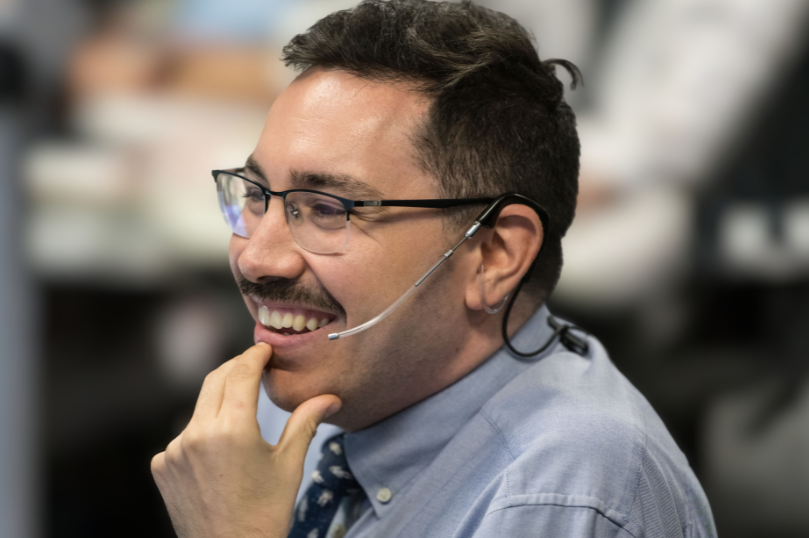
Alumnus Profile: Rob Consolo, Embry-Riddle ’17
At the Florida Mu Chapter of Phi Delta Theta, I joined during the fall of 2014 in the Alpha Mu class (Bond Number #264). Being a smaller-than-average university, and thus a smaller chapter size, the tight-knit nature of the brotherhood could not be beaten. The weight of our values as an organization weighed more heavily on us because we held the bar high for each brother and didn’t let our size or our resources dictate our ability to succeed in meeting that bar. I joined because that really showed through during recruitment season. I saw a group of men who truly cared for each other and everything they did. It certainly didn’t hurt that Brother Neil Armstrong, the first man to walk on the moon, was a proud member himself. In the Fraternity, I constantly sought ways to develop leadership skills and to give back to the organization that gave to me, serving a term as vice president as well as in a variety of other officer roles. Phi Delta Theta taught me perseverance, patience, teamwork, and the value of surrounding yourself with people you want to learn from, develop from, and grow with.
Today, those values and developments play into my day-to-day life. I work at NASA’s Johnson Space Center in Houston, Texas, as an International Space Station and Orion flight controller. This means that I get the opportunity every day to train astronauts and personally oversee and operate the electrical, mechanical, and thermal systems onboard the space station and Orion. Working as a team, I am challenged every single day to plan, train, and eventually fly our next mission or effort. Recently, I served as backroom support for the Artemis II mission, in which one of our jobs was operating the solar arrays. The arrays have cameras at the very tips that allow us to capture images that inspire the world, pyrotechnics for the staging of the vehicle, and mechanical and structural systems like hatches and windows. I now serve as the Artemis III backup mission lead for my group, and we are working to define and plan our next moves with the exciting prospect of landing humans on the moon very, very soon.

The solar eclipse captured from a camera mounted on one of the Orion spacecraft’s solar array wings during the Artemis II crew’s flyby of the Moon’s far side. The science community is investigating whether the glow around the Moon is from zodiacal light — interstellar dust that’s reflecting sunlight — the solar corona, or a combination of the two. Unlike minutes-long eclipses as viewed from Earth, the Artemis II crew saw the Sun hide behind the Moon for nearly an hour. In this image, Venus can be spotted on the left, and Saturn on the right of the Moon. Credit: NASA
How have you stayed connected with Phi Delta Theta after graduation?
After graduation, I joined the chapter advisory board to continue to oversee my home chapter, assist them through struggles as they arise, and ensure that The Bond remains strong at Florida Mu. I’ve enjoyed the experience because coming home to the chapter truly feels second nature, and it gives me the opportunity to work with those following in my own footsteps — doing what ought to be done but would not have been done unless I did it.
Who from your chapter inspired you? Have you ever told them that?
Brother Daniel Port was probably one of my biggest inspirations while active, and even today, that we’re all grown up. He has always pushed me to be my best and to give full effort to any task. He inspired me to ask questions, not be afraid to ask for help, and always encouraged me along the way. I think I’ve told him before, but if not — thank you, Dan, for always seeing the best in me!
What accomplishments or career milestones are you most proud of, and how do you attribute them to your experience?
My career highlight thus far was being the person at the console executing and capturing these images, and hopefully doing my part to inspire the next generation. The two pictures shown feature the Earthset and solar eclipse that occurred as part of our lunar flyby operation, and were the result of years of work perfecting the choreography that captured these images. The Artemis II mission was an unbelievable experience from planning to training, down to the very day the crew arrived safely back on Earth. We sent humans farther than ever before, and we’re just getting started. There were many points along the way where things were difficult, and the lessons imprinted on me during my time in the Fraternity kept me steadfast and focused on the mission. The unwavering support of my brothers and the guidance of those who mentored me also inspired me to see it through to the end.
How has Phi Delta Theta helped you become the greatest version of yourself?
For those who knew me in college, I was hyper-independent — to the point that it was a detriment. Phi Delta Theta taught me that I can rely on others. They showed me that teamwork, compassion, patience, and rectitude can not only advance the goals of an organization but also enhance an individual. That we can learn from each other and use that to avoid repeating each other’s failures. We make each other better by working hard together. These lessons have followed me to this day, allowing me to achieve my dream career and pursue what others said could not be done, and they have truly made me into the greatest version of myself. It also taught me that you are never done becoming even better — we can always learn and always improve.

NASA’s Orion spacecraft captures the Moon and the Earth in one frame during the Artemis II crew’s deep space journey at 6:39 p.m. ET on the sixth day of the mission. The right side of NASA’s Orion spacecraft is seen lit up by the Sun. A waxing crescent Moon is visible behind it. And then, a crescent Earth, tiny compared to the Moon, is about to set below the Moon’s horizon on the right. Credit: NASA
You attended Kleberg and served as a peer mentor. What would you tell current students about these opportunities?
First, I’ll say something about the Kleberg experience: talk about an amazing opportunity for young, growing Phis. These are soon-to-be leaders in their home chapters and in their careers, actively seeking out lessons to drive improvement in themselves and their actions. It was an absolute privilege to serve both as an attendee and as a mentor. My mentee group was an amazingly driven group of men, and one of the things I remember telling them is to never lose that spark. That spark is one of the most valuable things going forward in your career and in your life. It makes you work harder, keeps you goal-focused, and gives you that extra push to keep going when things are tough. But with that, it’s important to never forget the people and experiences along the way. Friendship, Sound Learning, Rectitude — when applied truly to one’s heart, those three phrases can send you anywhere and allow you to accomplish anything. You have the opportunity to be surrounded by those who embrace that message just as much as you do. Capitalize on it. Never give up, and always remember.
